Backpack Price Prediction: Why $BP Fell 36% Post-TGE?


Backpack Price Prediction: Can $BP Recover After Heavy Sell-Off?
Why is Backpack Price Prediction suddenly trending after such a sharp drop in price, especially when it was considered one of the most hyped projects in the Solana ecosystem?
$BP is currently trading near $0.1912, down 36.48%, and this fall is catching attention quickly across the market.
For a project backed by strong narrative, active community, and Solana ecosystem momentum, this kind of drop feels unexpected.
Adding to this, $BP was just listed recently across major platforms, including Backpack Exchange, KuCoin, and MEXC.
On the decentralized side, liquidity is being supported by Jupiter and Meteora, showing that accessibility and market reach are already strong.
What makes this move more interesting is the timing. The overall crypto market is actually moving higher, with a total market cap around $2.41T, up 2.72%.
At the same time, Ethereum is also showing strength with a 4.35% gain, which makes $BP’s opposite move stand out even more.
This is why Backpack price prediction is now becoming a key focus, as traders try to understand whether this is just early volatility or the start of a bigger trend.
Is this sharp drop just early volatility after launch, or is Backpack quietly setting up for its next big move?
What Is Backpack ($BP) and Its Uses?
Backpack is a next-generation all-in-one crypto platform that combines a centralized exchange and a self-custodial wallet.
It is mainly built around the Solana ecosystem, with a strong focus on security and user experience.
The $BP token is not just a regular coin. It gives users deeper access and benefits within the ecosystem:
Equity conversion: Stake $BP for one year to convert tokens into company equity
Trading benefits: Reduced fees, with some tiers offering zero maker fees
Yield boost: Up to 3% extra interest on USD balances through staking
IPO access: Early access to shares if Backpack launches a public listing
Launchpad access: Required to participate in new Solana project offerings
In simple terms, $BP acts more like a participation token than just a tradable asset.
Why Is $BP Seeing Heavy Selling After Launch?
The current drop in $BP is closely linked to what happened right after launch. Backpack distributed around 25% of its total supply through an airdrop, which means a large number of tokens suddenly entered circulation.
When users receive tokens for free, many of them tend to sell early. That creates immediate sell pressure, especially in the first 24–48 hours.
Right now, price action is being driven more by this distribution phase than by actual project fundamentals.
At the same time, market sentiment is also shaping behavior.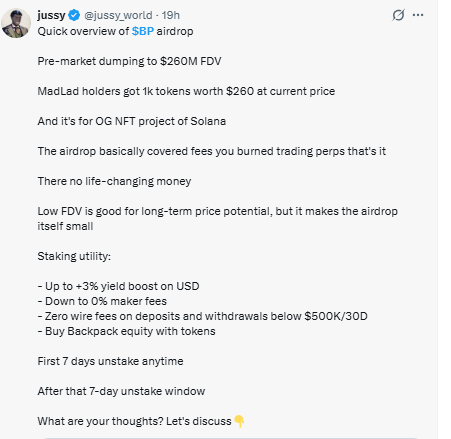
A recent overview shared by crypto commentator jussy (@jussy_world) pointed out that the airdrop value for many users was relatively small, which reduces the incentive to hold and increases the chances of early selling.
This aligns with what we are seeing in the market. Instead of strong accumulation, the focus is on quick exits, adding continuous pressure on price.
The sharpness of the fall also suggests that leverage played a role. As price started dropping, some positions likely got liquidated, which made the decline faster and more aggressive.
Key factors behind the current drop:
Airdrop selling pressure: Free tokens led to early profit booking
Small reward size: Lower holding motivation among users
Liquidation impact: Falling price triggered leveraged exits
High trading volume ($36.5M): As per CoinMarketCap, volume surged 712,266.84%, showing intense activity and ongoing distribution rather than steady accumulation
This is why Backpack price prediction is currently being driven more by supply dynamics than long-term demand.
Right now, the market is still absorbing this supply.
The key thing traders are watching is whether volume starts slowing down
Because that could be the first sign that selling pressure is fading and stability is starting to build
Technical Overview: $BP Key Levels and Price Structure
$BP is currently moving in a clear downtrend, and the structure looks more like a controlled decline rather than a one-time panic drop.
After launch, the price faced strong rejection around the $0.32–$0.33 zone, and since then it has been forming consistent lower highs.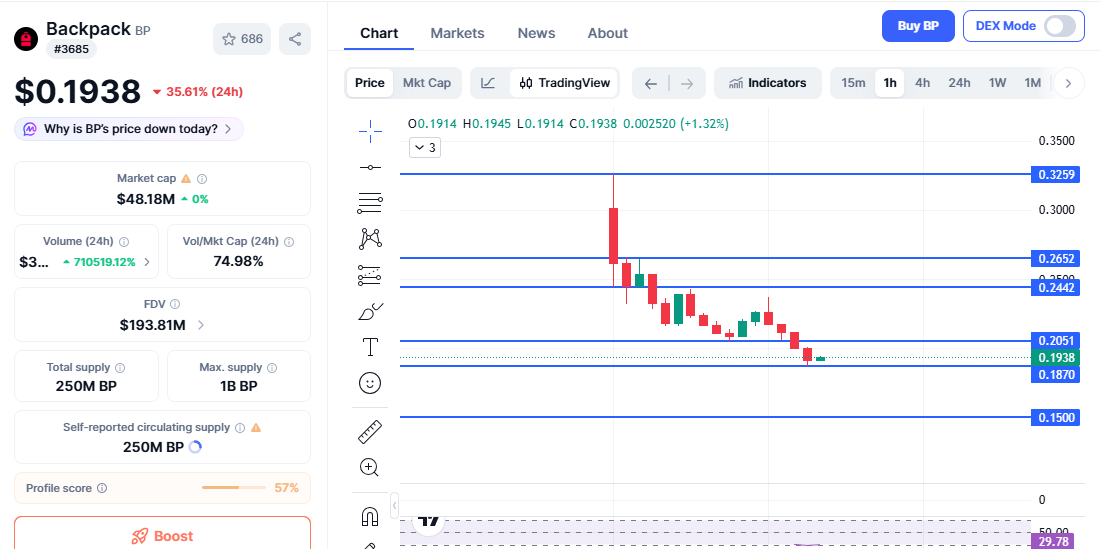
Right now, the price is trading near $0.19, which is acting as an immediate support area. Just below that, $0.187 is a key level to watch.
If this zone breaks, the next downside range could open toward $0.15, where stronger buying interest may appear.
On the upside, the first resistance sits around $0.205, followed by a broader rejection zone between $0.24 and $0.26.
This is where sellers have been stepping in repeatedly, preventing any meaningful recovery so far.
The current structure becomes easier to understand when broken down:
Trend direction: Clear downtrend with lower highs forming
Immediate support: $0.19 with a key level at $0.187
Major downside level: $0.15 if breakdown continues
Resistance zones: $0.205 and $0.24–$0.26 supply areas.
Market control: Sellers still dominant, buyers remain cautious
For any shift in momentum, $BP needs to hold above $0.20 and reclaim the $0.24 level with strength.
Until that happens, the pressure remains tilted toward the downside.
The current Backpack price prediction now depends on whether the $0.18–$0.19 support zone holds or if the market extends into another leg lower.
Expert View: Is This a Buying Opportunity or Trap?
The current Backpack price prediction is still influenced by post-TGE selling pressure rather than long-term weakness. Early distribution and low holding incentive have kept supply dominant in the short term.
If selling volume starts to decline and key support levels hold, this zone can act as an early accumulation range.
However, continued supply pressure may keep the price under stress in the near term.
Disclaimer: Cryptocurrency markets are highly volatile. This price prediction is based on technical structure and current developments, not financial advice. Investors should conduct independent research and assess risk tolerance before making decisions.