Bitcoin Hits $74K, Ethereum Surges 8.8% Today — 5 Key Reasons


Bitcoin And Ethereum Rally Hard: Key Drivers, Targets & What's Next
What does it take to turn weeks of crypto pain into a single session of explosive gains? On April 14, 2026, the market answered that question in full.
Bitcoin climbed over 5.15% to trade around $74,438, while Ethereum outpaced it with a massive 8.80% surge, pushing the price toward the critical $2,400 resistance zone.
The total crypto market capitalisation expanded by 4.53% to $2.52 trillion, and the momentum looks far more than a routine bounce.
After weeks of geopolitical pressure from the U.S.–Iran conflict and a bruising bear phase that dragged Bitcoin below $60,000, buyers are storming back in force.
The six-week resistance ceiling at $73,000 finally cracked on Monday as global stock markets erased their Iran-war losses and diplomatic signals began pointing toward de-escalation.
That break is now fuelling today's surge, with the altcoin market turning a vibrant green alongside the two market leaders.
The Market Setup: Key Levels and Price Structure
Looking at Bitcoin's daily chart, the picture tells a disciplined technical story. Price has been building inside an ascending wedge since the February lows near $58,900, printing higher lows week after week while absorbing heavy overhead supply.
Today's breakout above $74,000 marks a critical shift — Bitcoin is now trading above its 20-day and 50-day exponential moving averages for the first time in months, while the RSI sits at a healthy 53.89, leaving plenty of room to run before any overbought condition emerges.
The setup is essentially binary in the short run: either Bitcoin holds above $74,000 and continues pushing into the $75,000–$76,000 sell wall, or it fails at that resistance and rotates back toward the bid support sitting at $71,500. The ascending structure of the past two months means each pullback has been shallower — a classically bullish sign.
Short Liquidations Fuel the Upward Momentum
One of the most powerful rocket fuels behind today's move is the destruction of bearish positions. The 24-hour liquidation heatmap paints a strikingly one-sided picture: of the total $549 million liquidated across all crypto markets in the past 24 hours, a dominant $446.75 million came from short positions — traders who had bet on prices falling.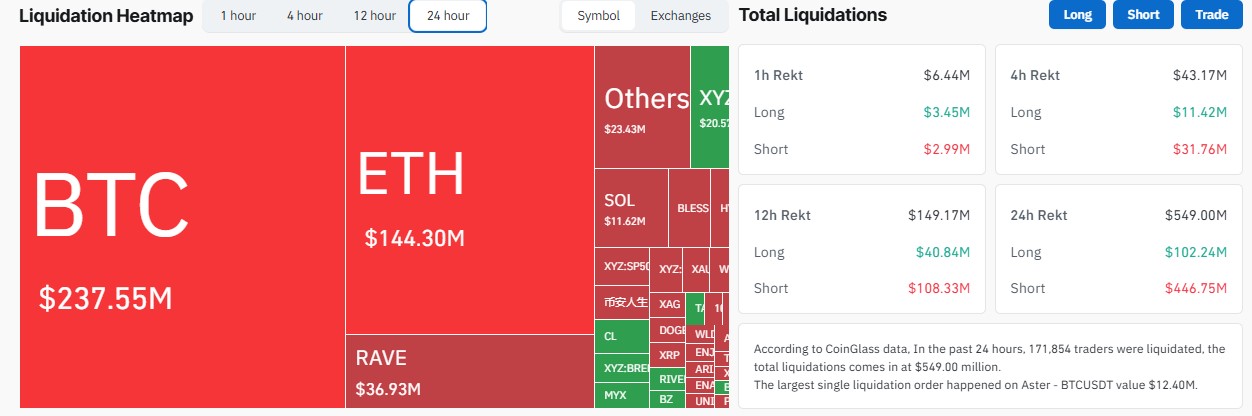
When short positions get forced out of the market at scale, it creates a mechanical upward pressure on price — a short squeeze. Traders who shorted near the lows were expecting further downside; instead, every forced buyback added buying pressure that drove the price higher, triggering even more liquidations in a cascading feedback loop.
The fact that short liquidations outnumber long liquidations by more than four to one confirms that this rally has genuine structural force behind it, not just speculative enthusiasm.
Ethereum Outperforms: ETF Inflows Lead the Way
While Bitcoin grabs the headlines, Ethereum is actually the stronger performer in today's session — and that outperformance is not accidental.
Ether ETFs recorded their most powerful week of net inflows in 2026 during the period ending April 10, pulling in approximately $187 million for the week, the highest weekly figure since these products launched. Cumulative net inflows into spot Ethereum ETFs have now surpassed a record $11.68 billion.
At the same time, Ethereum's on-chain activity is accelerating sharply. Daily network transactions jumped 41% week-over-week, rising from roughly 2.5 million to around 3.6 million transactions per day — the largest percentage surge among major blockchain networks globally.
Looking at the ETH daily chart, the coin is currently sitting above its 20 EMA and 50 EMA with RSI at 55.76, still comfortably below overbought territory at 70.
That combination of growing institutional demand and expanding on-chain activity gives Ethereum's move today a fundamentally different character compared to purely technical bounces.
Interestingly, Bitcoin spot ETFs saw net outflows of over $325 million on April 13, suggesting a meaningful capital rotation from Bitcoin into Ethereum — a pattern that has historically preceded strong altcoin seasons.
Macro Tailwinds: Geopolitics and Central Banks
Beyond the charts, two powerful macro forces are working in crypto's favour today.
First, signals of diplomatic progress on the U.S.–Iran conflict have restored risk appetite across global markets. After peace talks stalled over the weekend and Bitcoin dropped sharply on Monday morning, renewed reports of a possible ceasefire framework sent equities and crypto surging simultaneously — demonstrating once again that crypto now trades alongside, and sometimes ahead of, traditional risk assets during geopolitical pivots.
Second, the Bank of Japan signalled a dovish shift, cooling expectations of near-term interest rate hikes. This matters enormously for crypto because rising Japanese interest rates tend to unwind the yen carry trade — the same dynamic that triggered a brutal 24% Bitcoin crash in two days back in August 2024. With the BOJ stepping back from an aggressive tightening path, that systemic risk is reduced, freeing institutional investors to hold more exposure to high-growth assets like Bitcoin and Ethereum.
Looking ahead, all eyes are on the SEC's CLARITY Act roundtable scheduled for April 16, which could provide further regulatory clarity on crypto asset classifications — a historically bullish catalyst when signals are positive.
Bitcoin Price Targets: What Comes Next for BTC?
Bitcoin's current price action reflects a market in transition. After bottoming near $58,900 in February, BTC has been building a stronger base.
The ascending wedge breakout today is a meaningful signal, but the real test lies immediately ahead at the $75,000–$76,000 sell wall, where heavy whale ask orders are stacked.
A clean daily close above $76,000 opens the door to the mid-$80,000s, where the 200-day EMA currently sits at $83,218.
Near-term, the momentum remains bullish as long as Bitcoin holds the $69,000–$70,000 demand zone.
The RSI at 53.89 has significant room to expand toward 70 before signalling overheated conditions.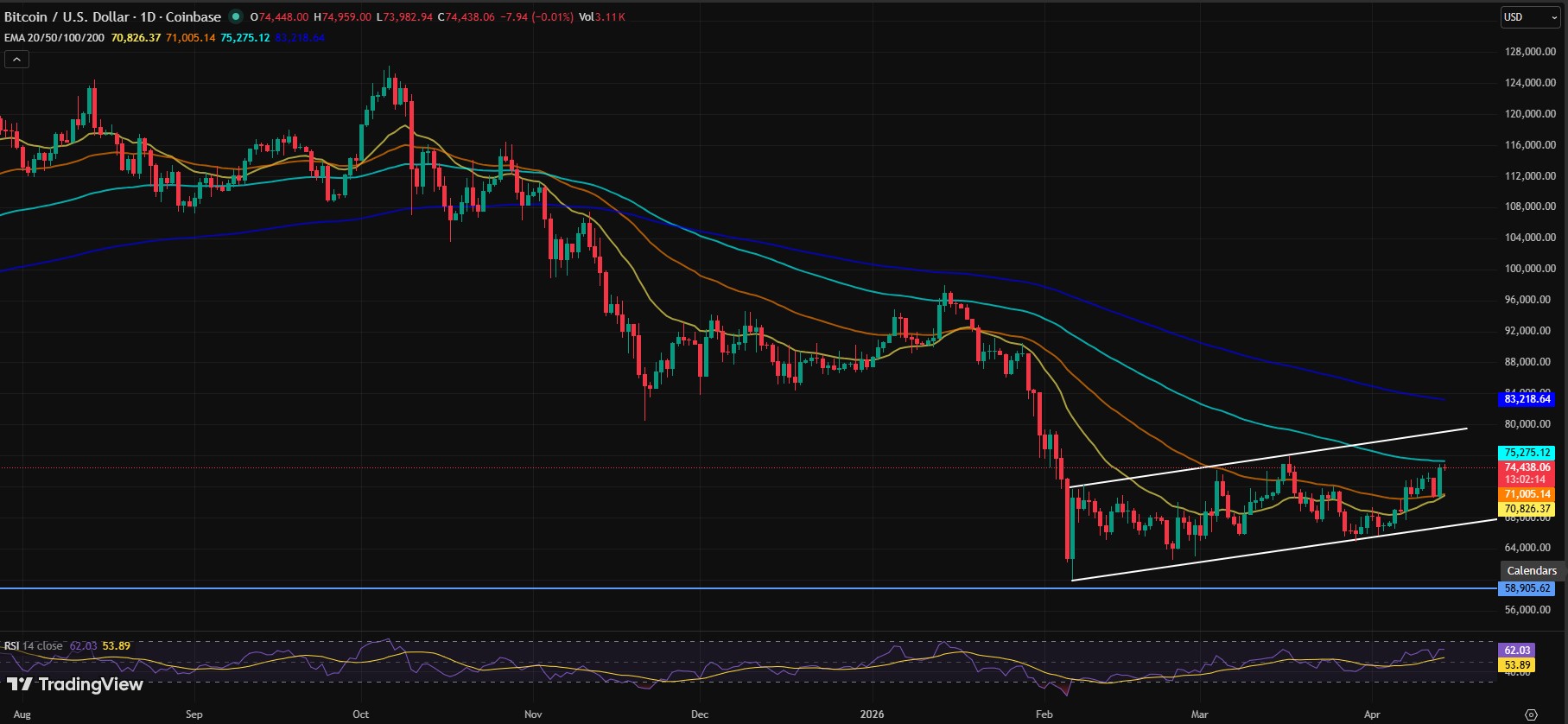
Traders are watching the April 16 SEC CLARITY Act roundtable closely as a potential swing-point for the next directional move.
Ethereum Price Outlook: Can ETH Reach $2,600?
Ethereum's daily chart highlights just how dramatically the narrative has flipped. From November 2025 through January 2026, ETH saw relentless selling pressure, crashing from above $3,400 all the way down to $1,800.
The highlighted consolidation zone on the daily chart shows ETH finding its footing and now staging a meaningful recovery. The current price around $2,377 puts it right at a pivotal area — a daily close above $2,400 would mark the first confirmed breakout above short-term resistance in several months.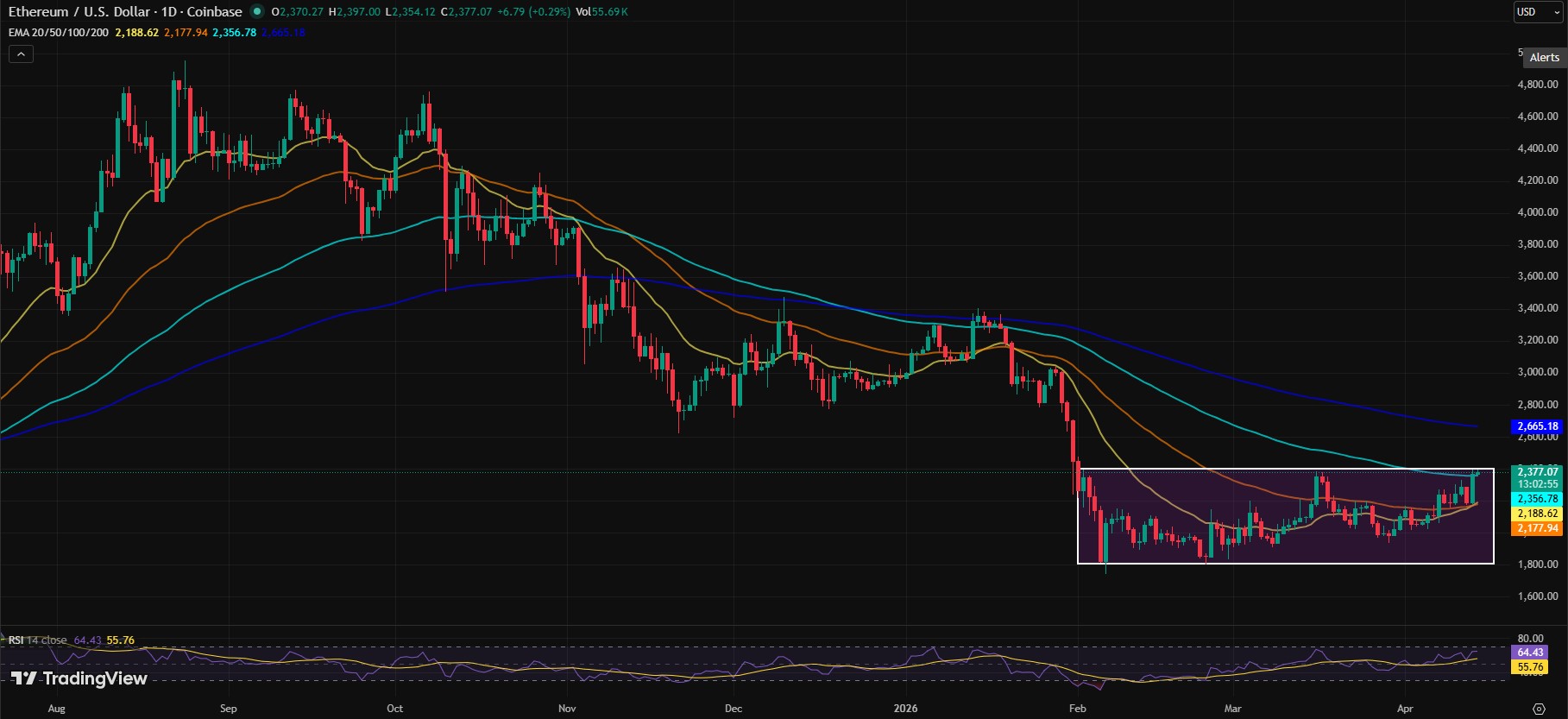
The Glamsterdam upgrade scheduled for the first half of 2026 continues to reduce exchange-held ETH supply as holders move coins into cold storage, a traditionally bullish on-chain signal.
However, a note of caution: while transactions are surging 41%, stablecoin transfer volume on Ethereum has dropped roughly 42.6% over the same period. This means the current burst of activity is not yet backed by the same quality of economic throughput seen during ETH's strongest rallies.
For the rally to become truly durable, stablecoin volumes need to recover alongside transaction counts.
Disclaimer: This article is for informational purposes only and does not constitute financial or investment advice. Cryptocurrency investments carry significant risk. Always conduct your own research before making any investment decisions.