Bittensor TAO Price Prediction 2026 Next AI Crypto


Bittensor TAO Price Prediction 2026 Key Levels
TAO After the Developer Sell-Off Shock
Bittensor TAO Price Prediction is navigating a classic sentiment versus fundamentals divergence this week. After surging 61% over the past month to above $334, TAO collapsed to approximately $262 on April 10, 2026, after a top subnet developer publicly left the project and sold approximately $10 million in tokens—erasing roughly $900 million in market cap within hours. Yet on April 7, Grayscale had boosted its TAO allocation in its AI-focused fund from 31% to 43%, providing a clear institutional bullish signal that directly preceded the developer drama.
Bittensor TAO Price Prediction Current Market Update:
TAO is trading near the $262 to $300 range at the time of writing, with a market cap of approximately $3.4 to $3.5 billion. The 70% staking lock-up rate — meaning 70% of all circulating TAO is locked in staking — provides a strong mechanical floor against aggressive selling. Only 30% of the supply is freely tradable, which means large directional moves require proportionally less capital in either direction.
With 128 active subnets running and generating an estimated $43 million in Q1 2026 revenue, Bittensor network activity has been completely unaffected by the developer departure. The protocol runs autonomously — no single developer controls network operations. The sell-off was a sentiment event, not a fundamental network failure.
Key Catalysts for TAO This Week (April 13 to 20)
Grayscale AI Fund Allocation at 43%: Grayscale increased TAO from 31% to 43% of its AI-focused fund on April 7 — the largest allocation increase for any asset in that fund. This institutional signal directly predates the developer sell-off and remains active.
Grayscale TAO ETF Application Pending SEC Review: 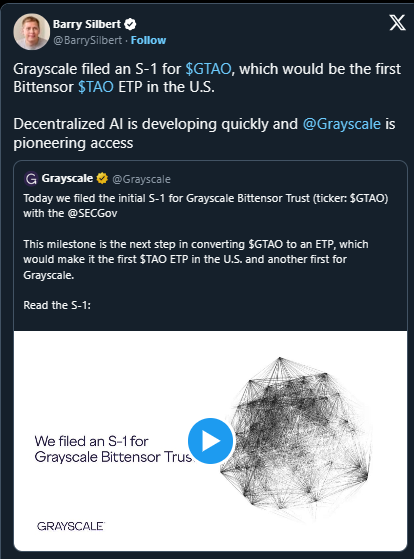 Beyond the fund allocation, Grayscale has a TAO-related ETF application with the SEC. Any positive update this week would be a significant catalyst for recovery.
70% Staking Rate Structural Support: With 70% of supply locked, the effective float is only 30% of total TAO. This mechanical supply constraint means recovery rallies require less capital than the headline market cap suggests.
128 Subnets Generating $43M Q1 Revenue: Real, verifiable revenue from decentralized AI subnet activity provides a fundamental basis for TAO valuation independent of speculative narratives.
Subnet Developer Exit Is Isolated: The departing developer led one subnet out of 128. Network redundancy means this is a manageable operational event, not a systemic threat to Bittensor protocol integrity.
Bittensor TAO Price Prediction Technical Levels: Support and Resistance This Week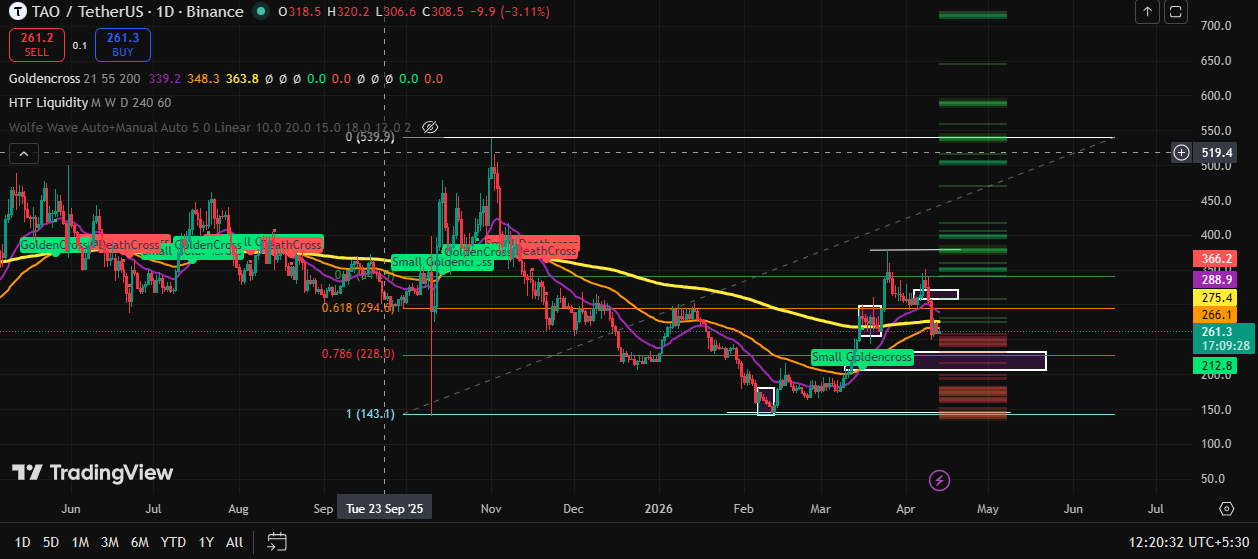
Level Type | Price Zone | Significance | Action Signal |
Key Resistance | $320 to $334 | Pre-sell-off high | Break above = recovery confirmed |
Immediate Resistance | $300 to $310 | Post-sell-off bounce target | Hold above $300 = base case intact |
Immediate Support | $250 to $262 | Current post-sell-off low | Hold above $250 = floor established |
Key Support | $220 to $230 | Monthly consolidation zone | Break below = extended bear case |
Bull Target (Week) | $310 to $340 | Recovery to pre-developer exit | Requires no further negative news |
TAO Weekly Price Prediction: April 13 to 20, 2026
Scenario | This Week's Target | End of April Target | Key Trigger |
Bull Case | $310 to $340 | $370 to $420 | No further developer exits, ETF news |
Base Case | $270 to $310 | $300 to $350 | Gradual sentiment recovery |
Bear Case | $200 to $240 | $180 to $230 | Additional large-holder exits |
Expert View on Bittensor TAO Price Prediction This Week
CoinGabbar analysis suggests the TAO developer exit sell-off represents a sentiment overreaction to a contained operational event. The Bittensor network runs 128 subnets—the loss of one developer team is materially similar to a large company losing one department head. The 70% staking rate, $43M Q1 revenue, and Grayscale institutional positioning at 43% allocation are all fundamental signals that were not changed by the developer exit. The question this week is whether the market re-prices that reality or whether additional holders use the news as an exit. Watch the $250 support zone—a hold above $250 with no further negative developer news this week supports a base case recovery toward $300 to $340. This analysis uses on-chain staking data, subnet revenue metrics, Grayscale fund flow data, and technical support analysis.
Key Risks for Bittensor TAO Price Prediction This Week
Additional developer exits: If one or more other prominent subnet developers follow the initial exit and sell large token positions, the bear case accelerates toward $200. Monitor major subnet developer wallet activity on-chain.
30% unstaked supply overhang: The 30% of TAO not in staking represents approximately $1 billion in potentially mobile supply. Any large holder in this group exiting at current levels would extend downward pressure.
Bitcoin macro weakness: TAO is correlated with Bitcoin. A Bitcoin break below $65,000 this week would create headwinds for any TAO recovery, regardless of Bittensor-specific catalysts.
Bittensor TAO Price Prediction ETF delay: The Grayscale TAO ETF application timeline is uncertain. Bittensor TAO Price Prediction A prolonged delay or negative SEC communication would remove the key institutional catalyst for recovery.
Bittensor TAO Price Disclaimer: Bittensor TAO Price Prediction is for informational purposes only and does not constitute financial advice. Cryptocurrency markets are highly volatile. All price predictions are speculative estimates based on publicly available data and analytical models.