CHIP Price Prediction May 2026: Is the USD.AI Dip a Buy?


Will Anchorage Custody Trigger a CHIP Price Breakout in 2026?
CHIP launched nine days ago. Since then, it has done things most tokens take months to pull off.
And in the last 24 hours alone, three things happened that nobody was expecting.
Anchorage Digital. Nika Finance. Cantor Fitzgerald.
Three names that do not usually show up in the same sentence as a nine-day-old token.
But here we are.
The USD.AI token is not behaving like a typical post-launch cooldown story. Something bigger is being built underneath the price action — and most people tracking the chart are missing it completely.
Before we get into the levels, here is what actually changed overnight.
USD.AI Makes It Into Cantor Fitzgerald's Weekly Brief
Cantor Fitzgerald — one of Wall Street's most respected research desks — featured USD.AI and CHIP in their weekly crypto and blockchain brief for April 19–25. 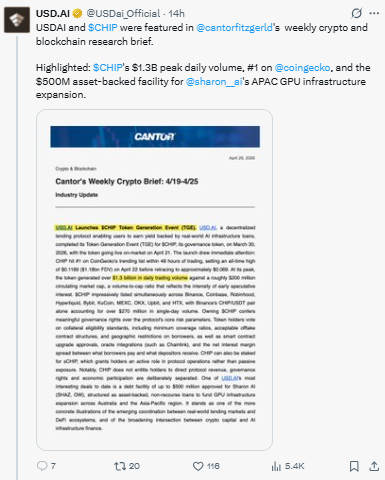
The callouts were specific: $1.3B peak daily trading volume, the number one spot on CoinGecko trending, and the $500M asset-backed facility for Sharon AI's GPU infrastructure expansion across Australia and the Asia-Pacific region.
This is not crypto Twitter hype. This is traditional finance paying attention.
Why Is CHIP Price Falling Today?
The CHIP coin was launched simultaneously on Binance, Bybit, OKX, KuCoin, MEXC, and Upbit. It ran from $0.03 to $0.1189 in under 24 hours — a 296% move.
CoinList buyers who got in at $0.03 are sitting on 140% gains even at today's price.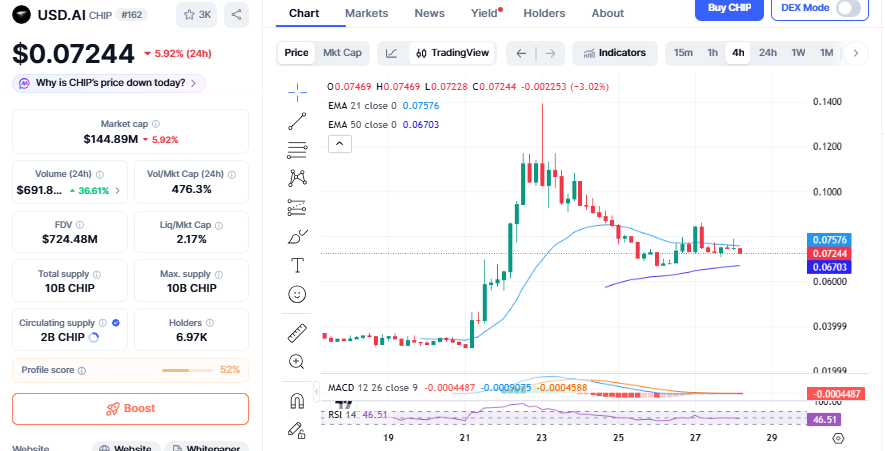
That math creates constant sell pressure between $0.07 and $0.09. Each time USD.AI tries to recover, early holders use the bounce to exit.
The 4-hour CoinMarketCap chart confirms this. Price is below EMA 21 ($0.07576).
MACD is negative across all three values.
The volume-to-market-cap ratio stands at 476.3%—which means speculation is still driving the price, not organic accumulation.
This is not a structural breakdown. It is profit booking from early money finding the exit.
Anchorage Custody: What Changes for the CHIP Price Forecast
Anchorage Digital holds a national trust charter from the OCC — the same regulatory body that oversees major US banks.
This is not a crypto-native custodian. This is federally regulated infrastructure for institutional capital.
For the CHIP USD. AI analysis, this matters in one specific way. Portfolio managers at hedge funds and family offices cannot hold tokens on exchanges.
They need regulated custodians with insurance and compliance frameworks. Anchorage going live for USD.AI removes that barrier.
It does not guarantee institutional buying. But it removes the excuse for not buying.
Combined with $658 million TVL already in the protocol before token launch, the GPU finance crypto narrative here is backed by real collateral—not speculation alone.
Nika Finance 3x Leverage: Bullish Catalyst or Double-Edged Sword?
Nika Finance listing CHIP with up to 3x leverage is a mixed signal.
On one hand, it creates new demand from momentum traders who want amplified exposure to a bounce.
On the other, leverage adds a liquidation layer.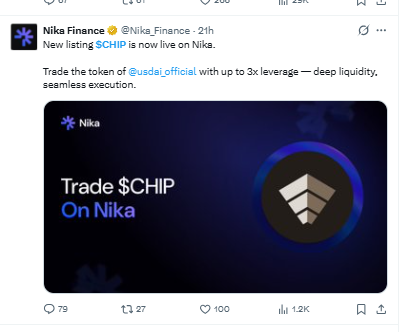
If the price drops through the $0.069-$0.072 demand zone, leveraged longs get flushed—and that adds mechanical selling pressure on an already weak tape.
At current prices, a 3x long entering near $0.07244 with a stop below EMA 50 ($0.06703) has roughly 7% downside risk against a potential 20–30% upside target if USD.AI reclaims EMA 21.
That is not a bad setup. But it is not risk-free either.
CHIP Price Prediction May 2026: Key Levels
Current price: $0.07244
EMA 21: $0.07576 — first resistance, must be reclaimed for any recovery
EMA 50: $0.06703—critical floor; a daily close below this turns the structure bearish
RSI: 46.51 — neutral, not oversold yet
Support zones:
-
$0.072–$0.069: Immediate demand zone. Buyers need to hold here.
-
$0.067 (EMA 50): The key medium-term floor.
-
$0.057: Base support from launch week. Only relevant if EMA 50 breaks.
Resistance above:
-
$0.07576 (EMA 21): First ceiling to reclaim.
-
$0.085–$0.09: Short-term target if EMA 21 breaks with volume.
-
$0.10: Psychological resistance; area where CoinList sellers are rotating out.
-
$0.1189: All-time high.
| Scenario | Price Range (May 2026) | Condition |
|---|---|---|
| Bearish | $0.057 – $0.069 | EMA 50 breaks, no institutional flow |
| Base | $0.072 – $0.095 | Demand zone holds, slow accumulation |
| Bullish | $0.10 – $0.15 | EMA 21 reclaimed; Anchorage drives inflows |
CHIP Coin Price Prediction 2026: Year-End View
Only 20% of the CHIP supply—2 billion of 10 billion tokens—is currently circulating. Investor unlocks begin April 2027. This single fact shapes the entire CHIP price target 2026 outlook.
Every level USD.AI achieves before April 2027 is happening with fractional supply. If the DeFi lending protocol continues growing TVL toward $1 billion and the AI infrastructure token narrative holds, the math for year-end is constructive.
Year-end 2026 analyst range:
-
Base case: $0.12–$0.18 (TVL growth, Anchorage custody driving slow institutional inflow)
-
Bull case: $0.22+ (Coinbase listing or major DeFi integration)
-
Bear case: $0.05–$0.07 (risk-off sentiment + unlock anxiety pricing in early)
Analyst View
The CHIP USD.AI analysis at current levels points to a critical zone. Anchorage custody and Nika Finance listing are infrastructure moves, not price catalysts.
They do not create immediate buying pressure. What they do is widen the pool of potential buyers over the next 4–8 weeks.
For the AI lending token to recover its short-term structure, price needs to close above EMA 21 at $0.07576 on meaningful volume.
Until that happens, the tape remains under pressure from CoinList profit booking.
The $0.067 EMA 50 is the line in the sand for May 2026. Hold it, and the base case stays intact.
Break it, and the CHIP crypto price today setup becomes significantly more cautious.
Disclaimer: This CHIP price prediction May 2026 article is for informational purposes only and does not constitute financial or investment advice. Cryptocurrency markets are highly volatile. All price targets, technical levels, and analyst views are based on publicly available data at time of publication. Always conduct your own research and consult a licensed financial advisor before investing. CoinGabbar does not recommend buying, selling, or holding any cryptocurrency.