Is Morgan Stanley's Solana ETF the Catalyst SOL Has Waited For?

Solana has spent most of May going nowhere fast.
SOL touched $98 briefly on May 11, then slipped right back. The $98 to $100 zone has blocked every recovery attempt this month.
Sellers keep showing up at the same spot, buyers keep losing confidence, and the chart looks like a coin flip that nobody wants to call.
But something just changed. And it came from a place most SOL traders were not watching.
Did the Memecoin Slowdown Break Solana's Price Engine?
The honest answer is yes, at least for now.
Solana's explosive run through 2024 and early 2025 was built on memecoin madness. Tokens were launching by the hundreds every week. DEX volumes were breaking records.
Users were buying SOL constantly just to cover gas fees and get into whatever new project was trending. That activity created a constant stream of real buying pressure on the token.
That stream has dried up. On-chain data shows a sharp cooldown in trading volumes across Solana's decentralized exchanges. Network fee revenue is down.
The retail crowd that drove all of that frenzy has moved on or gone quiet. Without that activity, the organic demand that was holding SOL at higher prices simply is not there anymore.
The Alpenglow upgrade is coming. Developers say it will bring ultra-fast transaction finality and performance good enough for enterprise use. That might be true. But enterprise adoption does not happen overnight.
It takes months, sometimes longer, before that kind of growth shows up in actual token demand. Right now, it is a promise, not a catalyst.
Is Goldman Sachs' Exit Still Weighing on SOL Price?
More than most people realize.
Goldman Sachs revealed in its quarterly 13F filings that it had fully exited its positions in Solana and XRP ETFs during the first quarter of 2026. The disclosure hit at the exact moment SOL was trying to push into a proper recovery.
Traders who were cautiously optimistic saw one of Wall Street's most-watched firms publicly walking away from Solana exposure. That confidence evaporated fast.
On top of that, several publicly traded companies, including Sol Strategies and Forward Industries, are still holding large SOL reserves they bought at much higher prices. Both are sitting on unrealized losses.
If market conditions deteriorate further, those positions could start hitting the market. That risk has kept a ceiling on sentiment even on days when the broader crypto market looks fine.
Why Are Institutions Still Buying Solana While Retail Steps Back?
Because they have a longer time horizon, and the data gives them reason to stay.
As per SosoValue, Spot Solana ETFs recorded $26.6 million in net inflows on May 11. Then $19.1 million on May 12. Another $21.3 million on May 6. These are not small numbers for a token trading under $95.
Total cumulative net inflows across these products have now crossed $1.12 billion, with total assets holding close to that same level for most of this month.
That is steady, consistent buying from people who do not panic at resistance zones. It shows that while retail traders are nervous, bigger players are treating every dip as a chance to add exposure before the next leg higher.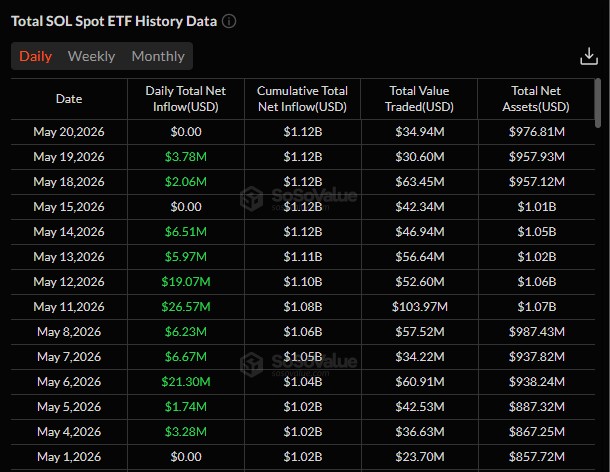
Could the Morgan Stanley MSOL Filing Change Everything for SOL?
This is the question the whole market is sitting with right now.
Morgan Stanley submitted an amended S-1 filing to the SEC for a proposed spot Solana ETF that would trade under the ticker MSOL. Coinbase Custody and BNY Mellon are named as the key service providers.
The level of detail in the filing signals this is not a speculative placeholder. These are real operational specifics.
Morgan Stanley manages client assets in the trillions. The investor base it serves includes retirement accounts, family offices, pension allocations, and corporate treasuries.
These are pools of capital that currently have no clean, regulated way to get SOL exposure. An approved MSOL ETF opens that door completely.
What makes the filing even more unusual is the stakeholder structure. The fund could stake up to 100 percent of its Solana holdings through third-party providers. No major crypto ETF has done this before. Bitcoin and Ethereum ETFs just hold the asset.
This one would actively lock SOL into staking, generate yield for investors, and reduce the amount of circulating supply sitting on the open market at the same time.
Less liquid supply and growing institutional demand for the same product. That combination has historically been a setup for price appreciation over time.
Approval is not guaranteed, but the filing has already shifted how the market is thinking about Solana's medium-term trajectory.
Will SOL Price Break Above $97 or Drop Back to $75?
The chart right now is telling two stories at the same time.
Solana is rangebound between roughly $80 and $97 on the daily timeframe. The 200 EMA sits up near $109, still above the current price, which means the long-term trend has not flipped bullish yet.
However, the shorter-term moving averages have started flattening out, a sign that the aggressive selling from earlier in the year is losing momentum.
A rising support trendline is also forming from the recent lows. Each time SOL pulls back, buyers are stepping in at a slightly higher level than before. That pattern suggests accumulation, not distribution.
The $97 level is where this story gets decided. SOL has been rejected there multiple times. A daily candle closing above $97 with real volume behind it would be a meaningful technical shift.
From there, $105 comes into view first, then the $109 to $110 area, where the 200 EMA is acting as the next major resistance.
On the downside, a break below the rising support around $80 to $82 would open the path toward $70 to $75. That would be a rough drop and would likely force out many current holders before any genuine recovery begins.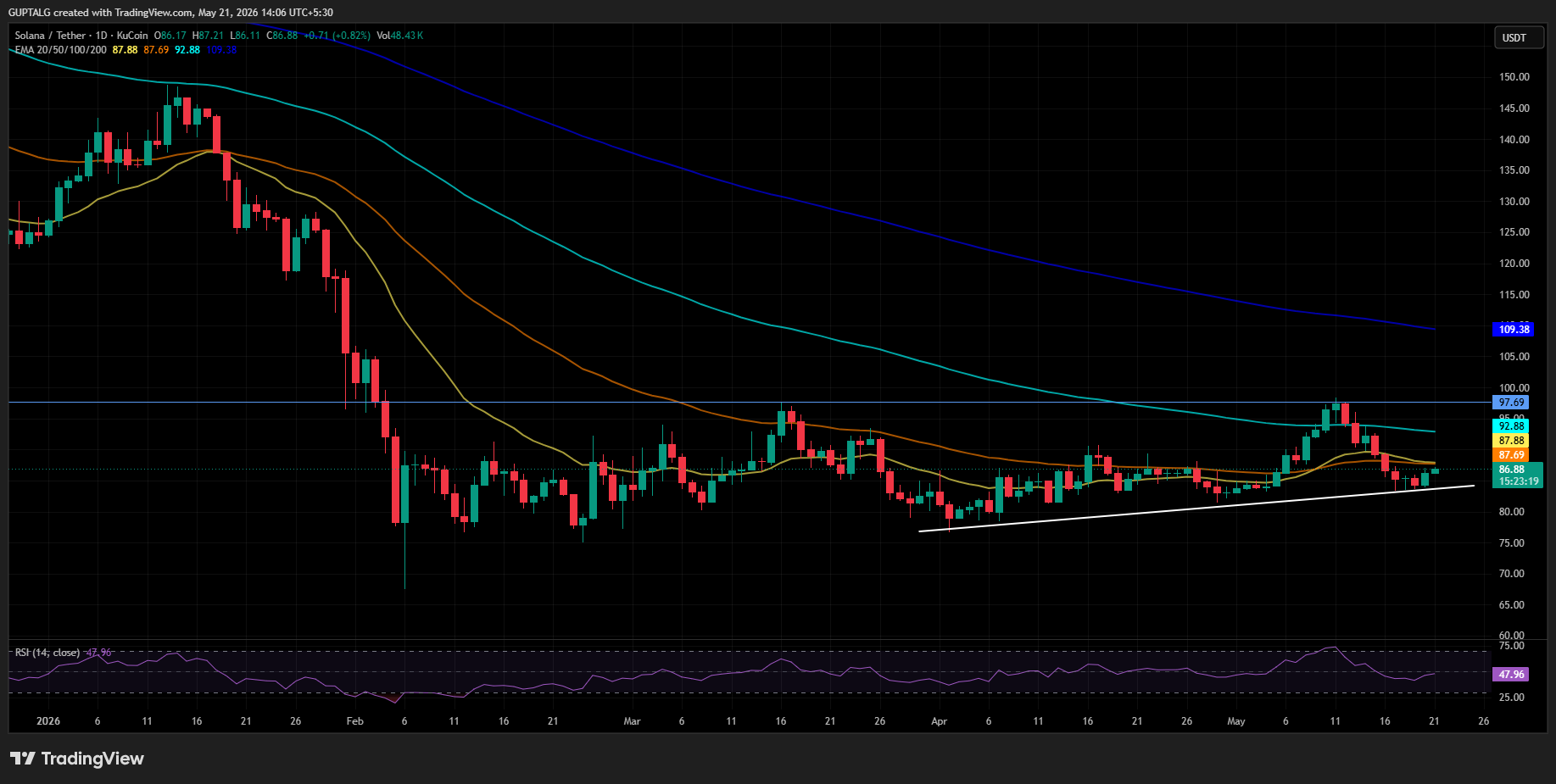
The most likely near-term scenario is continued sideways movement until either a macro catalyst or an ETF-related development forces a clear direction.
Disclaimer: This article is for informational and educational purposes only. It does not constitute financial advice. Crypto markets are volatile and carry significant risk. Always do your own research before making any investment decision.








.webp)