EdgeX Price Prediction: Will EDGE Token Surge After Listing?

EdgeX Price Prediction: Why $EDGE Pre-Market Hit $0.50 Today?
EdgeX price prediction is gaining momentum even before the official token launch, as pre-market activity and exchange announcements begin shaping expectations.
With the token generation event scheduled for March 31, early price movement already reflects trader positioning rather than confirmed valuation.
At this stage, EdgeX price prediction is being driven more by speculation and pre-launch interest than actual market stability.
EdgeX Listing Date: Exchange Confirmation and Launch Timeline
One of the strongest confirmations came from Bitget (@bitget), which announced the EDGE/USDT listing with trading starting on March 31.
Deposits are already open, which indicates that the listing process has moved beyond speculation.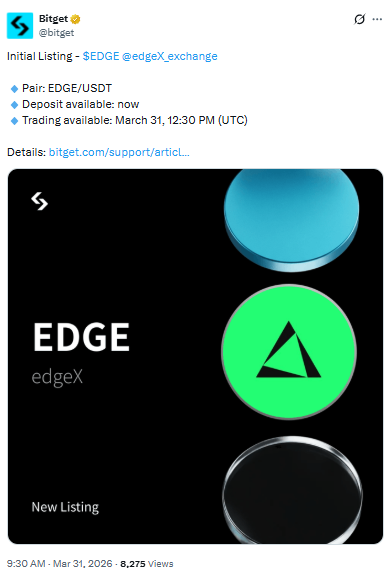
At the same time, EdgeX (@edgeX_exchange) confirmed that the token launch (TGE) is happening within 24 hours, aligning directly with the exchange listing timeline. 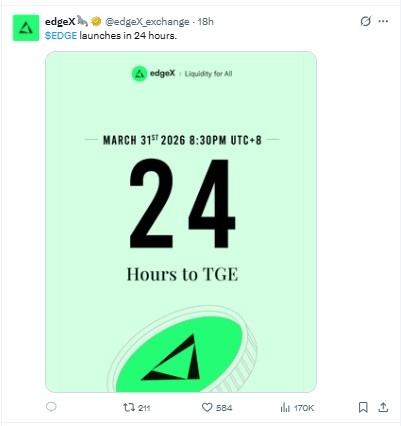
Key listing insights:
EDGE token listing scheduled for March 31
Trading pair confirmed: EDGE/USDT
Deposits already enabled
TGE countdown officially announced
This kind of synchronized listing and TGE setup usually increases early volatility, because both retail and pre-market traders enter at the same time.
For EdgeX price prediction, this confirms that the market is transitioning from the anticipation to execution phase.
EdgeX Price Prediction: Pre-Market Activity and Price Signals
Before the official listing, the token is already showing early price activity through pre-market tracking platforms.
While Aster (@Aster_DEX) confirmed that EDGE will be available for trading soon, the current price structure visible is coming from pre-market data reflected on CoinMarketCap, not from live perpetual trading.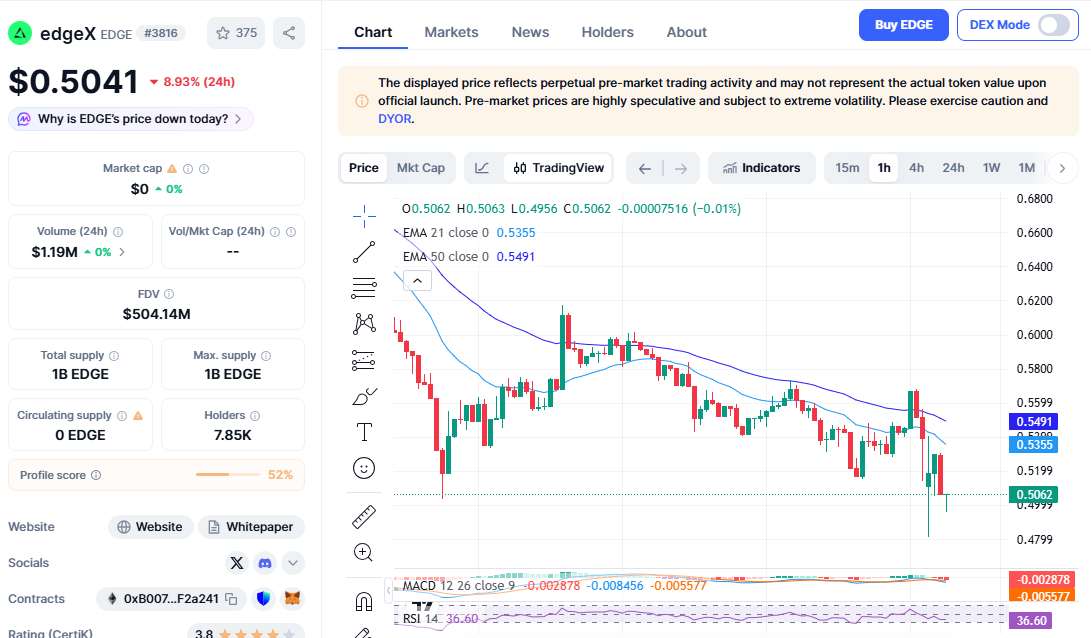
This distinction matters because pre-market charts often reflect speculative positioning rather than real order book depth.
Looking at the current price behavior:
Price is hovering near $0.50
Volatility remains high with sharp candles on both sides
EMA levels are positioned around $0.53–$0.55, acting as short-term resistance
Long downside wicks indicate liquidity grabs rather than stable accumulation
The platform itself clearly highlights that this price is based on pre-market activity and may not represent the actual value at launch.
For EdgeX price prediction, this becomes important because traders often anchor to these levels before listing.
Even if the price adjusts later, these zones tend to act as reference points during early trading sessions.
So while this is not fully reliable pricing yet, it still plays a role in shaping initial sentiment once the token goes live.
EdgeX Price Prediction: What Is Driving the Hype?
The movement is not just about listing. There are underlying factors pushing attention toward EdgeX.
EdgeX is positioned as a decentralized derivatives exchange (DEX) that combines centralized speed with DeFi-level security.
This hybrid approach is attracting interest, especially among traders who want performance without giving up custody.
Key drivers behind the hype:
High-speed infrastructure: Up to 200,000 orders per second with near-instant execution
Self-custody model: Users retain control over their funds
Perpetual trading support: Includes crypto, stocks, and prediction markets
Hybrid architecture: Off-chain speed with on-chain settlement
On top of that, the $EDGE token has multiple utilities, which adds another layer to EdgeX.
Trading fee discounts
Staking rewards from protocol revenue
Governance participation
Future gas fee utility
Liquidity incentives
This combination of product + token utility is what usually sustains interest beyond initial listing hype.
EdgeX Price Prediction: Expected Listing Price Range
Now comes the key part — what price could EDGE see after listing?
Based on pre-market trading, exchange listing confirmation, and current hype, a few realistic scenarios emerge.
Possible listing price ranges:
Conservative scenario: $0.30 – $0.45
If pre-market prices correct after listing pressure.Moderate scenario: $0.45 – $0.65
If current pricing sustains with steady demand.High hype scenario: $0.70 – $1.00
If strong demand meets limited early supply.
The current pre-market level around $0.50 already places the token within the mid-range expectation.
However, price at launch often depends on one key factor—whether early buyers hold or exit. Pre-market traders tend to take profits quickly, which can create sharp dips before stabilization.
EdgeX Price Prediction: Short-Term, Mid-Term, and Long-Term Outlook
EdgeX price prediction does not stop at listing, because the real structure forms after the initial volatility settles.
Short-term (0–3 months): Price could fluctuate between $0.40 and $0.80 as listing hype, profit-taking, and liquidity expansion balance out
Mid-term (3–6 months): If adoption grows, EdgeX price prediction may stabilize in the $0.70–$1.20 range
Long-term (6–12 months): With strong usage and ecosystem growth, price could move beyond $1.50 if participation remains consistent
At this stage, EdgeX price prediction is closely tied to how quickly the platform converts hype into actual trading volume.
Conclusion
EdgeX price prediction is entering a phase where speculation is about to meet real market conditions.
The listing is confirmed, the TGE timeline is clear, and pre-market activity has already set initial expectations.
What comes next depends less on announcements and more on behavior. Traders will be watching how the price reacts immediately after listing, especially whether the pre-market levels hold or get corrected.
The most important signals to track now are exchange volume, liquidity depth, and how quickly users adopt the platform after launch. If participation builds steadily, the current momentum could extend, but if early sellers dominate, the market may take time to stabilize before the next move.
Disclaimer: This content is for informational purposes only and does not constitute financial advice. Cryptocurrency investments are highly volatile and involve risk. Always do your own research before making investment decisions.
Also read:







.webp)