Ethereum at $2,375: Will ETH Break Out or Get Rejected Again?


Can Ethereum Break $2,375 Resistance or Will ETH Drop to $2,210?
Ethereum is at a point right now where the next few daily candles could decide everything. ETH has climbed to $2,375 — the top of its trading channel — and every serious trader has this level circled on their chart.
Why $2,375 Is the Only Level That Matters Right Now
This isn't some number a YouTuber picked randomly. The $2,375 zone has rejected ETH multiple times in the past. Sellers have shown up here consistently, and buyers who got excited at this level have been left holding bags more than once. That history is exactly why this zone carries so much weight today.
ETH is pressing against that same ceiling again. It hasn't broken yet. The whole market is essentially waiting to see whether this time is different — or whether the same old story plays out again.
Bitmine Is Buying ETH Every Single Week — Here's What That Means
Tom Lee's Bitmine added 101,745 ETH just last week. Their total stack now sits at 5,180,131 ETH, worth around $12.11 billion. They've also staked 4,362,757 ETH — that's 84% of everything they own locked up and earning yield.
Now look at the Lookonchain data from the image. Bitmine hasn't missed a single week of buying since December 2025. Some weeks it was 24,000 ETH. Some weeks it was over 100,000. But they never stopped. That's not a trade — that's a long-term conviction bet.
When a company stakes 84% of its holdings, it is not preparing to dump. That supply is gone from the market for the foreseeable future. Less ETH available to buy means even moderate demand can move prices harder than usual.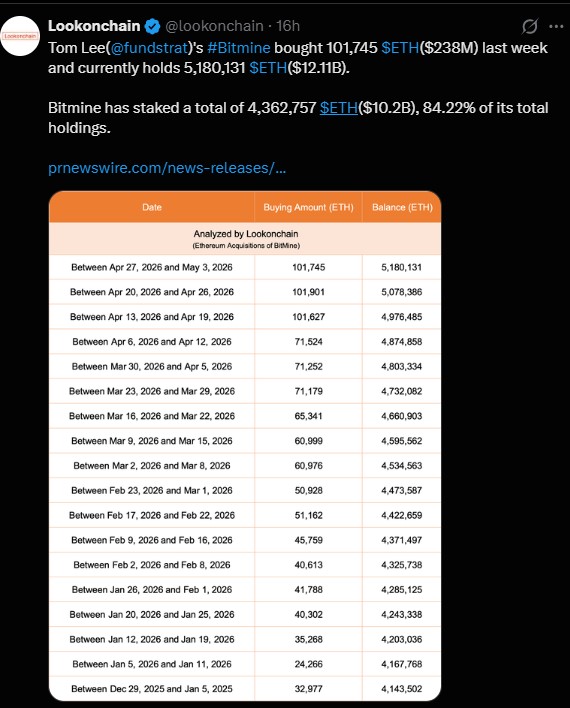
ETH Price Drops to $2,210: What Happens If the Rejection Comes
As per crypto analyst Ali, If ETH gets turned away at $2,375 like it has before, the obvious target is the lower end of the channel near $2,210. That's roughly a 7% pullback from current levels. It would sting short-term holders but wouldn't actually break the broader structure.
The channel would remain intact and another attempt at $2,375 would just be a matter of time.
ETH Rallies to $2,550: What a Real Breakout Looks Like
If ETH closes a full daily candle above $2,375 with real volume behind it — not just a wick, an actual close — the next structural target comes into view at $2,550-$2600.
That's another 7% from the breakout point. More importantly, it would mean the channel ceiling that has rejected ETH repeatedly has finally flipped into support, which changes the technical picture significantly going forward.
How to Know If ETH Is Actually Breaking Out
One spike above $2,375 means nothing. Markets fake these moves all the time to shake out shorts before reversing. What actually matters is the daily candle close.
If ETH closes above $2,375 on the daily chart — ideally with volume picking up — that's when the breakout becomes real. Until that happens, the resistance is still the resistance.
The interesting thing this time around is that institutional buying pressure from Bitmine and others is running at a pace the market hasn't seen at this level before.
Previous rejections happened without this kind of structural demand underneath. That doesn't mean a breakout is guaranteed, but it does mean the setup has more support than it's had in prior attempts.
Ethereum Price Prediction: What’s Next For ETH?
Bears need ETH to fail here and slide back to $2,210. Bulls need one clean daily close above $2,375 to start talking about $2,550.
The weekly buying from Bitmine is quietly tightening supply in the background while price fights it out at resistance.
The chart gives you the signal. Wait for the daily close — everything else is just noise.
This article is for informational purposes only and does not constitute financial advice. Always do your own research before making any investment decisions.