Reservoir (DAM) Price Prediction 2026: Binance Recovery Realistic


Reservoir (DAM) Price Prediction 2026 From ATH Down 77%
Reservoir (DAM) had one of the sharpest debut stories in DeFi last year. It launched on Binance Alpha in August 2025, hit an all-time high of $0.1652 by September, then spent the next five months giving most of that back. Today it is sitting around $0.037 — downroughly 77% from the peak, with a market cap just under $7.5 million.
That kind of drawdown invites two very different readings. One view is that the initial Binance Alpha pump was a speculative overshoot, and the protocol is now finding its real valuation floor.The other is that the underlying product — a cross-chain stablecoin engine issuing rUSD and its yield-bearing variant srUSD — has enough substance to rebuild from here, especially with Season 3 incentives running and a second Morpho vault campaign launched in March 2026.
This article lays out the current state of the protocol, the relevant on-chain and market data, and a set of scenarios for where DAM could trade through 2026 and into the next few years.As always, nothing here is financial advice.
Market — April 27, 2026
| Metric | Value | Notes |
| Current Price | ~$0.037 | CoinGecko live data |
| 24h Change | -8.40% | Recent selling pressure |
| 7-Day Change | -27.90% | Broader correction |
| Market Cap | $7.47M | CMC #1076 |
| FDV | $37.38M | Based on 1B total supply |
| Circulating Supply | 200M DAM | 20% of total supply |
| Total Supply | 1,000,000,000 DAM | Max supply |
| All-Time High | $0.1652 | September 19, 2025 |
| All-Time Low | $0.01346 | February 10, 2026 |
| Primary Exchange | Binance Alpha + Futures | Listed August 18, 2025 |
| Contract Address | 0x0Fed...e5A43B | Ethereum mainnet (ERC-20) |
| CertiK Rating | 4.0 / 5.0 | Security audit |
| Holders | 3,420+ | As of April 2026 |
What Is a Reservoir and What Does a Dam Actually Do?
Reservoir is a permissionless DeFi protocol built on Ethereum that lets users mint and redeem rUSD — a stablecoin backed by a diversified mix of digital assets and real-world assets. The protocol uses LayerZero and Stargate infrastructure to enable cross-chain minting, meaning users on multiple chains can access the same liquidity pool without manually bridging assets.
The yield-bearing version, srUSD, is where the protocol's core value proposition lives. By depositing rUSD into the staking module, users earn a yield sourced from the underlying asset portfolio. The protocol has handled significant stress — according to verified on-chain data, it processed around 150 million in redemptions within 48 hours during a volatility event in late 2025 with zero liquidations and zero bad debt. That is a meaningful track record for a relatively young DeFi protocol.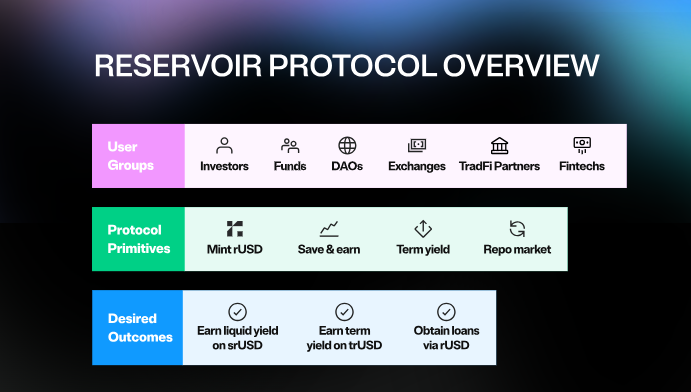
DAM is the governance token. Holders vote on risk parameters, supported collateral types, and other protocol decisions. Staking DAM also unlocks boosted rewards and additional points during the protocol's seasonal campaigns — a flywheel designed to tie governance participation to economic incentives.
Season 2 ended in December 2025.The protocol distributed a minimum 5% of total DAM supply to Season 2participants. Season 3 is currently running, with ongoing points accrual and aminimum 5% distribution promised over the six-month campaign. A second LiquidDAM campaign launched March 25, 2026, offering DAM rewards through the Reservoir rUSD Ecosystem Vault on Morpho — curated by Steakhouse Finance.
Price History: The ATH-to-Floor Cycle
DAM launched on Binance Alpha on August 18, 2025 — the first exchange to list it. The debut saw a 55% gain onday one, consistent with the initial pump patterns seen across other BinanceAlpha listings at the time. Momentum continued into September, where DAM hit $0.1652 — its current all-time high.
From there, the slide was gradual through Q4 2025, then accelerated in early 2026. The all-time low of $0.01346was set on February 10, 2026 — roughly a 91% peak-to-trough drawdown. Thesubsequent recovery to the current $0.037 range represents a 177% bounce from that floor, though it still leaves DAM well below its ATH.
The drawdown trajectory is fairly typical for a token that launched with speculative Binance Alpha momentum. The more relevant question now is whether the protocol's fundamentals —particularly the active Morpho vault campaigns and Season 3 incentives — can sustain a demand base that stabilizes the price at a higher level
Price Scenarios 2026–2030
The table below presents five scenarios based on protocol development milestones, broader DeFi market conditions, and historical patterns for Binance Alpha-listed tokens. These are analyst estimates — not guarantees.
| Scenario | 2026 Low | 2026 High | 2027–2028 Target | Key Catalyst |
| Bear | $0.015 | $0.035 | $0.02–$0.04 | Season 3 selloff, low TVL growth |
| Base | $0.035 | $0.09 | $0.08–$0.18 | Morpho vault growth, Season 3 rewards |
| Bull | $0.08 | $0.16 | $0.20–$0.45 | Binance Spot listing + TVL expansion |
| ATH Retest | $0.10 | $0.17 | $0.35–$0.65 | Cross-chain launch + DAO transition |
| 2028 Long | $0.20 | $0.50+ | $0.60–$1.00+ | Full DAO, multi-chain dominance |
Bull Case: What Has to Go Right
The strongest version of the bull thesis rests on three things coming together: a Binance Spot listing, meaningful TVL growth in the Morpho vaults, and the cross-chain minting infrastructure shipping on schedule.
Binance Alpha to Spot is a well-documented path. Tokens like APRO and Momentum (MMT) both graduated from Alpha to the main spot exchange within roughly two months of their Alpha listing. MMT saw a 4,000% spike at its HODLer listing — an outlier, but it illustrates the access that Spot listing provides versus Alpha-only. If DAM follows a similar trajectory, a Spot listing in H2 2026 would be the most significant near-term catalyst.
The Morpho vault expansion is a lower-burn driver. The second Liquid DAM campaign went live on March 25, 2026. If DAM rewards and rUSD yields attract enough liquidity providers, TVL grows, protocol revenue increases, and the governance token captures more of that value. A sustained increase in DAM demand through governance and staking is the organic version of this story.
A retrace to the $0.14–$0.17 ATHrange in this scenario would require a combination of Binance Spot listing and strong TVL data over 2–3 quarters. Not impossible, but it needs multiple catalysts to converge.
Bear Case: The Risks Worth Taking Seriously
The most obvious structural risk is supply overhang. Season 3 distributes a minimum 5% of the total DAM supply — 50million tokens — to participants over six months. If the majority of airdrop recipients sell immediately (as happened with many Season 2 recipients), that is consistent downward pressure on a $7.5 million market cap. Even modest sales volumes can move the price significantly at this liquidity level.
Binance Futures exposure is a double-edged sword. The protocol is already listed on Binance Futures, which means high-leverage short trades can cascade into spot price. There are documented instances of DAM appearing on Binance Futures loss lists during volatile sessions, with 37% volume drops amplifying downside moves. A thin order book makes the asset prone to sharp dislocations.
Competition is another thread. The yield-bearing stablecoin sector is crowded. Ethena, Frax, and newer entrants are all competing for the same TVL. If rUSD's yield advantage compresses relative to alternatives, the protocol loses its core acquisition argument for new users.
Finally, the Reservoir DAO launch is not until 2027. Until then, governance is centralized to some degree, which is a legitimate concern for DeFi users who weigh decentralization heavily in their protocol selection.
Month-by-Month Outlook: May–August 2026
May 2026
Season 3 points continue accruing. The Morpho vault TVL data from the March campaign should be visible on-chain.If rUSD TVL is growing, that is a constructive signal. Watch whether DAM holds above the $0.030 level — that is the critical support line between the current range and a retest of the February lows.
June–July 2026
The cross-chain minting infrastructure is one of the development milestones flagged for 2026. Any shipping announcement during this window would be a meaningful catalyst. At the same time, broader crypto market conditions in mid-summer typically set the tone for Q3 — if Bitcoin is above $90K–$100K, altcoin sentiment should support a recovery attempt.
August2026
One year post-Binance Alphalisting. If no Spot listing has materialized by this point, expect some disappointment selling from holders who entered around the August 2025 launch. Conversely, if a Spot listing is announced in this window, the anniversary narrative plus the actual listing could drive a sharp move up.
Key Technical Levels to Watch
| Level | Price | Significance |
| Strong Support | $0.013–$0.020 | ATL zone — bounce base in Feb 2026 |
| Current Support | $0.032–$0.037 | Present trading range |
| First Resistance | $0.055–$0.065 | Feb–March 2026 consolidation zone |
| Mid Resistance | $0.085–$0.10 | Pre-ATL support turned resistance |
| ATH Resistance | $0.1652 | September 2025 high — key recovery target |
Tokenomics and Supply Structure
| Category | Details | Implication |
| Total Supply | 1,000,000,000 DAM | Fixed max supply |
| Circulating Supply | ~200M DAM (20%) | 80% still to enter the market |
| Season 2 Distribution | Min. 5% of supply | 50M DAM — mostly distributed |
| Season 3 Distribution | Min. 5% of supply over 6 months | Ongoing sell pressure risk |
| Governance Utility | Voting on risk params and collateral | Drives holding incentive |
| Staking Utility | Boosted rewards and points | Locks supply during campaigns |
| Exchange Coverage | Binance Alpha, Futures, MEXC, PancakeSwap V3 | Growing but not Spot yet |
Risk Assessment
| Risk Factor | Severity | Likelihood | Mitigation |
| Season 3 airdrop selling | High | Likely | DAM staking incentives reduce immediate selling |
| No Binance Spot listing | High | Unconfirmed | Alpha to Spot path exists, but is not guaranteed |
| Thin liquidity on Futures | Medium | Ongoing | Watch open interest and funding rates |
| Stablecoin competition | Medium | Real | rUSD cross-chain moat is differentiated |
| Centralized governance until 2027 | Low-Med | Confirmed | DAO launch on roadmap for 2027 |
| 80% supply still unlocked | High | Long-term | Vesting schedule controls pace |
Disclaimer: This article is for informational purposes only and does not constitute financial or investment advice. DAM is a highly speculative asset with significant volatility. The protocol has not yet launched a full DAO, and 80% of total supply has not yet entered circulation. Price predictions represent analyst estimates based on available data and historical patterns — they carry no guarantee. Do Your Own Research before making any investment decision. CoinGabbar.com is not responsible for trading losses.
Also read: