ShareX Price Prediction: $SHARE Crashed 23%—Panic or Opportunity?


ShareX Price Prediction: Why $SHARE Dropped 23% Today
The ShareX price prediction looked very different 24 hours ago.
When $SHARE went live on LBank, KuCoin, MEXC, and Binance Alpha on May 8, 2026, the mood was optimistic.
Four simultaneous exchange listings , multiple airdrop campaigns, OKX Ventures backing — it checked every box a new token launch could check.
Then the market did what it almost always does after a coordinated multi-airdrop debut. It sold.
$SHARE is currently trading around $0.57, down over 23% in 24 hours.
Volume exploded by more than 2.2 million percent—which sounds incredible until you realize that most of that volume was airdrop recipients hitting the sell button the moment their tokens unlocked.
This is not a surprise. It was the most predictable outcome given the launch structure.
The real question is what the ShareX price prediction looks like from $0.57 onward — and whether this crash is an entry or a warning.
Why Did SHARE Token Price Fall 23% on Listing Day?
Three things hit at once, and they all pointed the same direction.
KuCoin distributed 200,000 SHARE tokens to HODLer airdrop participants. MEXC ran an Airdrop+ campaign with 60,000 SHARE and 30,000 USDT in prizes.
Binance Alpha airdrop claimants got their allocation through airdrop.sharex.network. These three groups got free tokens—and free tokens almost always get sold fast.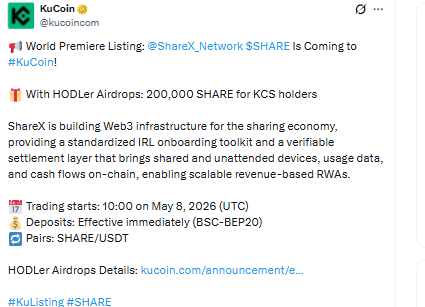
Not because holders are malicious, just because zero-cost tokens have zero emotional attachment.
When you did not pay for something, taking any profit feels rational.
Layer on top of that the FOMO buyers who jumped in during the initial listing pump, and you get a classic two-wave dump: first the airdrop sellers, then the disappointed latecomers cutting losses.
The 2.29 million percent volume spike confirms this. That kind of number means millions of dollars moved in hours — not organic buying, but airdrop-to-sell flows running simultaneously across four exchanges.
What made it sharper was the low float. Only 18 million SHARE tokens are currently in circulation against a total supply of 100 million.
That is an 18% float. With that little supply on order books, even moderate sell pressure moves the price hard.
Every airdrop recipient dumping 500 SHARE had an outsized impact compared to what the same sale would do in a high-float token.
The price drop is not a signal that the project is broken. It is the structure of the launch expressing itself.
Any serious SHARE token price analysis from this point has to start here—with the float, not the fundamentals.
SHARE Token Market Data: What the Numbers Actually Say
This is where most listing-day coverage falls short—jumping straight to price targets without first understanding the supply structure. 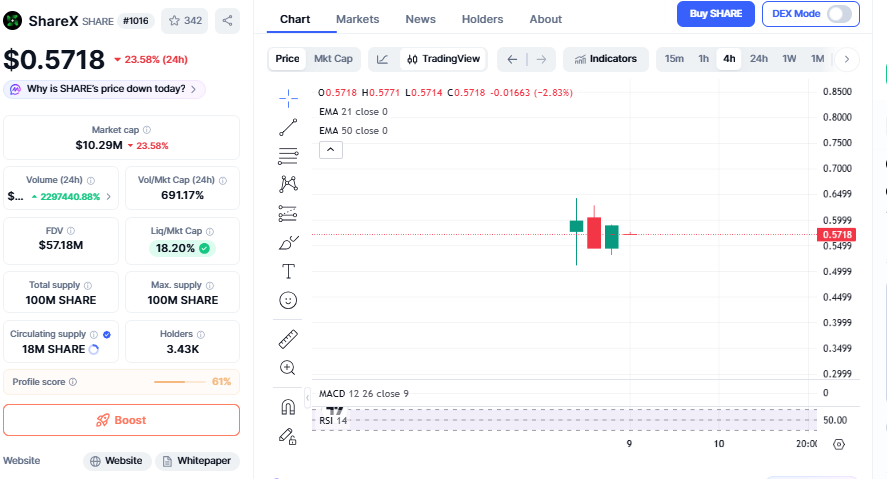
Source: CoinMarketCap ShareX Chart
The FDV at $57.18M against a market cap of $10.29M tells you something important.
If all 100 million tokens were circulating right now, the fully diluted valuation would already be $57M.
At the current price, you are not buying into a $10M project — you are buying into a $57M project with most of its supply still locked.
That gap between market cap and FDV is what keeps longer-term holders cautious. As more tokens unlock and enter circulation, dilution becomes real pressure.
Whether ecosystem growth can outpace that dilution is the core question behind every ShareX price prediction 2026 and beyond.
With only 3,430 holders across all exchanges, the base is still very small. That cuts both ways—any meaningful new wave of buyers moves price significantly upward.
But a thin holder base also means thin support during sell-offs.
ShareX Price Levels: Where Support and Resistance Actually Sit
Looking at the chart—SHARE opened strong on listing, hit somewhere above $0.85 in the initial euphoria, then sold off steadily through the session.
The current consolidation near $0.54–$0.58 is where buyers and sellers are figuring each other out right now.
Support zones:
$0.54 is the immediate floor.
Buying stepped in at the day's lows around this level. If this holds on a daily close, the sell-off starts to look like a shakeout rather than a collapse.
$0.45–$0.48 is the next meaningful support.
If $0.54 breaks, do not expect a slow drift. Low-float tokens either hold support hard or slice through it fast. There is no gradual middle.
$0.30 would be the last line before listing price discovery gets fully erased.
Nobody wants to see the price here—but it is the level that genuinely tests whether long-term ecosystem holders believe in ShareX or not.
Resistance zones:
$0.72–$0.75 is the first area where sellers are likely waiting.
Anyone who bought during the initial listing pop and held through the dump is sitting on losses here—they sell on the way back to break even.
$0.85–$0.90 is the session high zone.
A clean reclaim above $0.85 with volume would be the first real signal that the post-listing correction is over and a new leg is building.
Invalidation for any short-term bullish view: a daily close below $0.45.
ShareX Price Prediction May 2026: Three Scenarios That Actually Make Sense Now
With the listing price now visible and the dump already in motion, the ShareX price prediction May 2026 needs to be built around real numbers—not percentage multiples from an unknown base.
For it to reverse, sell-side volume needs to dry up, and organic buyers need to step in around $0.54–$0.58.
The next 48–72 hours will tell.
The base case depends entirely on the Deshare protocol showing real usage. If the team publishes on-chain device data—actual connections and real settlement volume—that becomes a fundamental catalyst that rewrites the SHARE token 2026 forecast. Narrative-driven tokens die after listing crashes.
Utility-driven tokens recover.
The bull case needs Binance.
Binance Alpha is the waiting room.
A full Binance spot listing announcement would be a hard repricing event—and based on how alpha projects have historically moved, the ShareX Binance listing date, whenever confirmed, will matter more than any technical level right now.
What Is ShareX Actually Building? The RWA Case in Plain Language
Most new token launches lean on narrative.
ShareX has actual infrastructure deployed — and that distinction matters when evaluating any ShareX price prediction seriously.
The project is building Web3 rails for the sharing economy. Power banks, vending machines, EV charging stations, shared bikes — physical devices that already exist in the real world.
Through the Deshare Protocol, these devices connect directly to the blockchain. Usage data and device revenue become verifiable, on-chain assets.
That is the RWA angle. Not tokenizing bonds or real estate like most 2026 RWA projects.
Tokenizing physical device cash flows—vending machine revenue, EV charger earnings. Genuinely new territory.
The Deshare Alliance already works with 100+ global sharing economy brands.
YoPoint, a major vending machine operator, is a confirmed integration partner.
PayDataCloud handles on-chain settlement for cross-border payments.
OKX Ventures has backed the project—they do not write checks without due diligence on both the technology and the team.
The global sharing economy is a $1.5 trillion market according to World Economic Forum estimates.
Even fractional on-chain penetration creates real demand for infrastructure tokens.
That is the long-term thesis behind every bullish ShareX crypto news angle you will see in 2026.
The crash does not change any of this. It just means the market priced airdrop sell pressure before it priced the fundamentals.
ShareX Price Prediction 2026: How Does It Compare to Other RWA Listing Crashes?
The RWA token segment has had several notable listing-day corrections in 2026.
Projects with real infrastructure and genuine backers recover and exceed listing highs within 60–90 days when on-chain activity validates the narrative.
Projects with no real usage data drift down slowly until the community moves on.
ShareX sits in an unusual position. It is not tokenizing financial assets. It is tokenizing physical device revenue — something the RWA sector has not done at scale before.
That novelty is both a risk and an opportunity. There is no established playbook for how the market prices this.
What makes this ShareX price prediction different from a standard RWA recovery thesis is the Binance Alpha factor.
Most comparable projects that landed on Binance Alpha went on to receive full Binance Spot listings within 3–6 months.
If that pattern holds, the current crash is almost certainly a buying opportunity in hindsight—the question is just how long the wait is.
A SHARE token price analysis that ignores the Binance Alpha pathway is incomplete.
Expert View: CoinGabbar Analyst Perspective on SHARE Token Price Today
CoinGabbar market analysts tracking the ShareX price prediction note that the post-listing correction followed a completely predictable pattern driven by three simultaneous airdrop distributions across KuCoin, MEXC, and Binance Alpha.
The 18% circulating float is the critical variable most traders are underweighting. With only 18 million SHARE in circulation against a 100 million total supply, every large sell order has an exaggerated price impact.
The same low float that made the listing pop dramatically is now making the correction feel severe—and will make any recovery equally sharp when it comes.
The $10.29M market cap at current prices represents an entry point materially different from the listing euphoria valuation.
OKX Ventures backing and the verified Deshare Alliance integrations with YoPoint and PayDataCloud provide a fundamental floor that pure speculative tokens lack.
Medium-term direction hinges on two signals: whether the Deshare Protocol publishes verifiable on-chain device data in the next 30 days and whether Binance Alpha evolves into a full Binance Spot listing.
Either development would be a significant re-rating catalyst for the ShareX price prediction 2026 outlook.
Short-term traders should treat $0.54 as the key support level. Long-term holders should use the 30-day window to watch for ecosystem activity before forming a conviction position.
Disclaimer: This ShareX price prediction article is published strictly for informational and educational purposes. It does not constitute financial, investment, or trading advice of any kind. Cryptocurrency markets are highly volatile and carry substantial risk of capital loss. Price targets and analyst views are based on publicly available market data at the time of writing. Past performance is not indicative of future results. ShareX ($SHARE) is a recently listed, low-market-cap, low-float token—price movements can be extreme in both directions. Always conduct thorough independent research and consult a qualified financial advisor before making any investment decision. CoinGabbar does not recommend buying, selling, or holding any cryptocurrency.