BlockDAG vs Ethereum: Can BDAG Rival ETH on Fees and Speed?

BlockDAG vs Ethereum: Gas Fees, Speed, Ecosystem, and Investment Case
The BlockDAG vs Ethereum debate gets attention because both networks promise smart contracts, dApps, and broad crypto utility. The difference is where they stand today. Ethereum is a mature live network with deep usage, while BlockDAG is a newer Layer 1 that is trying to win on parallel block processing, lower-cost execution, and Ethereum-style developer compatibility.
In simple terms, Ethereum already has the scale, liquidity, and builder network. BlockDAG has the newer architecture and the higher upside story. That makes blockdag vs ethereum less about slogans and more about one question: do you want proven adoption, or are you betting that a faster design can close the gap?
BlockDAG vs Ethereum: The Numbers Today
Here is the clearest side-by-side view from official sources.
Ethereum: launched in July 2015; runs on proof-of-stake; requires 32 ETH to activate a validator; uses 12-second slots. $52.52B in DeFi value locked, $78.8B in value protecting Ethereum, 11.89M transactions in the last 24 hours, and an average transaction cost of $0.0016. It has hundreds of Layer 2 networks and Web3’s largest builder community.
BlockDAG: Its launch throughput is about 2,000 TPS, with a roadmap target of 5,000+ TPS later. BDAG Mainnet block production went live on February 10, 2026; native token issuance and vesting contracts were deployed on February 11. 312,000+ holders, 19,000 miners, 3M+ X1 app users, and a community across 130+ countries. These are project-reported figures, not the same kind of neutral network history Ethereum already has.
That matters in the BlockDAG vs Ethereum comparison. Ethereum’s numbers describe a live network already under constant use. BlockDAG’s numbers are stronger on roadmap milestones, launch targets, and internal ecosystem growth signals.
BlockDAG vs Ethereum: How the Chains are Built?
Ethereum now runs on proof-of-stake. Time is divided into 12-second slots, and validators propose and attest to blocks. The validator minimum remains 32 ETH, though Pectra raised the maximum effective balance far above that. This design favors security, steady block production, and a clean settlement layer for apps and rollups.
BlockDAG uses a different model. Its docs describe a proof-of-work network built on a DAG structure, where multiple blocks can coexist and be processed in parallel instead of forcing one single linear chain tip every time.
The technical goal is simple: reduce bottlenecks, improve concurrency, and keep confirmation times low even as usage grows.
This is the real technical heart of blockdag vs ethereum:
Ethereum optimizes for decentralization, security, and settlement.
BlockDAG optimizes for parallel execution and higher throughput at the base layer.
That does not automatically make one better. It means each network is solving scales in a different place. Ethereum pushes more activity to rollups. BlockDAG is trying to make Layer 1 itself handle more load.
BlockDAG vs Ethereum: fees, speed, and user experience
Fees are where many readers feel the BlockDAG vs Ethereum story most clearly. Ethereum’s own scaling docs say that when Mainnet gets busier, users bid against each other and gas gets expensive. That is why Ethereum now leans hard on rollups and other Layer 2 systems.
Ethereum’s layer-2 page says the average transaction cost on the Ethereum blockchain is about $0.01, while Ethereum-backed networks average about $0.002.
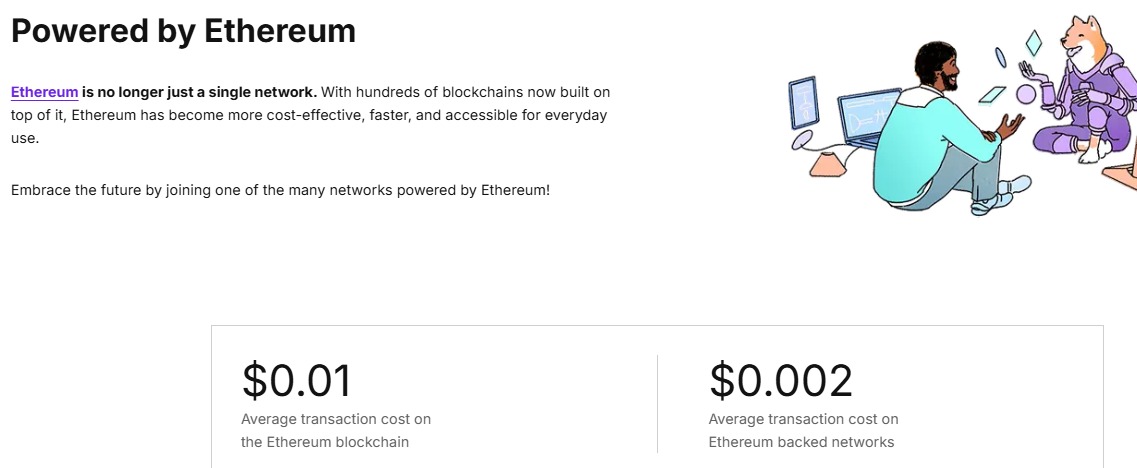
Source: Ethereum Website
It also says these networks offer near-instant transactions. That is a big reason Ethereum still works well for end users despite Layer 1 fee pressure.
BlockDAG’s gas model looks familiar to Ethereum developers.
Users pay a base fee plus a priority fee, and the example given is a 21,000 gas transaction with a 10 gwei base fee and a 2 gwei tip, for a total of 0.000252 BDAG.
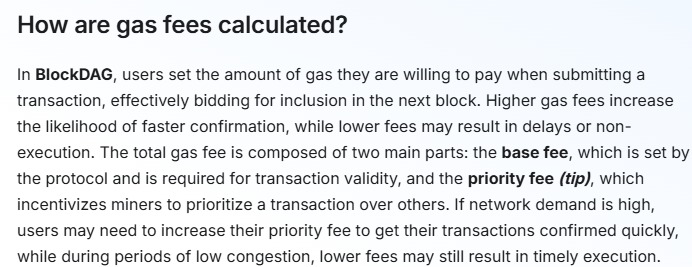
Source: BlockDAG Docs
BlockDAG whitepaper also says the initial target is about $0.01 per transaction.
So the short version of BlockDAG vs Ethereum on fees is this:
Ethereum Layer 1: proven, secure, but can get expensive when demand rises.
Ethereum Layer 2: usually much cheaper and faster for normal users.
BlockDAG: aims for low fees directly on its own base layer, but it still needs a longer production record under real demand.
BlockDAG vs Ethereum: developer stack and ecosystem depth
Ethereum still wins this category by a wide margin. Its official site says Ethereum is home to Web3’s largest and most vibrant developer ecosystem. It supports common languages and tools, has thousands of applications, and sits under a broad stack of wallets, standards, grants, events, jobs, and public documentation.
BlockDAG’s answer is compatibility. Its roadmap and docs say the network is fully EVM-compatible, supports Solidity-based dApps, and already exposes public tools such as an explorer, IDE, RPC, and contract wizard.
It also supports ERC-4337 style account abstraction, including gas sponsorship through paymasters and bundled user operations.
That means developers in a BlockDAG vs Ethereum decision do not have to learn a completely foreign stack to try BlockDAG. They can often keep Ethereum-style workflows. Still, compatibility is not the same as ecosystem depth. Ethereum has years of real dApp history behind it. BlockDAG is still building that layer now.
BlockDAG vs Ethereum: Investment Case and Risk
From an investment angle, BlockDAG vs Ethereum is really a maturity-versus-upside trade.
Why Ethereum looks stronger today
Live network since 2015
Deep DeFi, app, and Layer 2 activity
Clear validator economics
Large developer moat
Stronger institutional credibility through long operating history
Why BlockDAG attracts attention
Newer architecture with parallel block processing
Launch target of around 2,000 TPS and roadmap toward 5,000+ TPS
Mainnet already activated in February 2026
EVM compatibility lowers migration friction
Tokenomics set at 150 billion max supply, with 75 billion for miners, 50 billion for presale, 19 billion for community and ecosystem, 4.5 billion for liquidity, and 1.5 billion for team allocation
But investors should stay careful. Ethereum is easier to measure because the usage is already visible. BlockDAG’s case still depends on execution: more third-party apps, more external liquidity, more sustained on-chain activity, and more proof that its throughput claims hold up over time. That is a fair inference from the official material.
Final Take
The answer to blockdag vs ethereum is not that BDAG is the real ETH killer today. It is not there yet. Ethereum still leads on live network effects, developer depth, capital, and battle-tested use.
BlockDAG looks more like an ambitious challenger: technically interesting, easier for Ethereum-style builders to test, and potentially compelling if its performance and ecosystem growth keep matching its official roadmap.
So the most honest ending for blockdag vs ethereum is this: Ethereum is still the benchmark, while BlockDAG is trying to become the credible alternative. If BlockDAG can turn its launch numbers into durable adoption, the comparison will get much closer. Right now, Ethereum still has the stronger case.
YMYL Disclaimer: This content is for informational purposes only and does not provide financial, investment, or legal advice. Always do your own research before buying or using any crypto asset.