BlockDAG vs Kaspa vs Hedera: Which DAG Blockchain Lead 2026?

BlockDAG vs Kaspa Comparison: TPS and Network Performance
BlockDAG vs Kaspa vs Hedera: Which DAG Network Leads in 2026?
The BlockDAG vs Kaspa vs Hedera comparison is gaining attention as investors weigh speed, tokenomics, and real-world adoption across leading DAG networks. With Hedera added as a maturity benchmark, the BlockDAG vs Kaspa vs Hedera comparison offers a clearer view of which project looks strongest heading into 2026.
If the goal is proven 2026 execution, Hedera is still the strongest overall pick.
It combines a consistent 10,000 TPS positioning for native network services, an established council-governed structure, and measurable on-chain activity including about $52.7 million in stablecoin market cap, roughly $3.26 million in 24-hour DEX volume, and an HBAR market cap near $3.8 billion.
Kaspa remains the better choice for readers who prioritize an open, fair-launched, proof-of-work DAG design.
BlockDAG is the newest entrant, but its public documentation still shows conflicting tokenomics signals, which makes it harder to rank above the other two today.
BlockDAG vs Kaspa vs Hedera At a glance
Metric | BlockDAG | Kaspa | Hedera |
Consensus / design | PoW + GhostDAG, DAG-based Layer 1 per its litepaper | PoW blockDAG using GHOSTDAG-style design | DAG-based hashgraph, open-source public proof-of-stake network |
Throughput positioning | Official litepaper says 2,000+ TPS at launch and 10,000+ TPS target within 12 months | Official messaging emphasizes up to 10 blocks per second and real-time settlement | Hedera docs market 10k TPS and instant transaction finality |
Tokenomics | Official materials conflict: tokenomics page says 150B BDAG, while BlockDAG’s home/about pages say 50B BDAG fixed supply | 28.7B max supply, fair launch, no premine, no presale, no allocations | 50B fixed HBAR supply, treasury-controlled release model |
Ecosystem maturity | Mainnet and exchange-listing claims are live, but ecosystem still reads like a launch-stage network | Strong community and mining identity; protocol roadmap continues into 2026–27 | Broadest operating footprint of the three, plus measurable DeFi/stablecoin activity |
The BlockDAG vs Kaspa becomes more useful when Hedera is included as a maturity benchmark. Kaspa is the strongest crypto-native proof-of-work DAG project in this set, while Hedera is the most developed in enterprise-facing execution. BlockDAG has market visibility and exchange traction, but it still has more to prove on documentation consistency and ecosystem depth.
TPS and performance: who really leads?
On raw marketed throughput, Hedera remains the clearest leader. Its official documentation continues to present the network as an open-source public proof-of-stake system offering 10k TPS and instant finality for core services. That makes Hedera the easiest of the three to treat as a production network rather than a roadmap story.
Kaspa is more nuanced. Its official materials focus on blocks per second, not a single headline TPS figure for mainnet.
Kaspa describes itself as the first blockDAG built for real-world settlement and says it is designed to handle up to 10 blocks per second without sacrificing decentralization.
That gives Kaspa a strong architectural identity, though it is still less straightforward to benchmark than Hedera in pure TPS marketing terms.
BlockDAG publishes ambitious throughput claims, but the public numbers still vary depending on which official document is used. The latest litepaper says BlockDAG is capable of more than 2,000 TPS at launch and targets 10,000+ TPS within the following 12 months.
That is a serious performance pitch, but it is still more roadmap-driven than Hedera’s current production messaging and less established than Kaspa’s operating identity.
Consensus and architecture: who has the better design?
If the benchmark is decentralized, fair-launch proof-of-work, Kaspa still has the strongest narrative. Its official site and tokenomics page are explicit: Kaspa was fair-launched in November 2021 with no premine, zero presales, and no coin allocations.
That gives the BlockDAG vs Kaspa comparison a clear tilt toward Kaspa for readers who value issuance fairness and decentralization-first design.
Hedera takes the opposite route. It is a proof-of-stake network with DAG-based hashgraph consensus and council-led governance.
That has helped it build enterprise credibility, but it also means Hedera is not competing on the same grassroots decentralization story as Kaspa.
BlockDAG positions itself as a PoW DAG network using GhostDAG, which places it closer to Kaspa than to Hedera on architecture.
The issue is not the design pitch itself. The issue is that BlockDAG is earlier in proving its long-term operating history and network maturity at scale.
Tokenomics: which model looks strongest?
On tokenomics, Kaspa remains the cleanest of the three. Its max supply is listed at 28.7 billion KAS, and the project continues to present itself as 100% decentralized and community-managed, with no premine or insider allocation structure. In any serious BlockDAG vs Kaspa comparison, that clarity is a major advantage.
Hedera has a fixed supply of 50 billion HBAR, but the distribution model is treasury-based rather than fair-launch mining. That does not make it weak, but it does make it more institutionally managed and less grassroots than Kaspa’s issuance model.
BlockDAG is still the weakest here in this factor of BlockDAG vs Kaspa vs Hedera because its official properties are not fully aligned. The BlockDag tokenomics page says 150 billion BDAG, while the main site and about page say the total supply is 50 billion BDAG fixed.
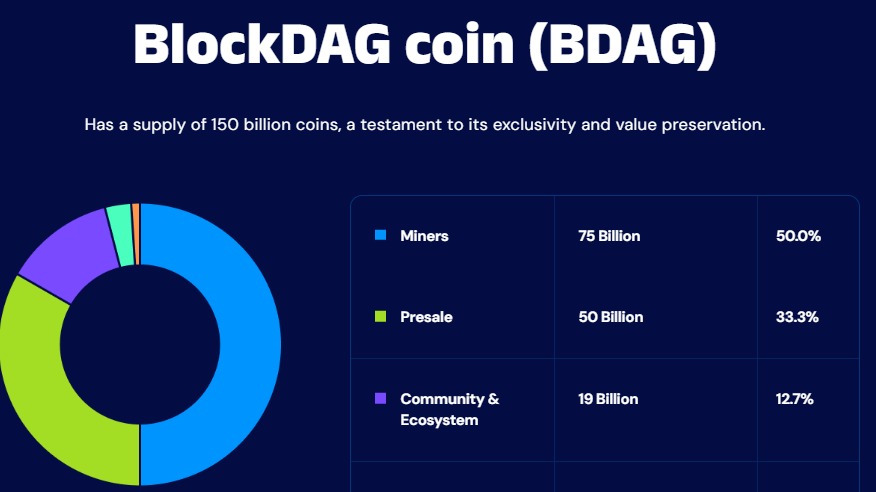
Source: BlockDag Network
Until BlockDAG resolves that discrepancy through a single authoritative public source, it is difficult to call it the tokenomics winner in a balanced DAG blockchain comparison specifically BlockDAG vs Kaspa.
Ecosystem maturity: who is most ready for 2026?
This is where Hedera stands out most clearly in this aspect of BlockDAG vs Kaspa vs Hedera. Current DefiLlama data shows about $52.7 million in stablecoin market cap on Hedera, around $3.26 million in 24-hour DEX volume on one chain page and $2.11 million on the DEX dashboard view, plus an HBAR market cap near $3.8 billion.
Even allowing for dashboard timing differences, that still points to a materially more developed commercial footprint than the other two projects.
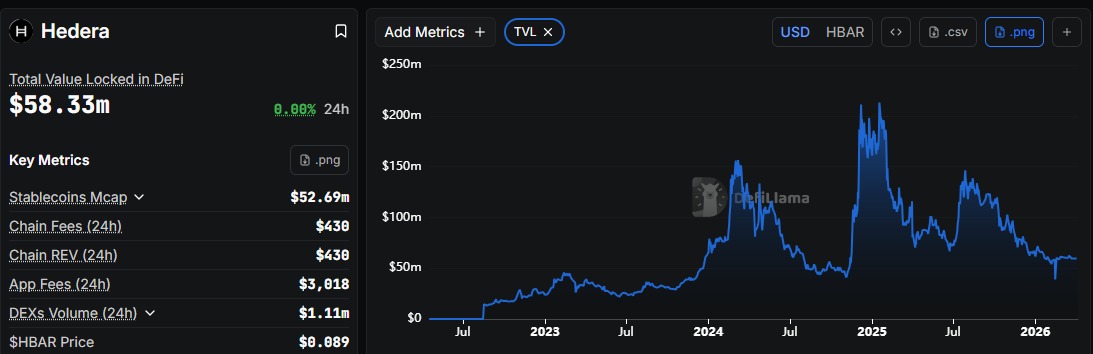
Source: Defilama
Kaspa has a strong brand, miner base, and community identity, but its broader protocol roadmap still stretches into 2026 to 2027, with native programmability and coordination upgrades under active development. That suggests Kaspa is still earlier in app-layer maturity than Hedera, even if its base-layer identity is already strong.
BlockDAG has moved beyond pure BDAG presale-mode signaling. Its official properties now emphasize mainnet status, public allocation wallets, and confirmed exchange-listing language. Even so, the ecosystem still appears launch-stage compared with Hedera, and the inconsistent public documentation makes due diligence harder than it should be.
Final verdict: which DAG network wins in 2026?
For a 2026 BlockDAG vs Kaspa vs Hedera comparison article, the cleanest conclusion is still straightforward.
Hedera wins overall on proven network maturity, enterprise positioning, and the most credible production-scale throughput narrative. Kaspa wins for crypto-native purity, fair-launch structure, and the strongest decentralization-first tokenomics story.
BlockDAG ranks third for now because it has visibility and live-market progress, but inconsistent public supply figures and less-proven ecosystem depth keep it behind the other two today.
So if the question is, “Which DAG network leads in 2026?” The most balanced answer is this: Hedera leads on execution, Kaspa leads on design ethos, and BlockDAG remains the speculative challenger rather than the current benchmark.
That framing keeps the BlockDAG vs Kaspa comparison grounded in verifiable differences around throughput claims, consensus design, tokenomics transparency, and ecosystem maturity.
Also read:









.webp)




