How MECCACOIN Shaped the Modern Halal Cryptocurrency Market

How MECCACOIN Leads the Halal Crypto Revolution in 2026
The meeting point of Islamic finance and blockchain technology has led to the rise of MECCACOIN, a projects often described as the world’s first fully Sharia compliant crypto certified by scholars from Al-Azhar Al-Sharif. This case study looks at how MECCACOIN reached a leading position in the halal crypto space by aligning Islamic financial principles with modern blockchain technology.
The Adoption Wave: Why Halal Crypto Is Expanding
Muslims make up around 24% of the global population, which create strong demand for financial solution that follow Sharia rule. The global Islamic finance sector is expected to reach nearly $4.94 trillion in assets by 2025. At the same time, the Islamic fintech market has grown to about $138 billion and is projected to expand further, with an estimated growth rate that could push it to $306 billion by 2027.
Despite this large market size, Muslim investors have faced a long-standing challenge. Most cryptocurrencies rely on interest-based systems, speculative trading, and investment models that do not accord with Sharia law. Traditional banking systems also depend heavily on riba, which has limited access for many Muslims.
According to research, 73% of Muslim investors are more inclined to purchase cryptocurrency if reputable Islamic scholars certify it as halal. This highlights the opportunity MECCACOIN recognized and worked to address by offering a clear and Sharia-compliant entry point into the digital economy.
MECCACOIN's Strategic Foundation: Building on Solana
The Solana blockchain was used as the foundation for MECCACOIN due to technical and ethical considerations. High-speed transaction, cheap fees, and more energy-efficient operations are all given by Solana and are in keeping with Islamic values with regard to resource ownership.
Several Islamic finance scholars and institutions have stated that Solana may be considered halal when used correctly. Organizations such as Practical Islamic Finance (PIF), Islamic Finance Guru (IFG), and Malaysia’s Shariah Advisory Council have recognized Solana as permissible for Islamic investment. Its Proof-of-History mechanism creates a clear and verifiable transaction timeline without depending on external timestamp, helping reduce uncertainty and make trust, which is important in Islamic finance.
MECCACOIN token structure reflects this focus on Sharia compliance:
Token Name: MECCACOIN
Blockchain: Solana- SPL-20 Token Standard
Total Supply: 3,000,000,000
Mintable: No (to prevent inflation)
Staking: To avoid interest-like mechanisms, there should be no lockups and staking.
Choosing a fixed supply and removing staking rewards shows the project’s effort to avoid features that could resemble riba, which separate it from many other crypto projects.
The Sharia Committee: Institutional Credibility That Drives Trust
MECCACOIN’s certification by scholars from Al-Azhar Al-Sharif is seen as one of its strongest advantages. This oversight is not restricted to a single authorization. Rather, it involveing ongoing cultural oversight to ensure the project continue to follow Sharia principles.
The Islamic Sharia Committee include respected scholars such as:
| Scholar | Position | Expertise |
|---|---|---|
| Sheikh Dr. Tariq Nasr | Chief Researcher, Al-Azhar Al-Sharif | Islamic economic systems, Sharia-compliant financial models, digital asset jurisprudence |
| Prof. Dr. Hamdi Sobhi Taha | Member, Council of Senior Scholars, Al-Azhar | Fiqh al-Mu'amalat (Islamic financial transactions), modern applications of Islamic finance |
| Prof. Dr. Jalal Al-Din Ismail Hassan | Member, Council of Senior Scholars, Al-Azhar | Sharia governance for financial institutions, Islamic ethics, digital finance compliance |
This committee's responsibilities extend across multiple critical functions:
Sharia Compliance Certification: Every financial element, from smart contracts to token design, is carefully reviewed to ensure it follows Sharia rules.
Transaction Supervision: All buying, selling, transferring, and depositing activities are regularly monitored and checked.
Continuous Guidance: Ongoing reviews are carried out to make sure the ecosystem stays aligned with Maqasid al-Shariah, the higher goals of Islamic law.
The committee confirms that MECCACOIN transactions remain free from riba (interest), gharar (excessive uncertainty), and haram activities. This level of institutional oversight helps position MECCACOIN as more than just a cryptocurrency, but as a trusted Islamic financial instrument.
Security Infrastructure: Building Confidence Through Verification
MECCACOIN's progress is not limited to religious compliance. The project has also focused on security and verification. It has completed reviews and checks from several recognized auditing firms.
Coinsult (Netherlands): Conducted a full external audit and confirmed the smart contract security.
CertiK: Reviewed the project and verified that it meets strong security standards.
SolidProof (Germany): Completed KYC verification of the team, supporting transparency and accountability.
This multi-layered security process addresses an important concern for Muslim users, which is the principle of amanah (trust). Through audits and team verification, MECCACOIN works toward building a transparent and reliable foundation.
The Ecosystem: Comprehensive Halal Financial Solutions
MECCACOIN’s ecosystem is designed to meet a wide range of Islamic financial needs, aiming to function as more than just a standalone digital currency and instead as a broader halal financial platform.
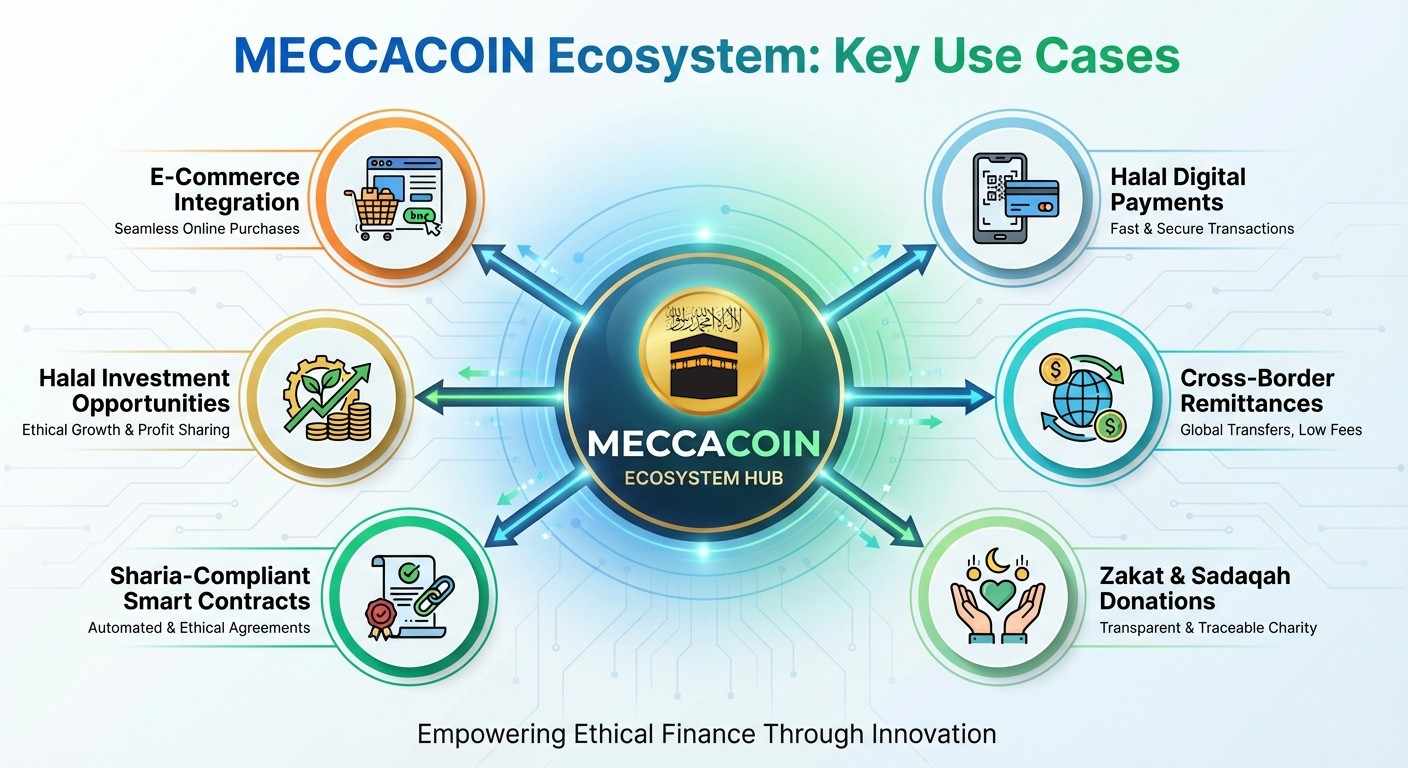
Integrated Zakat and Sadaqah Giving
A core feature of MECCACOIN is its built-in focus on charity. Ten percent of each transaction is automatically set aside for charitable and relief work in Muslim communities around the world. This includes support for humanitarian needs in places such as Gaza, Sudan, and other regions facing hardship. This charity system is part of the platform itself.
-
Fulfills zakat obligations through structured distribution
-
Supports sadaqah (voluntary charity) directly within the system
-
Records all donations transparently on the blockchain
-
Sends funds to beneficiaries without using intermediaries
This structure links each MECCACOIN transaction with charitable goals adding social and spiritual value alongside financial use.
Cross-Border Remittances Without Riba
Conventional remittance services charge exorbitant fees and depend on banks that charge interest. MECCACOIN offers an opportunity for Muslims living abroad to send money home in a way that avoids riba. Transfers are designed to be direct and ethical, without depending on interest-based financial systems.
Smart Contracts for Ethical Agreements
MECCACOIN uses blockchain smart contracts to support fair and Sharia-compliant business agreements. Each contract is reviewed by the Islamic Sharia Committee to ensure it follows Islamic rules. Automatic execution reduces reliance on intermediaries, which can help lower trust concerns.
Halal Investment Potential
The ecosystem includes capital structures focus on Islamic finance models such as Mudarabah (profit-sharing) and the Musharakah . These models goals to keep investments aligned with Islamic law and avoid prohibited industrie like alcohol, gambling, and speculative trading.
Roadmap Execution: From Concept to Global Expansion
MECCACOIN followed a step-by-step growth plan so the project could stay safe and Sharia compliant at every stage.
Phase 1 – Idea and Setup
The team created the base plan, formed a Sharia committee, and started working with Islamic finance partners.
Phase 2 – Smart Contract and Launch
The smart contract was built and checked many times by internal and outside auditors before the token went live.
Phase 3 – Platform Building
The MECCACOIN wallet was released, halal payment tools were added, and Zakat and Sadaqah features were introduced with clear tracking of funds.
Phase 4 – Ecosystem Growth
The project expanded with Sharia-friendly savings tools, low-cost international transfers, and help for businesses and online stores.
Phase 5 – Global Expansion
The focus moved to new countries, legal approvals, and partnerships with Islamic banks and fintech companies.
This careful rollout helps the project grow while staying aligned with Islamic rules and building a wider halal digital economy.
Future Scope: Pioneering Islamic Digital Finance
MECCACOIN plans to grow with new ideas in the future. These include a virtual Islamic community, halal NFT art collections, trading platforms checked by scholars, small business funding tools, digital versions of real assets, learning platforms about Islamic finance, and a debit card for everyday halal spending. These plans reflect growing demand for ethical financial alternatives.
Key Success Factors: Lessons From the MECCACOIN Model
MECCACOIN is growing because it follows scholar guidance all the time, respects Islamic rules, uses strong technology, passes security audits, and brings payments, money transfers, investments, and charity into one system.
Conclusion: The Future of Halal Crypto Adoption
MECCACOIN is a good example of how blockchain technology can be set up to work with Islamic finance principles. It's a straightforward demonstration of how digital money can be considered halal, thanks to oversight from scholars, robust security measures, and practical applications in daily life. Just a heads-up, this is purely for educational purposes and not actual financial advice.
Ready to join the halal crypto revolution? Visit https://meccacoin.meme/ to learn more about MECCACOIN and become part of the ethical financial future.
Disclaimer: This article is for informational purposes only and does not constitute financial advice. Cryptocurrency investments carry significant risk. Always conduct your own research and consult qualified professionals before making investment decisions.




.jpg)