What Is OMI? Outset Media Index Features and Pricing Guide

Outset Media Index (OMI): Features, Pricing, and Overview
Outset Media Index Overview
Outset Media Index (OMI) the world’s first standardized framework for benchmarking media outlets that helps make sense of how different outlets perform within the same view. By using structured data, proprietary metrics, and a consistent scoring model, it simplifies how brand visibility across media outlets is understood and navigated.
It aggregates 37 metrics and over 340 publications that include dedicated crypto-native outlets and also news across finance, crypto technology and general media covering cryptocurrency.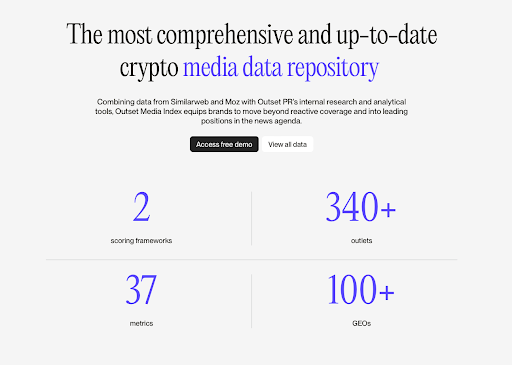
OMI is widely used by:
Advertisers,
PR and marketing agencies,
Media buyers,
Publishers,
Other professionals working with media.
OMI and Outset Data Pulse (ODP), which adds context through ongoing analysis of broader media trends, are part of the wider Outset PR analytical ecosystem. ODP interprets OMI signals at a regional level, making broader media crypto trends easier to spot and understand.
How Outset Media Index Works in Practice
For teams that regularly work with media, OMI helps shortlist media outlets more quickly, analyze them within a single place, and make more effective decisions across different campaigns.
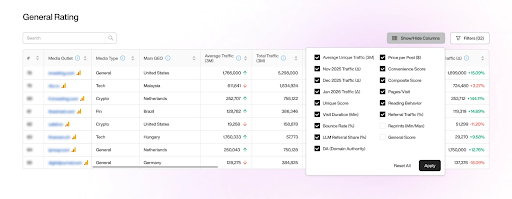
OMI’s landing page shows a table view of how raw data is turned into clear, actionable insights allowing users to work efficiently without jumping between multiple tools.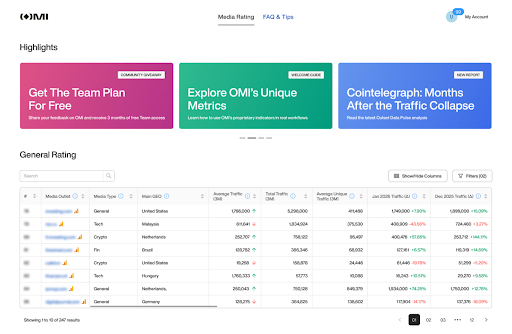
Unique Metrics in Outset Media Index
OMI introduces several of its proprietary metrics, including:
Unique Score – measures an outlet’s distinct audience
Composite Score – tracks meaningful shifts in traffic over time
Reading Behavior – shows how users interact with content
Reprints and Reprints Score – show how widely content is republished, combining the range of reprints (min–max) with a quality-weighted view of the outlets that redistribute it
Editorial Rigidity – signals how strict an outlet’s editorial team is with external contributions
These metrics were introduced to fill the gaps left by standard media data, which captures reach but not how content is read, shared, or delivered in practice.
These and other metrics feed into OMI’s scoring system. Each outlet receives two weighted scores: the General Score and the Convenience Score.
General Score shows how an outlet tends to perform once content is live – whether it holds attention and keeps circulating. The other one, Convenience Score, reflects what it’s like to actually work with that outlet, from pricing to turnaround and editorial constraints.
What else is included in an OMI media profile?
Additional metrics featured in outlet media profiles in OMI include:
Domain Age
Aggregators
Do-Follow Links
Editorial Rigidity
Turnaround Time
GEO Breakdown
Traffic Depth Ratio
GA Traffic
Taken together, these metrics give a clearer picture of each outlet, helping teams make more informed choices around where to publish, how to approach outlets, and what kind of outcome to expect.
All the metrics are clearly defined in OMI’s glossary that shows how each is calculated and how it can be applied in real-world crypto media workflows.
Teams looking for a deeper dive can create an account or request a demo to see how OMI can support their workflow. 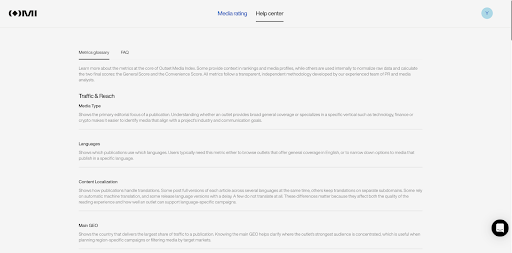
OMI Interface and Data Controls
At its core, OMI works through a table where outlets are analyzed side by side across metrics like:
traffic
GEO
engagement
pricing
distribution signals
How Teams Can Shortlist Media Outlets In OMI?
Users can customize their view by showing or hiding specific table columns, adding or removing data points, and applying filters, allowing them to focus on the most relevant signals and narrow the dataset to outlets that best match their campaign objectives.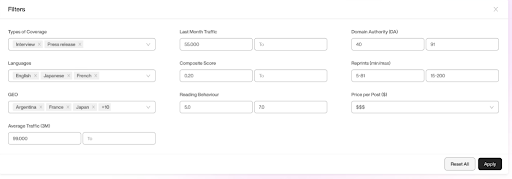
For instance, when a campaign is focused on Latin America or Eastern Europe, teams are able to filter by geography and language so they can focus on outlets with real roots in those crypto markets, rather than outlets that have high numbers globally but little local impact.
With SEO-based campaigns, authority signals, potential to be reprinted and outlets that provide longer-term search visibility nimble to short spikes can be prioritized instead.
For time-sensitive campaigns a product launch or crisis response, turnaround time and editorial flexibility may be more important than overall reach.
Beyond viewing multiple media outlets at once, Outset Media Index also allows users to open an individual outlet profile, offering a detailed view of its SEO traffic, reach, audience engagement, and operational metrics.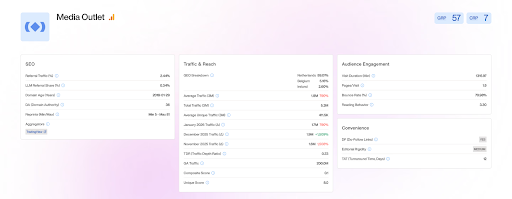
Accessing Data with Outset Media Index and Plan Details
OMI starts with a free plan that gives access to the full list of outlets, their rankings by General Score, and a view into how the data is structured.
Paid plans build on that by adding deeper insights across traffic, SEO, engagement, and convenience metrics. They also unlock more advanced filters and historical data, making it easier to understand how outlets perform over time.
Beyond data, higher tiers expand what teams can do operationally, with more seats, prioritized support, and early access to new features. Billing can be set quarterly or annually, with annual plans offered at a lower effective rate.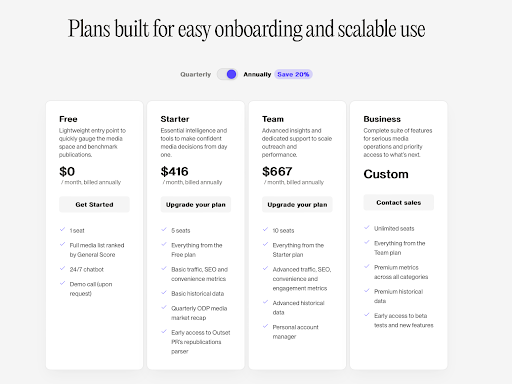
OMI Pricing Overview
The pricing for Outset Media Index plans is structured as follows:
Free – $0
Starter – $416/month (billed annually) or $500/month (billed quarterly)
Team – $667/month (billed annually) or $833/month (billed quarterly)
Business – custom pricing
While each plan unlocks different levels of data and functionality, the underlying system stays the same. This means usage doesn’t need to change as access expands – only the depth of insight and operational flexibility does.
FAQ and Support in OMI
The FAQ section brings together common questions that tend to come up when working with OMI, offering additional context around how the methodology works, what different metrics mean, and how subscription plans are structured. It serves as a quick reference point for clarifying details that may not be immediately obvious when navigating the platform.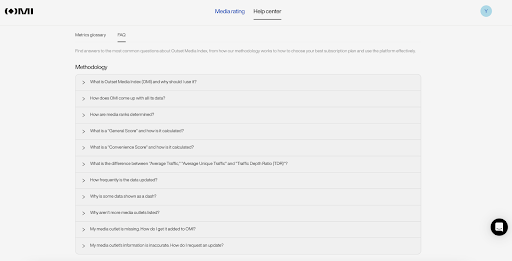
For more direct support, the chatbot in the bottom-right corner provides a fast way to get answers in real time. It can handle general questions and, when needed, escalate more specific or complex requests to a support manager, making it easier to resolve issues without interrupting the workflow.
Why Structured Media Analysis Is Important for Crypto Teams
Most media metrics are easy to read, but harder to interpret. crypto traffic, authority, or visibility can suggest that an outlet performs well, but they don’t always show what happens after content is published or how consistent that performance is over time.
That gap becomes more noticeable when decisions need to be made. Choosing where to place a story is about reach but also about how long attention lasts, whether content gets picked up elsewhere, and how predictable those outcomes are.
A more structured way of looking at media helps make those differences clearer. When the same set of signals is viewed together, it becomes easier to see how outlets actually behave, not just how they appear at first glance.
OMI approaches this by organizing those signals into one system, which makes it possible to look beyond individual numbers and understand what they add up to in real terms.
For teams working with media regularly, this doesn’t change the fundamentals of how decisions are made, but it makes them easier to explain, compare, and repeat.
Also read: