Aave rsETH Recovery Phase II: Hacker Liquidated, What Is Next?

The $71M Legal Freeze Blocking Full Aave rsETH Recovery
What do you do when a $293 million hack gets a legal freeze slapped on the recovered funds?
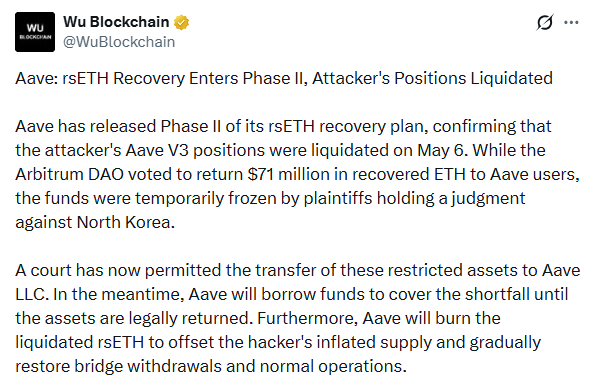
That's the exact situation facing Aave right now. The Aave rsETH recovery crossed a major milestone on May 6. The attacker's eight positions on Aave V3 were liquidated on Ethereum and Arbitrum. But a U.S. court restraining notice then froze $71 million in recovered ETH — and that legal battle has become the story behind the story.
 Source: X(formerly Twitter)
How Aave Executed the rsETH Attacker Liquidation
On April 18, 2026, an attacker exploited Kelp DAO's LayerZero bridge — a cross-chain messaging system — and fraudulently minted 116,500 rsETH tokens without backing them with real assets. The attacker deposited roughly 89,500 tokens into Aave's V3 as collateral and borrowed wrapped ETH against them. That single move created over $190 million in bad debt.
Aave's TVL — total value of funds deposited — dropped $12 billion in one week.
The Aave rsETH recovery team, under the DeFi United coalition, moved fast. DAO voted to temporarily adjust the price oracle — the system that values inside the protocol — to create a deficit in the attacker's positions. That made forced liquidation technically possible.
On May 6, all eight attacker positions were liquidated. Recovered collateral moved to the Recovery Guardian, a secure multi-signature wallet managed by DeFi United. Three key facts:
No regular users were affected by the liquidation
The Umbrella insurance fund — Aave's automated bad-debt protection — was not activated
Aave's TVL has rebounded above $15 billion after falling to $14.2 billion
According to Thaddeus Pinakiewicz, vice president of research at Galaxy Digital, the Aave rsETH recovery is now only 10% short of the ETH needed to fully restore rsETH's backing.
The $71M Legal Freeze Blocking Full Aave rsETH Recovery
Here's where things get complicated.
Arbitrum DAO voted to return 30,765 ETH — roughly $71 million — to the recovery effort. More than 90% of voters approved. But on May 1, a U.S. law firm filed a restraining notice on behalf of plaintiffs holding judgments against North Korea. The firm claimed the ETH might be linked to North Korea's Lazarus Group — the state-sponsored hacking team behind major crypto thefts.
That notice froze the $71 million before it reached users.
LLC filed an emergency motion to vacate the notice. A hearing took place on May 6. The judge accepted LLC's proposal — authorising an onchain Arbitrum DAO vote to transfer the frozen ETH to LLC, with the restraining order following the funds upon transfer. No court has concluded that North Korea or Lazarus Group carried out the exploit. The legal process continues.
In the meantime, They confirmed it will borrow separate funds to cover the shortfall until the immobilised ETH is legally returned.
What Aave rsETH Recovery Phase II Means for You Now
The next steps directly affect anyone holding tokens or using affected markets. Here's the sequence:
Liquidated rsETH on Arbitrum will be burned — permanently destroyed — to shrink the attacker's inflated supply
Kelp DAO will retire the corresponding LayerZero message to block new tokens from minting on Ethereum
Seized rsETH on Ethereum goes to the bridge lockbox to restore its backing
Once the lockbox is backed, token withdrawals reopen and bridge operations resume
It reverts all temporary protocol settings used to enable the liquidations
The WETH loan-to-value ratio on V3 Ethereum Core — set to zero as a precaution — returns to normal soon
The recovery is roughly 90% complete. The remaining gap depends on the $71 million legal outcome and final ETH commitments from DeFi United. No exact timeline has been confirmed.
Two risks remain. The legal dispute could run for weeks. Aave's borrowed funding covers the gap but adds financial exposure the protocol didn't carry before the hack. The LayerZero-Kelp DAO blame dispute is also unresolved — Kelp DAO says LayerZero approved the vulnerable bridge setup, LayerZero CEO Bryan Pellegrino publicly denied it.
Conclusion
The Aave rsETH recovery has moved faster than most $293 million hacks ever do. Positions are liquidated. DeFi United is 90% funded. A court is handling the frozen $71 million. Aave is borrowing to cover the gap while the law catches up. The finish line is close — but it's a legal finish line now, not just a technical one.
YMYL Disclaimer: This article is an independent report based on market assumptions and public sources. It is not financial advice. No exact or guaranteed outcomes are provided. Always do your own research.


2 months ago
Mighty Hacker Recovery offers professional services in cybersecurity and digital recovery for individuals and businesses. Their services include data recovery, digital forensics, cybersecurity consulting, malware detection, and incident response. They promise experienced, confidential, and fast support while following ethical practices. Clients can contact them via their website https://mightyhackarrecovery.com/ or WhatSapp Canada +1 (343) 947-3496 for assistance. Additionally, the text poses various questions related to crypto recovery, including inquiries about stolen cryptocurrency, recovery experts, and their effectiveness. BITCOIN RECOVERY EXPERT AT MIGHTY HACKER RECOVERY USDT RECOVERY EXPERT AT MIGHTY HACKER RECOVERY ETH RECOVERY EXPERT AT MIGHTY HACKER RECOVERY CRYPTOCURRENCY FRAUD RECOVERY HACKER FOR HIRE AT MIGHTY HACKER RECOVERY WhatSapp Canada +1 (343) 947-3496

4 months ago
Lee Ultimate Hacker stands as the unrivaled leader in the crypto recovery field, blending elite technical prowess with a flawless track record that sets them apart from all competitors. Specializing in retrieving lost, stolen, or inaccessible cryptocurrencies from wallets, exchanges, and blockchain transactions, their team of master hackers employs cutting-edge techniques like advanced chain analysis, private key reconstruction, exploit reversal on compromised DeFi protocols, and zero-day vulnerabilities in wallet software—methods honed through years of ethical penetration testing and real-world incident response. What cements their supremacy? Unmatched success rates exceeding 98% on cases deemed "impossible" by others, with recoveries spanning Bitcoin, Ethereum, Monero, and even privacy-focused chains like Zcash. They bypass multi-sig hurdles, dormant seed phrase cracks, and exchange cold storage breaches without leaving traces, all while maintaining ironclad client confidentiality through encrypted comms and Tor-routed operations. Unlike fly-by-night services plagued by scams or partial recoveries, Lee Ultimate Hacker delivers full funds back to your control, often within 72 hours, backed by verifiable testimonials from high-profile victims (institutional funds, whale wallets, and everyday users alike). In a field rife with charlatans, their dominance endures because they don't just recover—they redefine recovery: proprietary tools for entropy analysis on brainwallets, custom fuzzers for smart contract exploits, and forensic ledger scraping that outpaces tools like Chainalysis or Elliptic. If you've lost access, they're not a service; they're the apex predator in crypto's shadows. Contact at leeultimatehacker @ a o l . c o m) whatspp +1 ( 7 1 5 ) 3 1 4 - 9 2 4 8 for consultations—results speak louder than promises.
4 months ago
RECOVERING OF STOLEN BITCOIN ASSETS! CONTACT CRYPTO TRACER PRO On January 2, 2025, I was contacted by a broker who convinced me to invest in a platform called CryptoGlobaltrade. After discussing the opportunity with them, I decided to make an initial investment of €90,000. Shortly after, I was told that in order to access my withdrawal, I would need to deposit an additional €14,500. Trusting their advice, I followed through with the second deposit. Unfortunately, after making this payment, I was unable to access my funds. For two months, I made numerous attempts to contact CryptoGlobaltrade, but received no response. It became increasingly clear that I had been scammed. As I started to lose hope, I spoke to a longtime high school friend who had gone through a similar situation. She explained how she had managed to recover her lost funds with the help of a certified recovery team. After hearing her story and learning about her positive experience, I decided to reach out to them for help. I discovered that the recovery team she recommended was called Crypto Tracer Pro. After doing some research and reading reviews from others who had successfully recovered their funds with their assistance, I felt confident that they could help me too. I contacted them immediately, after an extensive search for a trustworthy recovery team. My friend had specifically recommended them, knowing that they had handled her case efficiently and professionally. I was impressed with how quickly the team took action. Within just three days of reaching out to them, they successfully recovered 100% of my lost investment. They kept me informed every step of the way and made sure that I understood the process. The recovery team only charged a 10% fee on the amount they recovered, which I was more than happy to pay given the outstanding results they delivered. They provided me with the support and expertise I needed during a difficult time. If you find yourself in a similar situation and have lost money to a scam, I highly recommend reaching out to them via their contact Contact info: Email cryptotracerpro@gmail.com Whatsapp: +447473245185 Website: https://crypto-tracer-pro.webnode.page
4 months ago
He made a lot of good changes on my credit report by erasing all the past eviction, bad collections and DUI off my credit report history and also increased my FICO score above 876 across my three credit bureaus report you can contatc him for all kind of hacks, he helped my sister get all her stolen funds from a fraudulent cryptocurrency company . Email him here via EMAIL realcyberhackers @ gmail com orwhatsapp +14106350697
4 months ago
Cryptos such as Bitcoin, USDT, Ethereum, and others have opened new profit opportunities, but they have also created fertile ground for sophisticated online fraud. Many have fallen victim to scams involving Bitcoin, forex trading, impersonation, phishing, and fraudulent investment platforms. At Dune Nectar Web Expert, our mission is to support victims of these crimes through professional investigation and cyber intelligence without adding further financial burden. No-Upfront-Fee Policy: One of the biggest concerns for scam victims is the risk of losing even more money while trying to recover stolen funds. That’s why we operate on a no-upfront-fee basis. Our clients only pay a percentage after a successful recovery. Our Expertise: We handle a broad spectrum of cyber-enabled financial crimes, including: • Cryptocurrency and Bitcoin scams • Forex trading fraud • Romance scams • Business email compromise (BEC) • Phishing and impersonation attacks • Fraudulent trading platforms • Ransomware incidents • ICO-related fraud • Fake investment schemes and giveaways • Pump-and-dump operations • Pig-butchering scams • Flash loan exploits • Broker and dealer fraud • Blackmail and extortion cases Our Investigation Process: Every case begins with a detailed forensic analysis. We don’t rely on guesswork—our approach is evidence-driven and methodical. 1. Blockchain Forensics. Using advanced tools and techniques, we track how assets move across networks, even when scammers attempt to obscure them through mixers or multiple transfers. 2. Identifying Key Actors. Recovery depends on identifying where funds end up. We focus on locating: • Destination wallets • Exchanges involved • Possible links to real-world identities This step is critical for determining viable recovery pathways. Our Aim: We understand that victims of fraud are often under stress and uncertainty. That’s why we prioritize: • Transparency – Clear communication at every stage.• Confidentiality – Strict protection of client information. • Realistic Expectations – Honest assessments of recovery potential. We don’t promise guaranteed outcomes—but we do promise a professional, ethical, and determined effort in every case. At Dune Nectar Web Expert, we combine technical expertise, investigative rigor, and a client-first approach to help victims navigate the path toward recovery—without upfront risk. Email: Support@dunenectaronlineexpert.com Web: https://dunenectaronlineexpert.com/index.htm WhatsApp: https://wa.link/635uh7








