Aave V4 Launches on Ethereum Mainnet With Modular Lending


How The Aave V4 Ethereum Launch Impacts Credit Markets
Aave V4 is now live on Ethereum mainnet, marking the biggest upgrade to the protocol in about two years. The new release changes how the platform manages capital and risk across its markets. It uses a hub-and-spoke structure that lets separate borrowing venues tap shared funds without placing all exposure in one setup. The launch comes as DeFi projects try to move beyond crypto-native use cases and into broader credit markets. At the time of writing, It is trading at $97.61, suggesting the token’s immediate reaction has remained limited.
 Source: X(formerly Twitter)
New Hub and Spoke Structure
The main feature of the upgrade is a modular design. In this system, the hub serves as a central pool of funds. The spokes are separate markets that can run with their own collateral rules, risk settings, and borrowing terms.
This matters because older DeFi credit systems often had to choose between flexibility and deep pools of capital. When markets were split apart, capital could become fragmented. When everything sat in one pool, risk became harder to isolate. The new setup is designed to solve that trade-off by keeping funds connected while allowing each market to operate under its own rules.
The release is also built to support more advanced credit products. These include structured finance, fixed-rate products, and some real-world asset related uses. The team has said the rollout will stay controlled at first, with limited assets and conservative caps, so governance can watch performance before expanding further.
Broader Reach in DeFi Credit
The protocol already holds a leading position in decentralized finance, and Aave V4 is designed to extend that edge. It has one of the largest total value locked figures in the sector, giving it a strong base of capital compared with most rivals.
That scale is important. It means new markets do not need to build funding from scratch. Instead, they can connect to shared reserves while keeping their own controls in place. This could make the system more attractive for projects that want custom credit environments without losing access to deep on-chain capital.
The new framework also creates more room for tokenized collateral, institution-focused borrowing models, and other on-chain credit products. In that sense, this is not only a technical update. It is also a strategic move to position the protocol as a larger credit infrastructure layer within Ethereum DeFi.
Aave V4 Launch Gets Mild Market Response
Despite the importance of the rollout, the market response has been calm. It is currently trading at $97.61, and price action has stayed modest, showing that traders are not treating the event as an immediate breakout catalyst.
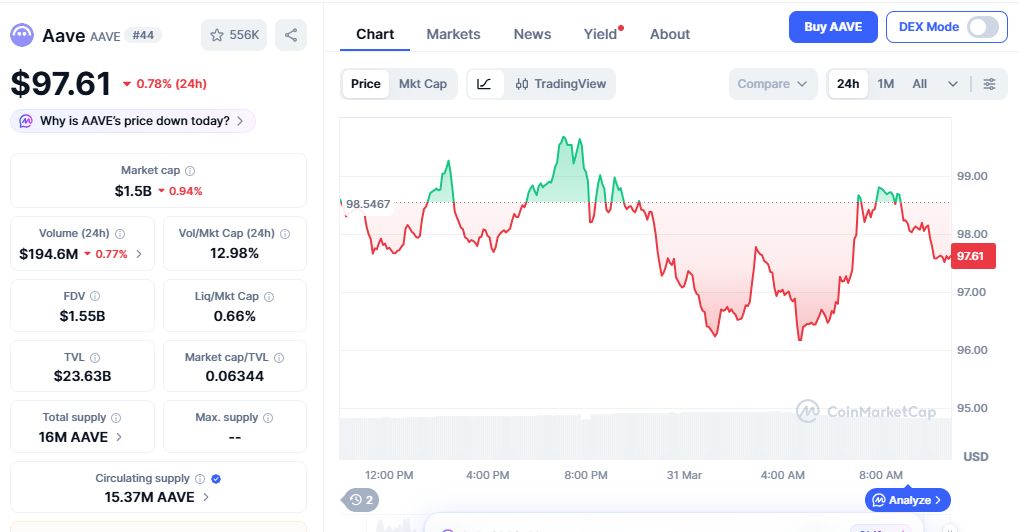 Source: CoinMarketCap AAVE price
That muted move is common after major protocol releases. Traders often wait for real usage data instead of reacting only to headlines. In the case of Aave V4, the next signals will likely come from capital flows, new market activity, supported assets, and the pace of future expansion.
Even so, the update improves Aave’s long-term market position. It gives the platform a clearer path into new credit categories while keeping its core strength in deep DeFi markets. If the rollout remains stable, Aave V4 could become one of the more important upgrades in Ethereum-based finance this year.
Future Outlook
The next stage for Aave V4 will depend on execution. Market participants will likely watch how the protocol handles risk, how quickly new spoke markets are added, and whether borrower demand grows across these new environments.
If adoption builds steadily, Aave V4 may help push DeFi credit toward more flexible and more specialized markets. That would support the broader trend of turning on-chain capital into usable financial infrastructure. For now, the upgrade gives the protocol a stronger framework, but the real test will be how that framework performs under live demand.
Your Money Your Life (YMYL) Disclaimer: Investing in crypto involves risk. This news is for educational purposes and is not financial advice. Always do your own research before using digital asset platforms.