Another US Government Shutdown Risk Rises Ahead of 2026 Deadline

Federal Reserve Rate Cuts Add Pressure Amid US Government Shutdown Ris
The risk of another US government shutdown is rising after American lawmakers left for the Christmas recess without settling major spending disagreements. The meeting in Washington ended without passing a budget deal or even agreeing on a voting framework.
Since no new funding bill or temporary extension has been approved, many non-essential government services could stop if talks fail before the January 31, 2026, deadline.

Source: Coin Bureau
With current government funding set to expire in January, and no new settlements happening, markets are again bracing for another political lockup just months after the longest one in history. This uncertainty also affects financial markets, including the already volatile crypto sector.
What Does the Current Scenario Reflect? Market Reactions
This situation is similar to the recent shutdown that started on October 1, 2025, and ended around November 12–13, lasting about 43 days, the longest in US history. That operational pause ended without fixing the main budget disputes, which raises the risk that the next funding talks could once again drag on until the last minute.
Prediction markets highlight how uncertain the situation remains. Kalshi is pricing in about a 43% chance of a shutdown, while major banks such as Goldman Sachs put the risk between 20% and 50%. Short shutdowns usually have a small economic impact, but longer ones often increase volatility across financial markets.
Economic Impact of a US Government Shutdown
Since the introduction of the shutdown rule in the early 1980s, there have been a total of about 21 disputes that resulted in either a partial or whole govt closure in the US. Most of these lasted only one to three days, but a few dragged on and caused major disruptions.
In general, an eventual service halt reduces the GDP growth rate by 0.05% to 0.2% in weekly terms because of delayed government spending and lost productivity because of furloughed workers. Although most lost output returns with the reopening, lost business due to such aspects as lost tourism will never be regained.
Prolonged government shutdowns also affect the dissemination of economic statistics, making economic policy-making more difficult, among other issues in social services such as food assistance. Economists note that shutdowns impact depend more on duration than political headlines.
Impact on Cryptocurrencies
The US Government Shutdown impact on crypto has been inconsistent. Bitcoin rose during the 2013-shutdown, fell modestly during the 2018–2019 episode, and showed mixed, volatile behavior during the 2025 govt closure. There is no clear historical correlation, as crypto performance largely depends on the broader market cycle and liquidity conditions.
Current Statics: The crypto market fell 1.16% in 24 hours, extending its 30-day decline to 4.75%. Bitcoin slipped 1.55% to $87.402, while Ethereum dropped 1.36% to $2,927.
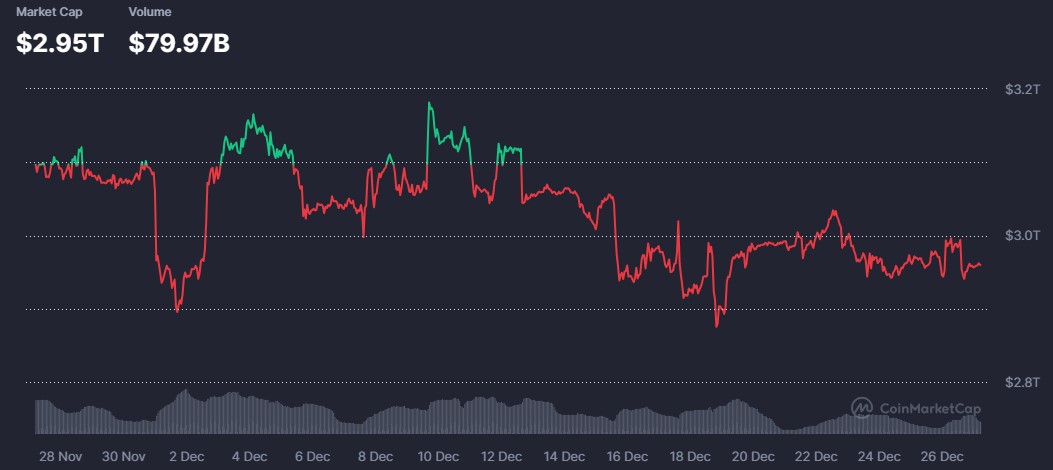
Source: CoinMarketCap Data
Recent data shows the market is underperforming and highly sensitive to new developments. However, some investors view crypto as a hedge during fiscal dysfunction, especially if shutdowns coincide with expectations of easier monetary policy.
What Comes Next? Fed Rate Decision in 2026
Federal reserve policy adds another layer of uncertainty. As of December 2025, the Fed has already cut interest rates three times, lowering the rate to 3.50%–3.75%. 2026 expecting more rate cuts, where official projections point to one additional cut, though markets are pricing in two to three cuts.
But another layer to the Govt stoppage could influence the outcomes. Shutdown-driven slow growth or data disruptions may force the central bank to act more aggressively, and hopes for quicker rate cuts could grow.
This may increase short-term swings in stocks and crypto, while helping assets that benefit from easier liquidity. In short, for investors, another US government shutdown could mean higher volatility across stocks, bonds, and crypto markets.
Also read:









