Arthur Hayes Says US Iran war and bond market stress may boost bitcoin


Why Arthur Hayes Says Oil Rally Could Trigger Crypto Bullish Cycle?
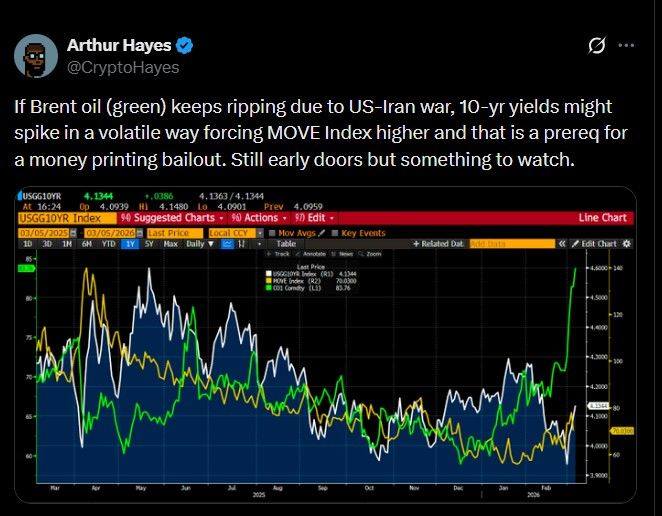
Crypto industry are watching macro signals closely after Arthur Hayes says rising oil prices tied to the US–Iran conflict could create financial stress that eventually forces central banks to inject liquidity into the global system.
In a recent comment, the BitMEX Co-founder explained that if Brent crude continues rising sharply, it could push U.S. bond yields higher while increasing volatility in the Treasury market. This stress would likely push the MOVE Index, which measures bond market turbulence, upward. According to Hayes, that type of instability is often a precursor to a monetary rescue, where authorities expand liquidity to stabilize markets.
Source: X Official
In simple terms, Hayes is signaling that geopolitical shocks could eventually trigger conditions that lead to large-scale monetary easing, a scenario historically favorable for risk assets, including Bitcoin.
How Oil Prices and Bond Yields Could Affect Crypto
Hayes’ theory is based on the chain reaction that higher energy prices can cause in global financial systems.
If oil keeps rising because of geopolitical conflict:
Inflation pressure increases across major economies
Government borrowing costs may jump as Treasury yields spike
When yields rise quickly, bond markets become unstable. That volatility is reflected in the MOVE Index, which acts as a stress indicator for interest-rate markets. If instability grows large enough, policymakers sometimes intervene through liquidity injections to calm industry.
Such actions can indirectly benefit digital assets. Liquidity expansions often push capital toward alternative stores of value such as Bitcoin, which investors increasingly treat as a hedge against monetary expansion.
Interestingly, this outlook appears while Arthur Hayes says macro indicators may be setting up conditions similar to previous periods when large stimulus programs helped push cryptocurrency Industry higher.
Fed Policy Outlook Adds Another Macro Layer
Another important macro signal is coming from the upcoming Federal Reserve meeting. Futures markets currently show about 97% probability that policymakers will not reduce borrowing costs in March, with only around 2.6% expecting a small 0.25% reduction.
Authorities remain cautious mainly because:
Inflation still sits above the 2% target
Economic growth and employment remain relatively strong
Maintaining higher borrowing costs keeps financial conditions tight, which is why investors are watching global events closely. If geopolitical tensions cause financial stress, it could eventually force a shift toward easier monetary policy — the type of environment Hayes believes could benefit digital assets.
Global Markets React to Escalating Conflict
Financial markets have already reacted strongly to the growing conflict. Analysts estimate U.S. equities have lost more than $2 trillion in value since February 2 amid rising geopolitical risk.
The conflict intensified after Operation Epic Fury began on February 28, when U.S. and Israeli forces targeted Iranian military leadership, missile infrastructure, and naval assets. The strike reportedly killed Iran’s Supreme Leader Ayatollah Ali Khamenei near Tehran.
Officials linked the operation to an alleged Iranian assassination plot against former President Donald Trump. Iran responded with ballistic missile strikes targeting Israeli and U.S. positions.
One strike near Minab reportedly destroyed a girls’ school, killing 160 to 175 young children, prompting strong concern from the United Nations and global observers.
Such developments have raised fears about wider regional instability and disruptions to global energy supply.
What This Could Mean for Bitcoin
If tensions continue pushing oil prices higher, macro volatility could increase across financial markets. Historically, extreme financial stress sometimes leads central banks to expand liquidity in order to stabilize systems.
That type of environment can encourage investors to seek alternative assets like Bitcoin. Since the cryptocurrency often sets the direction for the broader digital asset sector, a shift in macro liquidity could influence the entire ecosystem.
Conclusion:
While uncertainty remains high, Arthur Hayes says rising oil prices, bond market volatility, and geopolitical instability could eventually push policymakers toward liquidity injections. If that scenario unfolds, the resulting monetary expansion could create favorable conditions for Bitcoin and the wider cryptocurrency market.
This content is for informational purposes only and does not constitute financial or investment advice. Cryptocurrency and financial markets involve risk, and readers should conduct independent research before making investment decisions
Also read:








