Aster DEX Launches RWA Futures With Bonus Rewards


Aster DEX Launches Permissionless RWA Perpetuals
Have you seen a decentralized exchange quietly add real‑world asset futures without any gatekeepers? That is exactly what has just happened on it. The platform has gone live with five new token listings and RWA perpetuals, marking a clear shift toward open, permissionless listings. The move also comes with a neat little incentive that could push more traders through the door.
Source: X Account
Aster DEX Opens Permissionless Listing Door
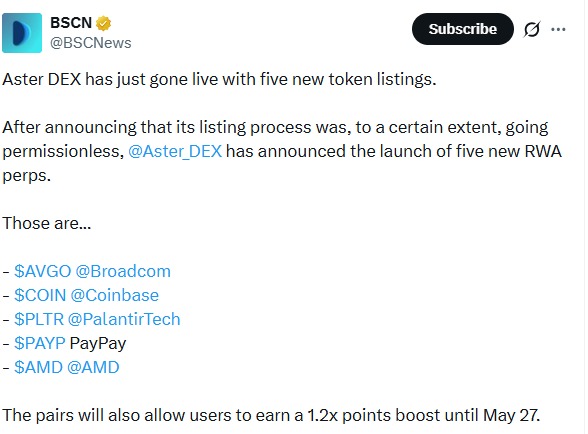
Earlier this week, Aster DEX announced that its listing process would be, to a certain extent, permissionless. This means the team is de‑emphasizing centralized approval and letting more projects and synthetics appear organically. The result is today’s launch of five new RWA perps. For traders, the change feels like a small policy shift, but the impact on order‑flow and liquidity could be real over time.
The five new RWA perpetuals are tied to mainstream real‑world assets, giving crypto users a more familiar way to express directional views. The pairs are:
$AVGO linked to Broadcom (AVGO)
$COIN linked to Coinbase (COIN)
$PLTR linked to Palantir Technologies (PLTR)
$PAYP linked to PayPal (PAYP)
$AMD linked to Advanced Micro Devices (AMD)
These are not just random tickers; they are liquid, recognizable companies from tech, payments, and AI, giving the new perps a natural anchor to the traditional markets. The pairs are live for trading, and users can now open longs or shorts on the price action of these stocks inside the Aster DEX interface.
1.2x Points Boost Until May 27
To make the launch stick, Aster DEX has added a short‑term incentive. Users trading the new perps will earn a 1.2x points boost on qualifying activity until May 27, 2026. The points system is typically used for airdrop claims, community rewards, or fee-reduction mechanics on many DeFi platforms, so the 1.2x bump is a clear way to lift on-chain activity without burning the house.
The boost is a classic “growth hack” strategy in the 2026 crypto playbook: pair a fresh product drop with a time‑bound reward. For traders, the window is small enough to matter. Two weeks is long enough to test strategies, but short enough to feel urgent. That kind of subtle pressure is exactly what drives spikes in TVL and trading volume on permissionless DEXs.
Why RWA Perps Matter on Aster DEX
Perpetuals on Aster DEX are not just toys. They let users express leveraged views on price without owning the underlying stock. The new RWA perps turn the DEX into a hybrid layer: it keeps the familiar DeFi feel while mirroring the risk‑reward profile of traditional stock futures. The four‑letter tickers (AVGO, COIN, PLTR, PAYP, AMD) are deliberate.
AVGO and AMD tap into the ongoing AI and semiconductor story.
COIN leans into the Coinbase‑ETF narrative that still influences crypto mood.
PLTR trades on data and government‑tech exposure.
PAYP sits squarely in the digital‑payments and fintech space.
By picking these names, It is giving traders a basket of macro‑linked assets under one DeFi‑style interface. That is the point of RWA perps in 2026: they are not just derivatives, they are on‑chain windows into real‑world risk.
Analysis and Future Outlook
The launch of five new perps and the move toward permissionless listings signal that Aster DEX is treating itself as an infrastructure layer, not just a trading venue. The platform’s approach—low‑friction exposure, short‑term points boosts, and clear tickers—could appeal to traders who already watch the Nasdaq but prefer on‑chain settlement.
If the 1.2x points program generates real activity, Aster DEX may double‑down on more RWA perps, from indices to commodities. The real test will be depth of liquidity and slippage around earnings events, where spot‑stock and futures markets often move the most. For now, the launch is a quiet but meaningful step in the ongoing RWA‑DeFi crossover story.
YMYL Disclaimer: Cryptocurrency and derivative trading carry high risk, including total loss of capital. The RWA perps on Aster DEX are speculative instruments and are not suitable for all investors. Always understand the fees, leverage, and counterparty risks before trading.
Also read:








