17 Lawmakers Agreed on Something Rare: Locking Up Bitcoin Until 2046


Congress Just Voted to Never Sell US Bitcoin: Here's What It Means
The American Reserve Modernization Act would make the U.S. Treasury the official keeper of federal Bitcoin and ban any sale for two decades. But what does that actually mean for you?
On May 21, 2026, two U.S. lawmakers introduced a landmark Bitcoin reserve bill. It's called ARMA. If it passes, the U.S. government won't sell a single Bitcoins for at least 20 years. And the ripple effects could change how the entire world treats BTCs as money.
A Bipartisan Push Nobody Saw Coming
Republican Nick Begich of Alaska and Democrat Jared Golden of Maine introduced ARMA together. ARMA is not yet law; it still needs to pass both chambers. But Bipartisan supports 17 co-sponsors, and a clear framework makes it serious. That bipartisan support is rare in today's Congress. The bill launched with 17 co-sponsors from both parties.
The goal is simple. Create a Strategic Bitcoin Reserve inside the U.S. Treasury Department. Think of it as a national savings account — but in crypto. No spending it. No selling it. Just holding it for the long term. The bill also creates a separate Digital Asset Stockpile for other government-held cryptocurrencies that aren't BTC.
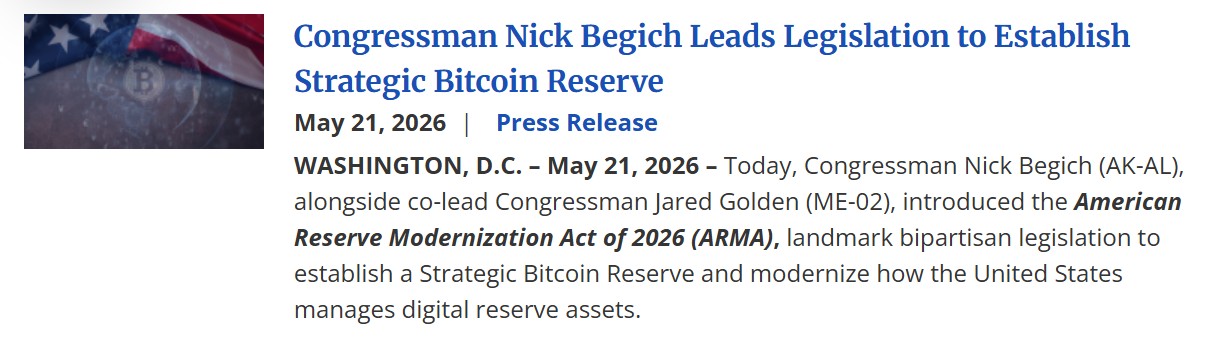
Source: Official Press Release
What ARMA Actually Does?
Right now, under the American Reserve Modernization Act (ARMA), the U.S. government holds Bitcoins. It gets it through criminal seizures and court-ordered forfeitures. But there's no rule about what happens next. Past administrations simply auctioned it off. ARMA changes that permanently. Here's what the bill requires:
All federal agencies must report every piece of crypto they hold, then transfer it to the Treasury.
BTC in the reserve can't be sold for at least 20 years — except to reduce the national debt.
The government must publish quarterly "Proof of Reserve" reports so the public can verify what's held.
Independent third-party auditors will review the books regularly.
Congress gets direct oversight of the entire reserve system.
A study will explore growing the reserve without raising taxes or adding to the $39 trillion national debt.
The bill also protects your rights directly. It states clearly: the federal government cannot block Americans from owning, moving, or self-custodying digital assets. Self-custody means holding Bitcoins in your own wallet — not on an exchange.
Why a 20-Year Lock Changes Everything?
When a government commits to not selling an asset for two decades, markets pay attention. It removes what traders call "sell pressure" — the risk that a massive seller dumps coins and crashes the price.
The U.S. is already one of the largest BTC holders in the world. Locking that up by law sends a clear signal to every other country: America treats BTC as a serious reserve asset, not a budget item.
"Bitcoin is the digital equivalent of gold." — Rep. Pat Harrigan (NC-10)
This bill also builds directly on President Trump's March 2025 executive order, which first directed the government to explore a reserve. ARMA turns that idea into actual law — far harder to reverse.

Source: Cryptorover X
What This Means for Everyday Investors
If you hold crypto — or you're thinking about it — this matters. A government-backed reserves signals legitimacy. It shifts from "speculative bet" toward "recognized store of value." The bill explicitly limits any future Bitcoin investment or sales to debt reduction only, not day-to-day spending.
The Bottom Line
ARMA still needs to pass both chambers of Congress to become law. But bipartisan backing and 17 co-sponsors make it serious. If passed, it would be the most significant U.S. BTC legislation ever signed. The digital financial race is real. And Congress just officially joined it.
Investment Disclaimer: This article is for informational purposes only and does not constitute financial or investment advice. Cryptocurrency markets are volatile. Please do your own research before making any investment decisions. All information is based on publicly available press releases as of May 22, 2026. Legislative outcomes may change. Verify details through official government sources before acting on any information.







