Backpack Tokenomics Revealed Ahead of TGE and $1B Funding Talks

Backpack Tokenomics Structure Highlights User Rewards and IPO Lockups
Backpack tokenomics have been officially unveiled, giving the crypto market a clear look at how the upcoming Backpack TGE will work. Backpack Exchange, a centralized trading platform built by former FTX and Alameda executives, is positioning itself as a compliance-first, Solana-native CEX with long-term ambitions, including a potential U.S. IPO.
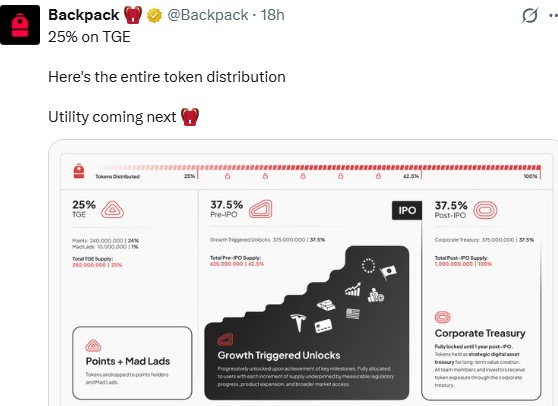
The total supply under the tokenomics model is fixed at 1 billion tokens. Out of this, 25% of the supply will be released at TGE, while the remaining tokens are locked under strict, milestone-based rules. This approach signals that the project is prioritizing controlled growth over quick speculation.
Backpack Tokenomics Breakdown and TGE Allocation
The tokenomics structure is designed to favor users rather than insiders. At launch, 250 million tokens (25%) will enter circulation.
Source: X (formerly Twittet)
Here is how the TGE allocation is structured:
240 million tokens (24%) allocated to points holders
10 million tokens (1%) reserved for Mad Lads NFT holders
There will be no team tokens to be unlocked, which means the founders, employees, and early investors will not be able to receive the tokens as long as the IPO or exit happens one year or more into the future as per the coins created by the model.
Growth-Linked Unlocks and Post IPO Treasury Plan
One of the major highlights in the Backpack tokenomics is that there is an allocation of 37.5% reserved for pre-IPO investors, which they can only enjoy after meeting certain growth milestones.
Another 37.5% of the supply is allocated to the post-IPO corporate treasury. These tokens remain fully locked until one year after an IPO and are intended to support long-term operations rather than short-term market activity.
This structure makes the tokenomics one of the most restrictive and user-focused models currently seen in the CEX space.
Backpack Exchange Funding and Regulatory Position
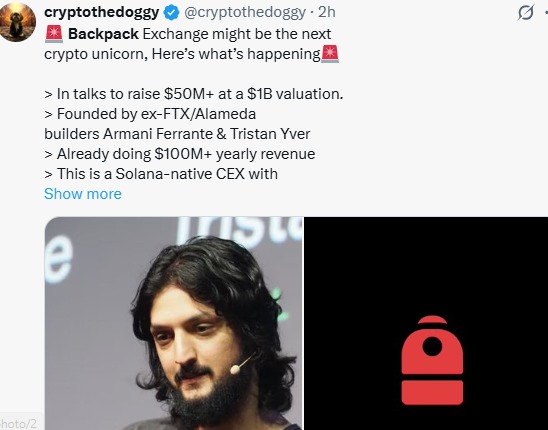
Backpack Exchange is reportedly in talks to raise $50 million or more at a $1 billion pre-money valuation, according to Axios. The company has already raised $17 million in 2024 and is said to generate over $100 million in annual revenue.
Source: X (formerly Twitter)
On the regulatory side, the Exchange is licensed in Dubai, holds MiFID II approval for derivatives in the EU, and has plans for U.S. market entry. It also aims to become the first centralized exchange to offer equities on-chain.
Token Utility and RWA Expansion
Utility under tokenomics is expected to roll out after TGE. The platform already supports self-custody wallets, perpetual trading, and xNFTs. It has also partnered with Superstate to bring tokenized stocks like AAPL and TSLA to Solana.
This RWA focus could play a major role in long-term demand for the token.
Backpack Token Price Prediction
Based on tokenomics, only 25% supply will be liquid at TGE, which may support price stability. If the fully diluted valuation targets $1 billion, a reasonable TGE price range could be $0.20–$0.35.
In the short term, volatility can be expected. In the medium term, exchange growth, regulatory progress, and clarity on IPO would be factors influencing price.
Conclusion
Tokenomics for backpacks highlight a notable trend of slow, regulated, and user-centric growth. With strict unlock schedules, incentives tied to an IPO, and more real-world asset support, this is intent on being taken as a serious project, not just a hype-led launch. Of course, only time will tell, not promises made.
YMYL Disclaimer: This content is for informational purposes only, not financial advice. Crypto investments are risky always research before investing.









