Bitcoin Mining Difficulty Hits All-Time High in 2026


Bitcoin Mining Profitability After the 2024 Halving
Not every miner survived this pressure.
Miners running hardware above approximately 25 joules per terahash found themselves operating at a loss in most electricity markets after the halving. The efficiency gap in Bitcoin mining
The shift from 98 J/TH to sub-15 J/TH over eight years represents roughly a 7x improvement in energy efficiency. Today's best machines —like the Antminer S21 XP at 13.5 J/TH—produce the same output as seven older rigs using the same power.
Large pools like Foundry USA and F2Pool continue to dominate the global hashrate. Smaller operations are pooling together or moving to cloud just to stay viable. Companies like MARA and CleanSpark have responded by reinvesting in infrastructure and choosing not to sell their mined.
The landscape is consolidating fast. Industrial-scale operators with cheap electricity and next-gen ASICs are pulling further ahead.
Current price: $78,203.48
Market cap: $1.56T
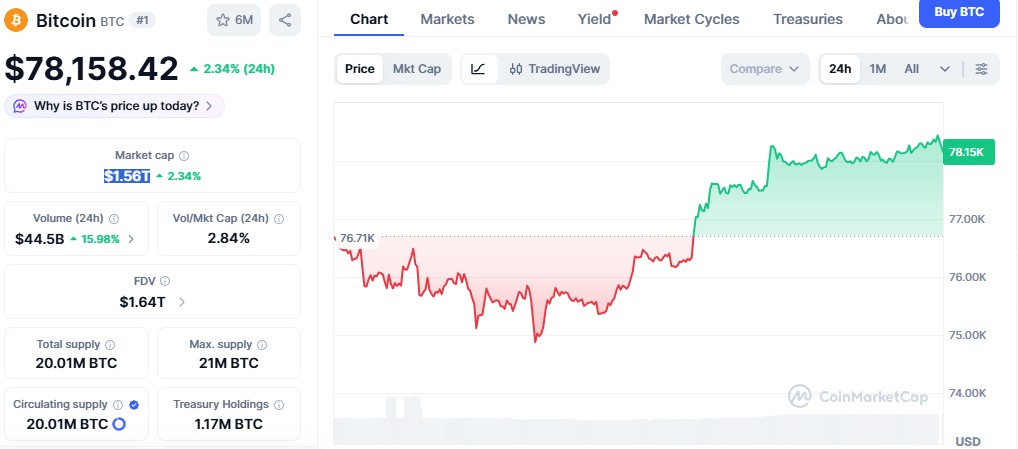
Source: Coinmarket cap
Bitcoin Profitability After the 2024 Halving
Here is the uncomfortable truth about Bitcoin right now.
Hash price—daily revenue per unit of computing power—collapsed 66% since BTC's October 2025 peak. Miners earn half the bitcoin per block after the April 2024 halving, and each is worth roughly half what it was at the top.
JPMorgan estimated the average industry production cost at $77,000 per BTC. The most efficient miners with sub-$0.05/kWh power and the latest ASICs can produce BTC for $34,000–$43,000. Everyone else is underwater.
Daily revenue dropped to yearly lows of $28 million in late January 2026, with the profitability index at 14-month lows.
Yet Bitcoin mining continues. Why? Because surviving miners know the difficulty adjustment works in their favor. When weak miners exit, difficulty drops, and margins recover for those who remain.
Expert Analysis: What Mining Data Signals Next
The February 2026 difficulty spike is not just a technical milestone. It is a market signal.
Every previous time BTC traded below its cost of production, a specific five-phase sequence followed, ending in price recovery once miner capitulation completed. Phemex: The February spike to 144.4T suggests surviving miners have rebuilt capacity—placing the network firmly in Phase 4 of that cycle.
companies are also repurposing data center infrastructure for AI. Bitfarms dropped "bitcoin" from its corporate name. Riot Platforms faces activist pressure to expand AI operations. Phemex: The economics make sense—AI hosting currently generates more revenue per megawatt than bitcoin mining in some markets.
Bitcoin hit a record $122,000 in July 2025. At that price, earned over $380,000 per block despite the halving. Price remains the single most important variable in profitability—and the difficulty data suggests the network is healthier than the revenue numbers alone imply.
The next difficulty adjustment will reveal whether this record level holds—or whether the market forces another reset.
Conclusion
Bitcoin in 2026 is a game of efficiency, endurance, and timing. Difficulty hit an all-time high. Hashrate crossed 1 ZH/s. Rewards halved. Yet the network kept growing. The miners who survive this pressure are the ones who will shape BTC's next chapter—and the difficulty chart is telling you exactly where they stand.
Disclaimer: This article is for informational purposes only — not financial advice. Always do your own research before making any investment decisions.








