EigenLayer News: $15B TVL Surge After 96 ETH Rule Change

EigenLayer News: TVL Crosses $15B After Major Restaking Update
EigenLayer News: Why the 96 ETH Shift Matters?
Could one rule change turn a busy Ethereum project into one of crypto’s biggest capital stories? That is the core of this EigenLayer news update. After lifting its caps, it moved past $15 billion in total value locked, or TVL. The jump came soon after its April 9 launch, when actively validated services, known as AVSs, started going live. That gave the market a new reason to watch a project that had already built strong attention before launch.
TVL Jump Followed a Clear Trigger
The latest EigenLayer news did not come from hype alone. The major trigger was simple: the platform lifted its caps. That allowed more native ether and liquid staked ether to enter the system. It lets users stake ETH, then restake that same capital to help secure other protocols. That is why the project’s restaking model drew so much attention once the launch became active.
Source: X official
For readers tracking EigenLayer TVL, timing is the key detail. The launch did more than mark a start date. It allowed AVSs to begin operating in a live setting. That made the project feel less like a future promise and more like working infrastructure. In crypto, capital often waits for that shift.
The 96 ETH Cut Changed Access
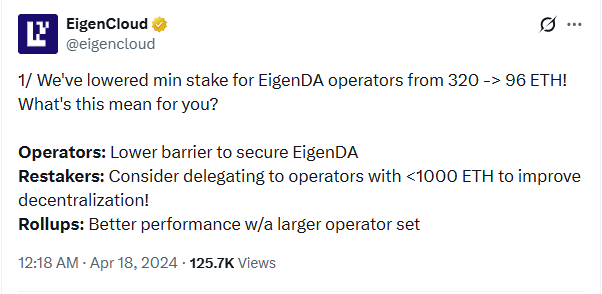
Another major part of it came from EigenDA. The project lowered the minimum stake for operators on its data availability layer from 320 ETH to 96 ETH. That is a sharp cut. It does not make the role cheap or simple, but it does lower the entry bar in a clear way. In markets, access changes can shape participation as much as price moves do.
This also gave the operator layer a more practical story. A lower threshold can help widen participation, while live AVSs give operators a clearer purpose. That is why this EigenLayer news cycle stood out. It was not only about locked value. It was also about what that value could support across Ethereum.
Six AVSs Added More Weight
After the update, EigenLayer EIGEN launched six AVSs: AltLayer, Brevis, Eoracle, Lagrange, WitnessChain, and Xterio. That added depth to the post-launch story. Instead of one headline about deposits, the market got a broader view of service rollout. This is where it became more than a TVL story.
The project also drew cloud divisions from Google, Coinbase, and HashKey as protocol operators. That does not end the debate over long-term value, but it does show that large infrastructure names were willing to engage. Founder Sreeram Kannan summed up the idea on X by saying more ETH used as collateral can strengthen ETH as a risk asset for economic security.
Expert Analysis: What Comes Next?
This EigenLayer news phase matters because it brought together fresh capital, live services, and lower operator requirements. That mix is stronger than buzz alone. The deeper question now is whether live services can keep growing at the same pace as deposits.
Conclusion
This story is not just about TVL crossing $15 billion. It is about timing, access, and live use. Caps were lifted. AVSs went live. Operator rules changed. Together, those steps turned EigenLayer news into a sharper market signal for Ethereum watchers.
Disclaimer: This content is for information only, not financial advice. Always do your own research before making any crypto decision.









