Bitcoin Mining Could Move to Space as Starcloud Tests Orbital Rigs


Bitcoin Mining Industry Expands While Profitability Remains Tight
A U.S. startup has sparked fresh discussion in the crypto industry after revealing plans to experiment with Bitcoin mining in space.
Starcloud, a small aerospace and computing startup, says it plans to launch a satellite with Bitcoin mining hardware later this year, potentially as part of its growing space infrastructure project, becoming the first company to test production operations in orbit.

The announcement came from Starcloud CEO Philip Johnston during an interview on the HyperChange YouTube channel. While the company is currently mainly building orbital data centers, Johnston confirmed that BTC creation machines will also be part of upcoming missions.
Why Is the Company Sure About the Experiment?
The move follows Starcloud’s earlier test where it successfully ran a high-performance Nvidia H100 GPU in orbit. The experiment showed that powerful computing infrastructure can operate outside Earth, opening the door for new applications.
Because of this success, the company now believes Bitcoin mining could also function in space-based data centers.
Johnston later wrote on X that “the cat is out of the bag,” claiming Starcloud aims to become the first company to conduct block creation directly from space.
What’s Driving the Idea? Challenges of BTC Mining on Earth
Bitcoin mining is the process of creating new bitcoins and confirming transactions on the Bitcoin network.
When people send Bitcoin, the transactions must be confirmed. Miners use powerful computers to solve complex math problems, and the first to solve it adds a group of transactions (a block) to the blockchain. In return, the miner earns new bitcoins and transaction fees, helping keep the network secure.
However, the systems used by miners, called ASIC miners that are designed only for solving complex math problems, are expensive to buy and consume a huge amount of electricity. In addition, it needs cooling systems, proper space, and maintenance to keep running without overheating.
How Starcloud’s Idea Wins: BTC Mining Space Infrastructure
Energy is at the center of Starcloud’s long-term vision for the network processing, believing space could offer major advantages in energy. Satellites in orbit can access nearly constant solar power, which may provide a cleaner and potentially cheaper power source compared to Earth-based processing farms.
The process currently consumes roughly 20 gigawatts of electricity globally, according to industry estimates. Johnston believes some of that computing demand could eventually shift off the planet.
Another reason the idea is appealing is hardware cost. Compared with enterprise AI GPUs like Nvidia’s H100—often priced above $30,000+, Bitcoin mining machines usually cost between a few hundred and several thousand dollars.
That makes them a relatively low-risk test for space-based computing infrastructure.
The Concept Still Faces Technical Hurdles
Even with potential energy benefits, several major technical challenges still remain.
Cooling hardware in space is difficult because there is no air to dissipate heat, meaning satellites must rely on large radiators. Radiation from cosmic rays can also damage electronics, and network latency could cause space-based miners to receive blockchain updates slower than Earth-based competitors.
Mining Industry in 2026: Is BTC Price Influencing the Sector?
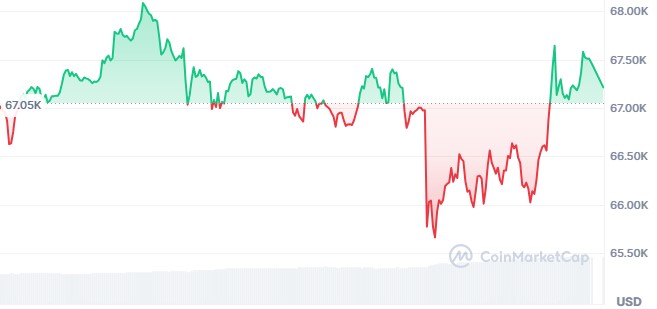
Bitcoin price is frequently facing downturns and taking support at many key levels. At the time of writing, the coin is trading near $67,439, down 4.7% monthly and 21.65% yearly. Since its ATH in 2025, the asset has struggled to hold back, even on supporting levels, resulting in millions of liquidations. However, long-term confidence still persists among investors.
The Bitcoin mining sector, on other hand, remains affected by it but still firmly grounded among people. The network hash rate is around 1 ZH/s (about 978–1,029 EH/s), close to all-time highs, showing that the network is becoming bigger and more secure. However, profitability remains tight after the 2024 BTC halving, reduced reward to 3.125 BTC.
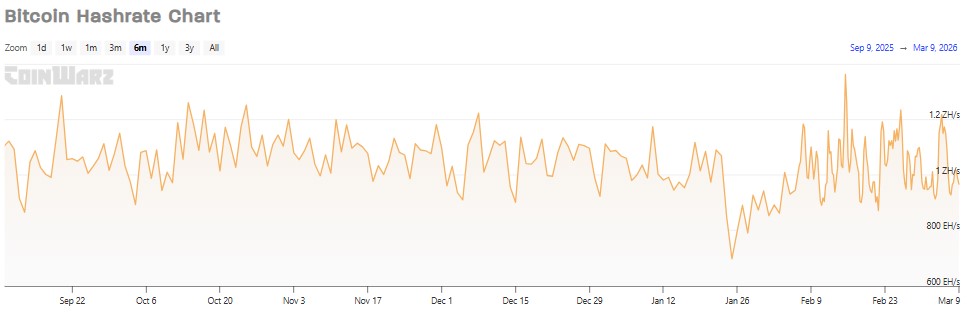
Source: Coin Warz
Here, large industrial miners such as Marathon Digital, Riot Platforms, and Iris Energy, control a major share of the network’s computing power, while the U.S. leads globally, with 37–40% of total hash rate, followed by Russia and other regions.
At Last
For now, Starcloud’s project is viewed mainly as an experimental proof of concept.
Still, if the company succeeds, Bitcoin mining in space could open the door to a completely new frontier for the cryptocurrency industry, one powered by solar energy beyond Earth.
Also read:









