Bitcoin Quantum-Resistant Wallet Rescue Tool Prototype Revealed


How the New Bitcoin Quantum-Resistant Wallet Tool Works
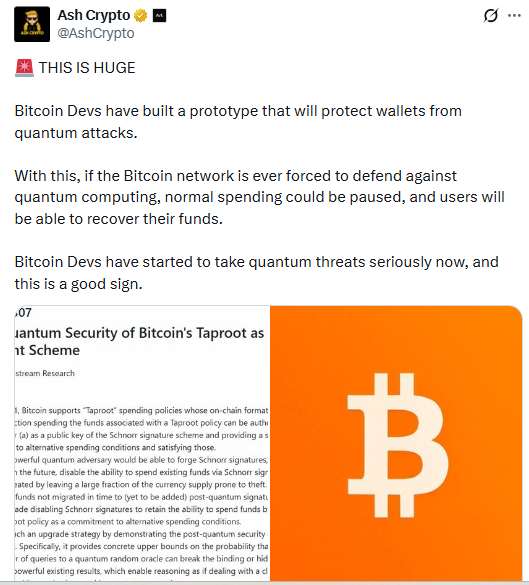
Can BTC protect itself from a quantum attack without locking ordinary users out of their funds? This question now has a more practical answer. Lightning Labs CTO, Olaoluwa Osuntokun, posted a working Bitcoin Quantum-Resistant Wallet prototype to the Bitcoin's Developer Mailing List on April 8. This news is important because it ties into the broader conversation on how BTC can secure itself against future quantum risks. One proposal, BIP-360, is already being discussed as a way to make BTC more quantum-resistant. Osuntokun’s new prototype adds another layer to the solution.
 Source: X(formerly Twitter)
Bitcoin Quantum-Resistant Wallet Rescue Plan Emerges
BTC developers have been trying to solve a major problem for years. If quantum computers can break Bitcoin’s encryption, BTC will need an upgrade to disable the current spending system. While this could protect the network, it could also lock users out of their funds. Modern wallets, like those based on BIP-86 and Taproot, rely on this encryption, making them vulnerable.
Osuntokun’s new prototype solves this problem. His system uses zk-STARK proofs, a type of zero-knowledge proof. This proof shows that a wallet key was created using BIP-32 seed material and follows the BIP-86 path. This allows users to prove they own a wallet without revealing their private key. This is an improvement over earlier designs, which exposed the BIP-32 seed and risked compromising other wallets derived from it.
Why Bitcoin Quantum-Resistant Wallet Matters Now
To understand why this new prototype is important, let's look at BIP-360. This proposal suggests a solution called Pay-to-Merkle-Root (P2MR), which removes the vulnerable key path. This makes BTC more resistant to quantum threats. But the problem is that not all users will be able to switch to this new system in time. This is where the Bitcoin Quantum-Resistant Wallet prototype comes in. It provides a rescue path for users who might miss the migration deadline.
The prototype is not just an idea; it works in practice. Osuntokun tested it on a consumer MacBook, and the model generated a 1.7 MB proof in about 55 seconds. It verified the proof in under two seconds, showing that it could work efficiently in real-world situations.
Bitcoin Quantum-Resistant Wallet and Market Context
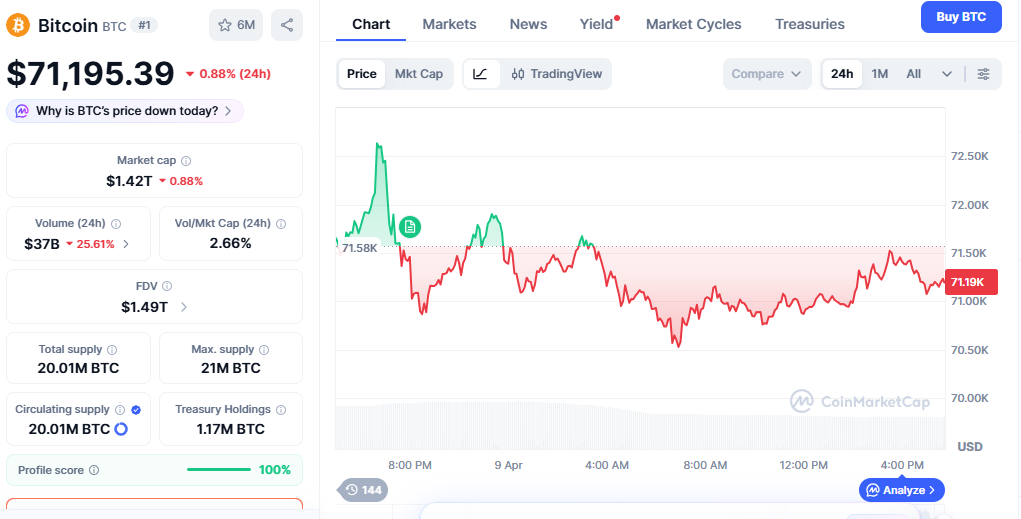
For most traders, this is more about Bitcoin's long-term security than short-term price movements. As of April 9, BTC was trading around $71,195. While the price is stable, the real focus is on the ongoing technical debate over how to protect BTC from quantum attacks. The Bitcoin Quantum-Resistant Wallet prototype has not yet been added to Bitcoin’s main code. BIP-360 is still a draft, and there is no clear timeline for implementation.
 Source: CoinMarketCap Data
Future Outlook
The prototype changes the conversation. Developers now have a working example of how BTC could defend itself against quantum risks. This is no longer just a theoretical idea; it’s something that can be tested and improved. If quantum threats become a real concern in the future, tools like this could help this digital asset avoid locking users out of their funds while still protecting the network.
YMYL Disclaimer: This article is for informational purposes only. It is not financial, legal, tax, or cybersecurity advice. Crypto protocol changes and market conditions can shift quickly, so readers should review primary sources before making financial or technical decisions.
Also read:









