Google Quantum Warning: Bitcoin Encryption Could Fall in 9 Minutes


How the Google Quantum Warning Redefines Blockchain Safety
The world of digital money just received a major wake-up call. A new Google Quantum Warning suggests that the math protecting your Bitcoin and Ethereum wallets might be easier to break than we thought. For a long time, experts believed it would take millions of special bits (qubits) to hack into a crypto account. However, new research from the search giant's AI team shows that a computer with fewer than 500,000 physical qubits could do the job in a very short time.
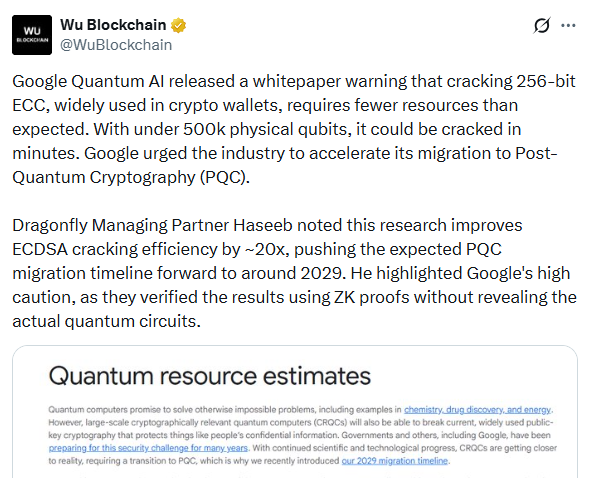 Source: X(formerly Twitter)
Breaking Bitcoin in Under Ten Minutes
This Google Quantum Warning describes a very fast type of attack. When you send Bitcoin to someone, your "public key" is briefly visible on the network. A powerful high-speed computer could use that short window to find your "private key" and steal your funds before the network even finishes the transfer.
According to the study, this final step could take only nine minutes. Since Bitcoin usually takes about ten minutes to confirm a transaction, a hacker would have a 41% chance of winning the race. This changes the risk from a distant, future problem to a real engineering challenge that needs to be fixed soon.
Why Taproot and Exposed Keys Increase the Risk
The Google Quantum Warning also points out some issues with Bitcoin’s recent Taproot upgrade. While Taproot made the network faster and more private, it also makes public keys visible by default. This gives advanced computers exactly what they need to start an attack.
Right now, about 6.9 million BTC which is one-third of all the coins in existence are in wallets where the public key is already exposed. This includes:
Coins from the very early days of Bitcoin.
Wallets that have been used many times before.
Newer wallets that use the default settings of the Taproot system.
The Move to Post-Quantum Safety by 2029
While next-generation computers are not strong enough to do this today, they are improving quickly. The search giant believes that by 2029, we will see quantum systems powerful enough to be a threat. Because of this, the Google Quantum Warning urges the crypto community to switch to "Post-Quantum Cryptography" (PQC). These are new security methods built to resist even the strongest automated attacks.
Expert Analysis: A Much Faster Threat
The data from search engine shows that the efficiency of these attacks has improved by about 20 times.
Future Outlook
By using better math and error correction, researchers have lowered the barrier for cryptographic hacking. Google's own "Willow" chip has shown that these machines are scaling up fast. For people building blockchain tech, the year 2029 is now a hard deadline. Bitcoin and Ethereum are huge networks, and changing their security will take a long time. As this Google Quantum Warning proves, we no longer have the luxury of waiting until the next decade to act.
Your Money Your Life (YMYL) Disclaimer: Google Quantum Warning represents a significant long-term risk to digital assets. This report is for educational purposes and is not financial advice. Always monitor the security updates and migration plans of the blockchain networks you use.






