Celia Token Listing Date Next? March 30 Burn And Liquidity Plan Reveal


Celia Token Listing Date Seek Clarity As March 30 Token Burn Event Set
The project announced a March 30 token burn of unclaimed tokens, followed by a liquidity injection. The update also covers mainnet migration progress, Celia Token Listing Date, cNGN stablecoin integration, ecosystem growth, and community reactions.
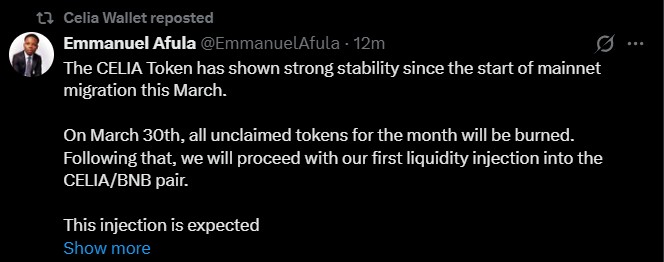
March 30 Event: Token Burn to Reshape Supply
As part of a significant Celia Wallet update, the team has verified that all unclaimed tokens of March will be burnt forever on March 30, 2026. This relocation has a direct effect on circulating supply and is part of the overall plan after the CELIA mainnet launch date at the beginning of this month.
The burn mechanism is linked to the Celia token claim process, which makes sure that only actively claimed tokens are in circulation. These deflationary measures are commonly perceived to be bullish, particularly in the early stages of ecosystem development. Nonetheless, the burn timeline shift (3/29 to 3/30) has elicited mixed feelings with some users requiring more clarity on the execution timelines.
Source: Official X
Liquidity Injection Above Presale: A Strategic Price Move
It will proceed to inject its initial liquidity in the trading pair on Binance Smart Chain immediately after the burn.
It is worth noting that the team has reported that the Celia listing Price will be higher than the pre-sale price of more than $0.20. This places the project highly in front of the estimated listing date and is an indicator of confidence in the long-term growth.
This liquidity action is essential to facilitate the trading and facilitate Celia Wallet Withdrawal functionality, which the users have been waiting for a long time to have.
Source: X
CELIA Token Price Today and Market Position
At present, according to initial trading signals and community values, the price today is around $0.000046, with a micro-cap value of approximately $46K.
This stark difference between the unofficial price of today and the anticipated Celia listing date and price (> $0.20) brings out the transition period between mining and migration and the open market trading. The disconnection also justifies the increasing speculation in the price of and the volatility that may occur on listing.
Celia Token Price Prediction: What Lies Ahead?
According to the existing market realities and fundamentals of the project, the price forecast may be considered in phases:
Short-term (Post-listing): There will be volatility of between $0.05 and $0.25 because of liquidity changes.
Mid-term (3-6 months): Stabilization in case of adoption and utilities increase.
Long-term: Could be profitable in the long run in case of the ecosystem utility, staking, and user base growth.
The future valuation will greatly depend on the success of mining, staking, and real-world payments.
cNGN Integration: Expanding Real-World Utility
To further expand the ecosystem, the Wallet has stated that it would integrate cNGN, which is a Naira-pegged stablecoin. This will enable the users to make transactions with local currency equivalents in addition to USDT, USDC, and BUSD.
Users can pay with services, and transaction costs will be in BNB or utility, and adoption will be increased, particularly in African markets. This action reinforces as a Web2 Web3 financial system bridge.
Ecosystem Growth & Community Sentiment
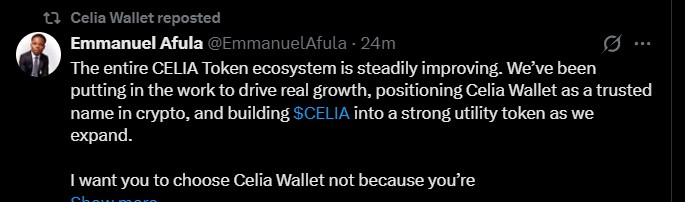
The statements by Emmanuel Afula indicate that the project is aimed at creating actual utility and not short-term hype. The team urges the users to think long-term despite the opportunities of taking profits. There is also a mixed reaction from the community:
Bullish users view good fundamentals and future listings.
The skeptics require transparency on the size of liquidity and the start of trading.
This is a normal transition period before the official launch.
Final Outlook: Early-Stage but High Potential
It is at a critical stage with the Celia listing date drawing near. The three elements of the token burn, liquidity injection, and integration of the stablecoins indicate a maturing ecosystem.
Although there are risks associated with the volatility in the early stages, the systematic implementation of the project and use-based model can serve to ensure sustainability in the long-term.
At this point, everyone is watching March 30, the day when the project will become a name in the history of the transition of a mining into a trading asset.
Disclaimer: This is not financial advice. Do your own research and invest. CoinGabbar does not cause any financial losses. Cryptocurrencies are extremely unstable, and you can lose all of your money.







