$900K Crypto Fraud: Four Accused of Laundering Funds


U.S. Indicts Four in North Korea-Linked Crypto Fraud Case
In North Korea, there is a case, recently reported that the four people of Democratic Republic of Korea had been indicted for stealing $900,000 in the form of digital currency or known as Crypto Fraud, had been indicted in the United States.
The accused-Kim Kwang Jin, Kang Tae Bok, Jong Pong Ju and Chang Nam ||-- allegedly posed as remote IT workers to infiltrate US and international tech companies, ultimately siphoning funds to help finance the North Korean regime’s spotlight on the growing use of cyber-enabled fraud by North Korea to bypass sanctions and generate foreign revenue.
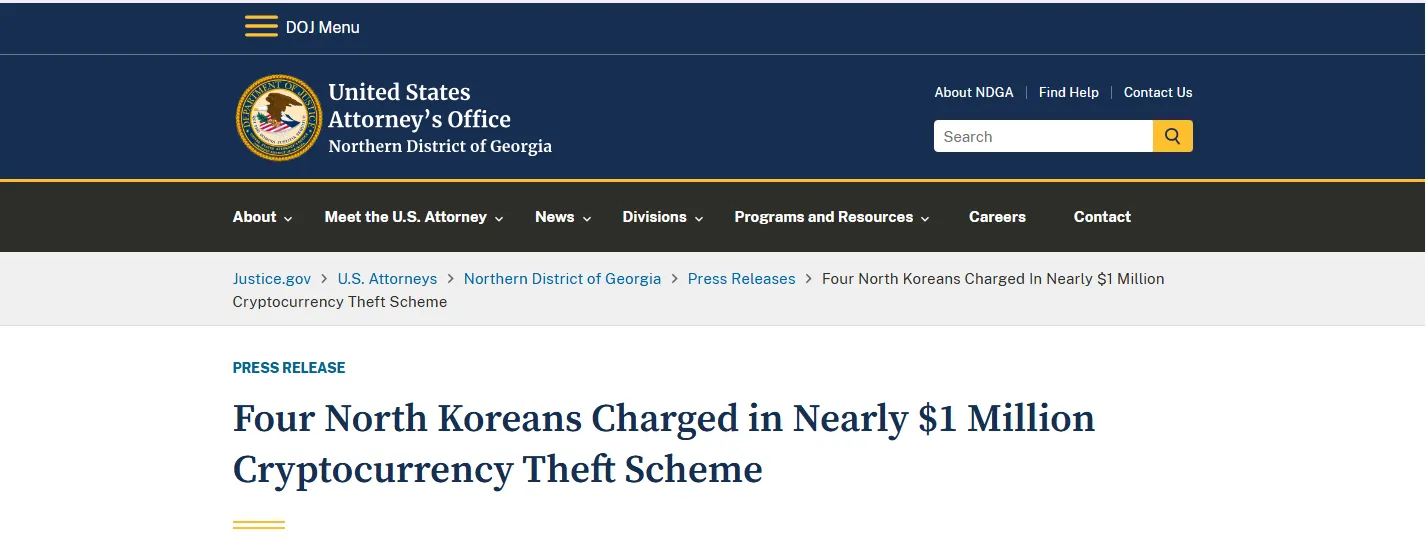
Source: Attorney’s Office
How the Scheme Unfold: Infiltrating Through Remote Work
According to federal prosecutors, this fraud scheme began in 2019, when the four men entered the UAE using North Korean Documents. Disguised with fake and stolen identities, they secure remote developer jobs at a blockchain firm in Atlanta and a Serbian virtual token company.
The man who used the stolen identities to take the citizenship of US is Kim Kwang Jin, while the second man Jong Pong Ju firstly known by Bryan Cho and later after that Peter Xiao– who turned out to be Chang Nam || which is hired on the recommendation of Jong. The companies were completely unaware they had hired North Korean nationals.
The Thefts: Exploiting Trust for Millions in Crypto
Once inside, the operatives earned trust and gained access to sensitive blockchain infrastructure. Jong Pong Pu stole $175,000 in digital assets, after a month later, Kim Kwang Jin manipulated him with smart contracts code to extract an additional $740,000.
These coordinated thefts are a textbook case of crypto fraud, where trusted access is abused to reroute virtual assets to illicit accounts under the regime’s control.
The Laundering Operation: Hiding Crypto Tails
To obscure the stolen funds, the team used a virtual currency mixer– a stool often employed by cybercriminals to anonymize digital transactions. Funds were then transferred to accounts that were under control of Kang Tae Bok and Chang Nam|| accounts were opened from fake Malaysian IDs under aliases.
This laundering process represents another layer of crypto fraud, in which stolen digital assets are processed through fake identities and false documentation to bypass financial scrutiny.
US Authorities Respond: “A threat to National and Cyber Security”
US authorities were quick to condemn the actions. US attorney Theodore S. Hertzberg said the scheme”exploits the trust of American companies” and warned that crypto fraud poses a serious risk to9 businesses embracing remote work.
Assistant Attorney General John A. Eisenberg noted that such schemes are ‘designed to evade sanctions and directly fund North Korea’s weapons programs.” FBI special agent Paul Brown added that the operators used “false identities to penetrate companies and stole the digital assets to fund their regime” in the form of Crypto Fraud.
A Wider Effort: Part of DOJ’s ‘DPRK ReVGen’ initiatives
The indictment is part of the DOJ's broader DPRK RevGen: Domestic Enabler Initiative, launched in March 2024. This initiative focuses on dismantling crypto fraud and cyber- enabled revenue generation networks by targeting both-foreign operatives and their domestic enablers.
Assistants US Attorneys Samir Kaushal and Alex R. Sistla, along with Trial Attorney Jacques Singer-Emery, are leading the prosecution with support from FBI cyber and counterintelligence teams.
What Happens Next?
The four individuals were indicted on June 24, 2025, and are presumed innocent until proven guilty. However, their story serves as a warning to tech firms worldwide. Crypto Fraud Demonstrates how hostile regimes were exploiting digital ecosystems and the remote work culture, structures to fund sanctioned activities.
As the industry expands, companies are urged to vet remote workers thoroughly and monitor unusual activity in the Blockchain ecosystems.
This case is a reminder, behind anonymous avatars and online job applications, there may be actors with far more sinister goals than just earning a paycheck.






