Dormant Ethereum Wallets Exploit: $800K Drained as Bitmine Bets Big

Ethereum Wallet Exploit Drains Dormant Funds as Bitmine Boosts Staking
Ethereum faces a dual narrative this week. A suspected exploit drained hundreds of inactive wallets. At the same time, Bitmine increased its staking position. The events highlight both security risks and rising institutional interest in ETH.
Dormant Ethereum Wallets Drained in Suspected Live Exploit: What Happened?
Blockchain analysts flagged unusual activity across old Ethereum wallets. Many had stayed inactive for years. Some showed no movement for over a decade. A single address appears linked to the draining activity. Losses have reached nearly $800,000 so far. Investigators continue to track the funds. Early analysis points to compromised private keys.
A private key is a secret code used to access crypto funds. Older wallets may have used weak random number systems. This flaw made them easier to crack over time. Importantly, the issue does not affect Ethereum’s core network. It also does not involve smart contract bugs. Instead, it targets legacy wallet setups. Attackers moved funds through cross-chain services like THORChain. This step helps obscure transaction trails.
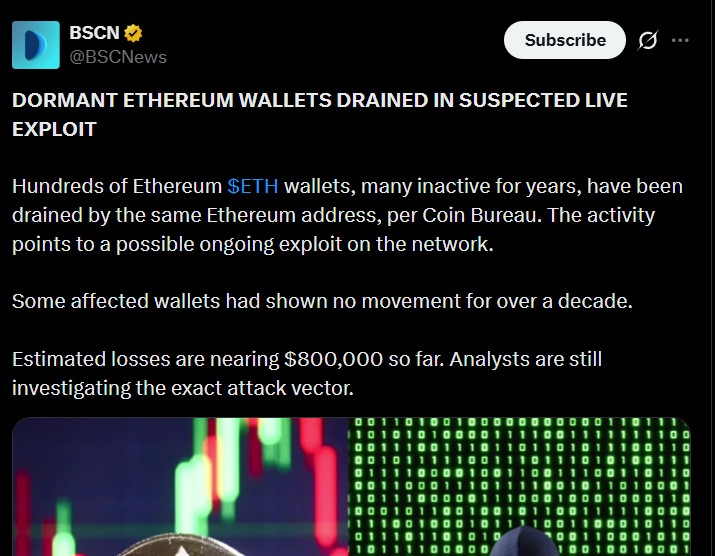
Source: BSCN X Post
Bitmine Doubles Down: A Bold ETH Staking Push
While security concerns rise, institutional demand tells another story. Bitmine Immersion Technologies, chaired by Tom Lee, expanded its Ethereum stake. The firm added 162,088 ETH. The purchase is worth about $366 million.
On-chain data from Lookonchain confirmed the move. Bitmine now holds 4,194,029 ETH in staking. This stash is valued at nearly $9.48 billion. That figure equals 82.59% of its total ETH holdings.
Bitmine follows a treasury strategy similar to MicroStrategy. It accumulates crypto and earns yield through staking. Bitmine Staking means locking coins to support network operations while earning rewards. The firm targets annual yields between 3% and 5%. It also aims to serve institutional clients.
Notably, Bitmine controls around 10.5% of Ethereum’s total staked supply. This concentration reflects a strong institutional conviction.

Source: Official BSCN News X
Why Legacy Wallet Security Still Matters Today?
This incident puts a spotlight on older crypto tools still in use. Early wallet generators often relied on weaker randomness. That made private keys easier to predict years later. Many users created wallets offline and never updated them.
Over time, these dormant funds became easy targets. Security standards have improved since then. Modern wallets use stronger encryption and hardware protection. Still, older wallets remain exposed if left unchanged. This case may push users to review storage methods. It also highlights the need for regular security updates in self-custody.
Market Reaction: Caution Meets Confidence
The wallet exploit raised fresh concerns among users. Long-term holders may now review old storage methods. Security discussions have intensified across crypto forums. At the same time, Bitmine’s move signals confidence in Ethereum’s future. Large-scale staking reduces circulating supply. This can influence market liquidity.
Traders appear cautious but attentive. There is no clear panic selling tied to the exploit. However, security awareness has increased. Institutional activity continues to support broader sentiment. Large allocations often signal long-term positioning.
Conclusion
ETH stands at a crossroads between risk and growth. The wallet exploit highlights weaknesses in early crypto storage methods. At the same time, Bitmine’s massive staking move shows rising institutional trust. Together, these events reflect a maturing market. Security and adoption will likely shape Ethereum’s next phase.
Disclaimer: This article is for informational purposes only. It does not provide financial advice. Cryptocurrency investments carry risk. Readers should conduct their own research before making any financial decisions.


2 months ago
Mighty Hacker Recovery offers professional services in cybersecurity and digital recovery for individuals and businesses. Their services include data recovery, digital forensics, cybersecurity consulting, malware detection, and incident response. They promise experienced, confidential, and fast support while following ethical practices. Clients can contact them via their website https://mightyhackarrecovery.com/ or WhatSapp Canada +1 (343) 947-3496 for assistance. Additionally, the text poses various questions related to crypto recovery, including inquiries about stolen cryptocurrency, recovery experts, and their effectiveness. BITCOIN RECOVERY EXPERT AT MIGHTY HACKER RECOVERY USDT RECOVERY EXPERT AT MIGHTY HACKER RECOVERY ETH RECOVERY EXPERT AT MIGHTY HACKER RECOVERY CRYPTOCURRENCY FRAUD RECOVERY HACKER FOR HIRE AT MIGHTY HACKER RECOVERY WhatSapp Canada +1 (343) 947-3496








