Espresso Airdrop Introduces Holder Score Ahead of ESP Token Launch

Espresso Airdrop Update Highlights Pre-TGE Sale and Listing Date Buzz
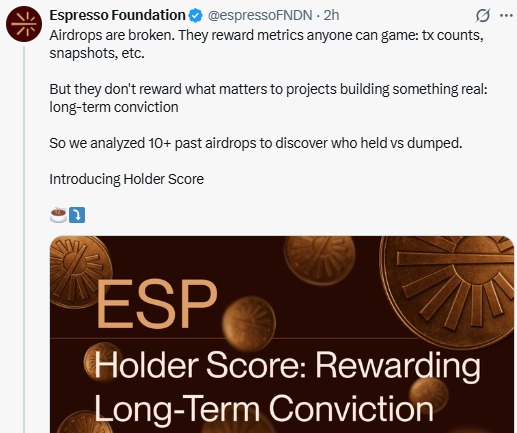
The Espresso Airdrop is drawing fresh attention after the Espresso Foundation introduced a new reward system called Holder Score. The update arrives just before the ESP token launch and reflects a growing effort in crypto to reward real supporters instead of short-term participants.
Airdrops have long been used to attract users, but many projects later discovered that quick sellers often create heavy price pressure.
Source: X (formerly Twitter)
A New Approach to Crypto Rewards
Traditional airdrops usually depend on wallet activity, transaction counts, or snapshots. While effective, these metrics are easy to game using bots or temporary activity.
After reviewing more than ten previous token distributions, the Foundation found that users who hold tokens longer often contribute more stability to a project. This insight led to the creation of Holder Score.
Holder Score is designed to measure conviction. Users who demonstrate stronger holding behavior could receive higher allocations when the ESP Airdrop claims open at token launch.
The project has also made its methodology public, covering eligibility across more than 30 activities while adding anti-Sybil protections to filter suspicious wallets.
More than 1 million addresses are expected to qualify, making this one of the larger infrastructure-focused airdrops in recent months.
ESP Token Utility and Network Vision
The ESP token will power the Espresso Network through a proof-of-stake model. It will be used for staking, securing the protocol, and paying future network fees.
Espresso is building infrastructure that helps blockchains communicate better. As the industry moves toward a multi-chain environment, faster confirmations and smoother interoperability are becoming essential. The project aims to act as a shared consensus layer that supports secure and efficient rollups.
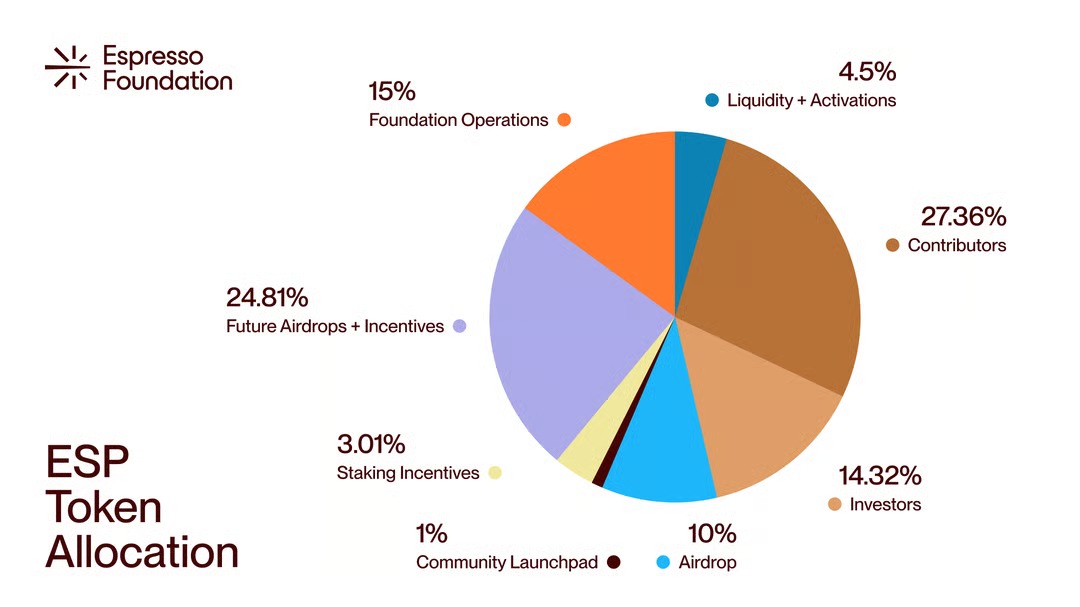
About 10% of the initial token supply has been reserved for the Espresso Airdrop, while additional rewards are planned to support ecosystem growth.
Tokenomics and Early Market Signals
The newly released tokenomics show an initial supply of 3.59 billion ESP tokens with no fixed maximum supply due to staking emissions over time.
The allocation includes 27.36% for contributors, 14.32% for investors, 24.81% for incentives, 15% for foundation operations, and 4.5% for liquidity support.
Source: Paragraph ESP Tokenomics
Notably, the community airdrop will be fully unlocked at launch.
While unlocked rewards can attract strong early participation, they sometimes increase the risk of short-term selling once trading begins.
Pre-market futures trading has already started, helping early price discovery. Some analysts expect the token could enter the market between $0.04 and $0.10, although the official launch price is still unknown.
Binance Wallet Sale Adds Momentum
Interest in the Espresso Airdrop increased further after Binance Wallet announced a Pre-TGE Prime Sale. Users with at least 240 Alpha Points can join the event, which deducts 15 points for participation.
The claim window lasts 24 hours and ends at 14:00 UTC on February 11, 2026. If users miss the deadline, their staked BNB and Alpha Points will be refunded within seven business days.
Roughly 53.8 million ESP tokens are being distributed through this pre-sale from the liquidity allocation, while the 10% community airdrop remains reserved for eligible participants.
Listing Buzz and Market Attention
Market curiosity has also grown after the ESP token appeared on Coinbase roadmap. Although this does not confirm a listing, such developments often improve visibility and bring early trader interest.
Some reports suggest a potential exchange debut in Q1 2026, but the team has not announced a fixed timeline yet.
Why Does Holder Score Matter?
The Espresso Airdrop may signal a broader shift in how crypto projects design reward programs. By prioritizing long-term holders instead of short-term activity, Espresso is trying to align incentives with sustainable growth.
If successful, this model could inspire other projects to rethink their distribution strategies.
Disclaimer: This article is for informational purposes only, kindly do your own research before investing.
Also read: