Ethereum Fusaka Upgrade Live: L1 & Layer 2 Improvements Explained


Ethereum Fusaka Upgrade Live: 8x Rollup Speed & Layer 2 Cost Reduction
Ethernet has already deployed the Fusaka upgrade on Mainnet, providing increased Layer 1 performance, increased blob capacity, and large Layer 2 cost savings. It is a significant advancement in the development of Ethereum.
Ethereum Fusaka Upgrade Brings Key Performance Boosts
The Fusaka upgrade was completed on December 3, 2025, and had 13 Ethereum Improvement Proposals (EIPs) that intend to enhance Layer 1 performance and optimize data availability to rollups.
The upgrade increases the size of blobs by eight times, enabling cheaper and more efficient storage of off-chain data, which is crucial in Layer 2 scaling solutions.
The Fusaka upgrade is a landmark event in the L1+rollup roadmap of Ethereum that will enable sub-second finality of transactions and higher throughput on the network.
The Layer 2 rollups can now cut down on transaction costs by up to 90% of what they were before Dencun.

Source: ethpandaops X
Blob Parameter Only Fork Mechanism Introduced
The Blob Parameter Only (BPO) fork switch is one of the best features of Fusaka. This is achieved by enabling Ethereum to safely expand blob capacity in the future without complete hard forks, enabling the network to transition to biannual upgrades as ConsenSys proposes.
This will mean that Ethereum will be able to iterate faster, responding to the increasing rollup demand and keeping the ecosystem stable. The developers and node operators are now able to expect faster upgrades and easier transitions of L2 integrations.
PeerDAS Enhances Data Availability Monitoring
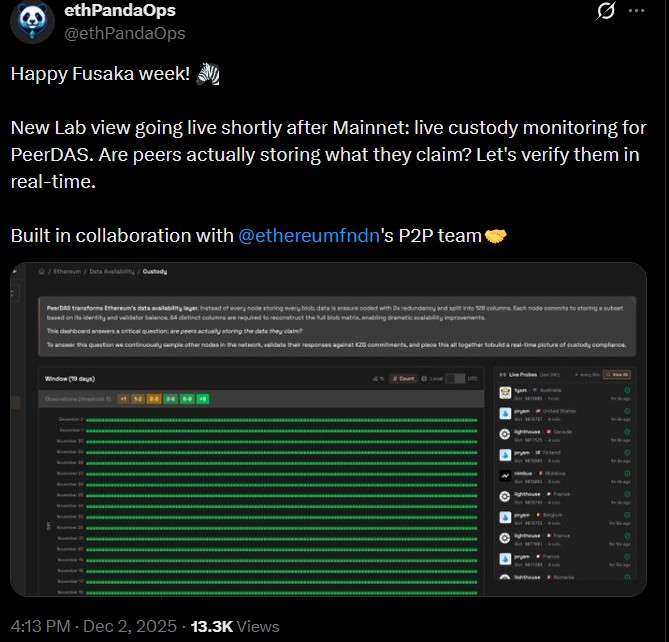
Another system that Fusaka introduces is PeerDAS, which is a new system that can be used to monitor the availability of blob data on the network.
PeerDAS is developed in collaboration with the P2P team of the Ethereum Foundation, and probes nodes such as Prysm and Lighthouse after every 80 seconds, and verifies storage commitments with KZG commitments.
The system uses 128 erasure-coded blob columns in order to ensure that peers store the data they claim.
This minimizes node storage requirements, as well as guarantees scalability and reliability of data distribution throughout the network.
Preliminary ethPandaOps testing shows a high level of compliance, and a new dashboard shows custody verification in real-time.
Source: X
Impact on Layer 2 and Rollup Ecosystems
The Fusaka upgrade is a major improvement of Layer 2 rollups in terms of throughput and reduced transaction costs.
The upgrade is likely to be beneficial to the Superchain and other Layer 2 ecosystems built on optimism, which will potentially be able to handle over 100,000 transactions per second with future upgrades, such as Glamsterdam, adding parallel execution and sub-second finality.
This is a significant step towards the scalability strategy of Ethereum, and it will make the network more effective for its developers, traders, and regular users.
Collaboration and Future Outlook
The success of Fusaka highlights the significance of the cooperation between the ETH Foundation, the developers of nodes, and community contributors.
Combining PeerDAS and implementing new fork functionality, ETH became a new standard in transparency, scalability, and L2 preparedness of the network.
The developers and validators are also advised to observe the network, report any problems, and investigate the new tools to verify real-time data.
Conclusion
The upgrade is a revolutionary move to scalable and cost-effective blockchain infrastructure, which prepares the way to L2 rollups that are faster and further ecosystem innovation.
Disclaimer: This article is for informational purposes only and does not constitute financial advice.









