Hyperliquid Price Surge as War Sparks 24/7 Trading Boom

Hyperliquid Price Surge Driven by Oil, Gold Perp Volume
The recent Hyperliquid price surge did not happen by accident. It came during a weekend when global tensions were rising and most traditional markets were closed.
After the U.S. and Israeli strikes on Iran, traders rushed to adjust their positions. But there was a problem. Major traditional exchanges like COMEX, NYMEX, and the NYSE were fully closed over the weekend. There was no access to oil, gold, silver, or equity index markets.
Source: X (formerly Twitter)
It became one of the only liquid venues open 24/7.
Why Traders Turned to Hyperliquid?
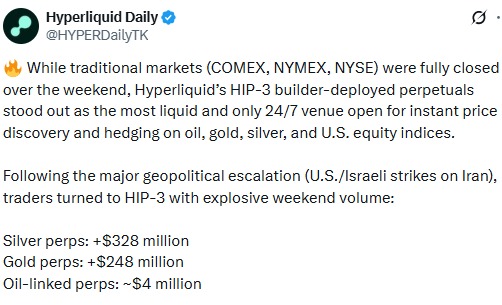
Hyperliquid’s HIP-3 builder-deployed perpetual markets allowed traders to instantly hedge and discover prices during the geopolitical shock. While traditional markets were offline, the platform was active.
Source: X (formerly Twitter)
As a result, weekend trading volumes exploded:
Silver perpetuals recorded more than $328 million in volume.
Gold perpetuals saw over $248 million in trading.
Oil-linked perpetuals added around $4 million.
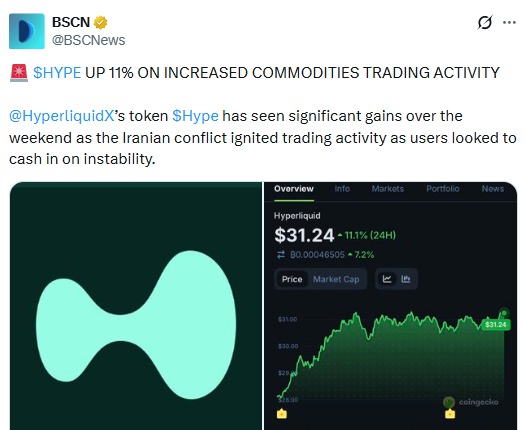
This sudden surge in activity directly supported the Hyperliquid price surge. Exchange-based tokens often rise when trading volume increases because higher activity signals platform demand and potential revenue growth.
HYPE climbed more than 11% at one point, pushing above the $31 level before cooling slightly.
Why the Pullback Happened?
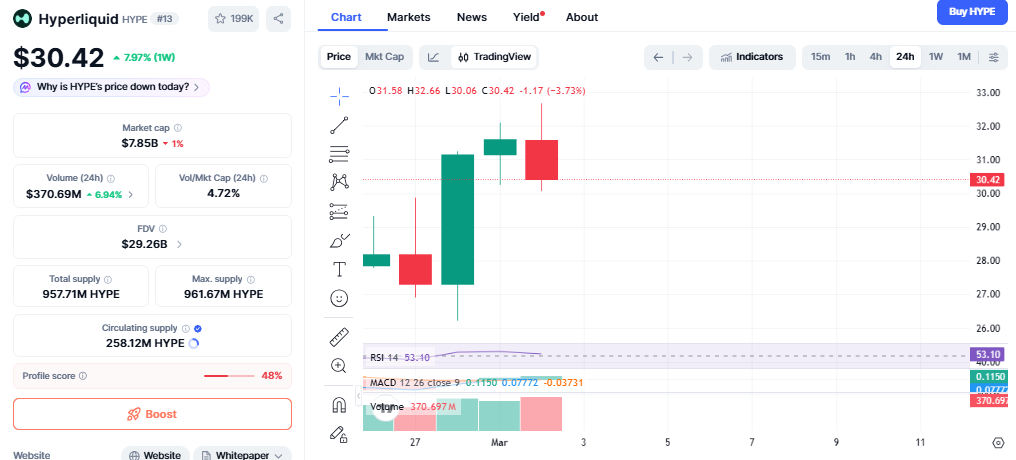
After the initial price rally, the token slipped back near $30 as per the CoinMarketCap. This decline does not appear linked to any negative news about Hyperliquid itself.
Source: CoinMarketcap
Instead, HYPE closely tracked Bitcoin’s pullback. Bitcoin fell roughly 2% amid broader market caution. The total crypto market cap also declined, showing this was a general risk-off move.
Hyperliquid is considered a high-beta asset. That means it tends to move more sharply in the same direction as Bitcoin. When Bitcoin falls, HYPE can amplify the move.
War Tensions and Crypto Market Reaction
Despite the serious geopolitical escalation, crypto markets did not collapse. Oil initially spiked but later cooled. Gold rose modestly. Stock markets saw limited declines.
Markets absorbing major news without panic often signals resilience. Still, sentiment remains cautious. The Fear & Greed Index remains in extreme fear territory, which keeps pressure on altcoins.
This shows how volatility benefits 24/7 crypto-native platforms when traditional finance shuts down.
Key Price Levels to Watch
The $30 level is important short-term support. If Bitcoin stabilizes near $65,000, HYPE could attempt another move toward $32–$33.
If Bitcoin weakens further and breaks below key support, it may test the $29.50 level, with the next major support near $28.
Volume remains strong, suggesting active participation rather than thin liquidity.
Bullish case: Continued volatility and stable Bitcoin push HYPE back toward recent highs above $32.
Bearish case: Broader market weakness drags HYPE toward the $28–$29 zone.
Conclusion
The Hyperliquid price surge highlights one key advantage of crypto industry: they never close. While traditional exchanges were offline during geopolitical escalation, the blockchain provided instant price discovery and hedging.
As long as volatility remains elevated, platforms like this may continue to see strong activity.
YMYL Disclaimer: This content is for informational purposes only and not financial advice. Crypto investments carry risk.
Also read:








