India EU Trade Deal Fuels Global Markets and Crypto Pivot

How the India EU Trade Deal Impacts the Crypto Economy
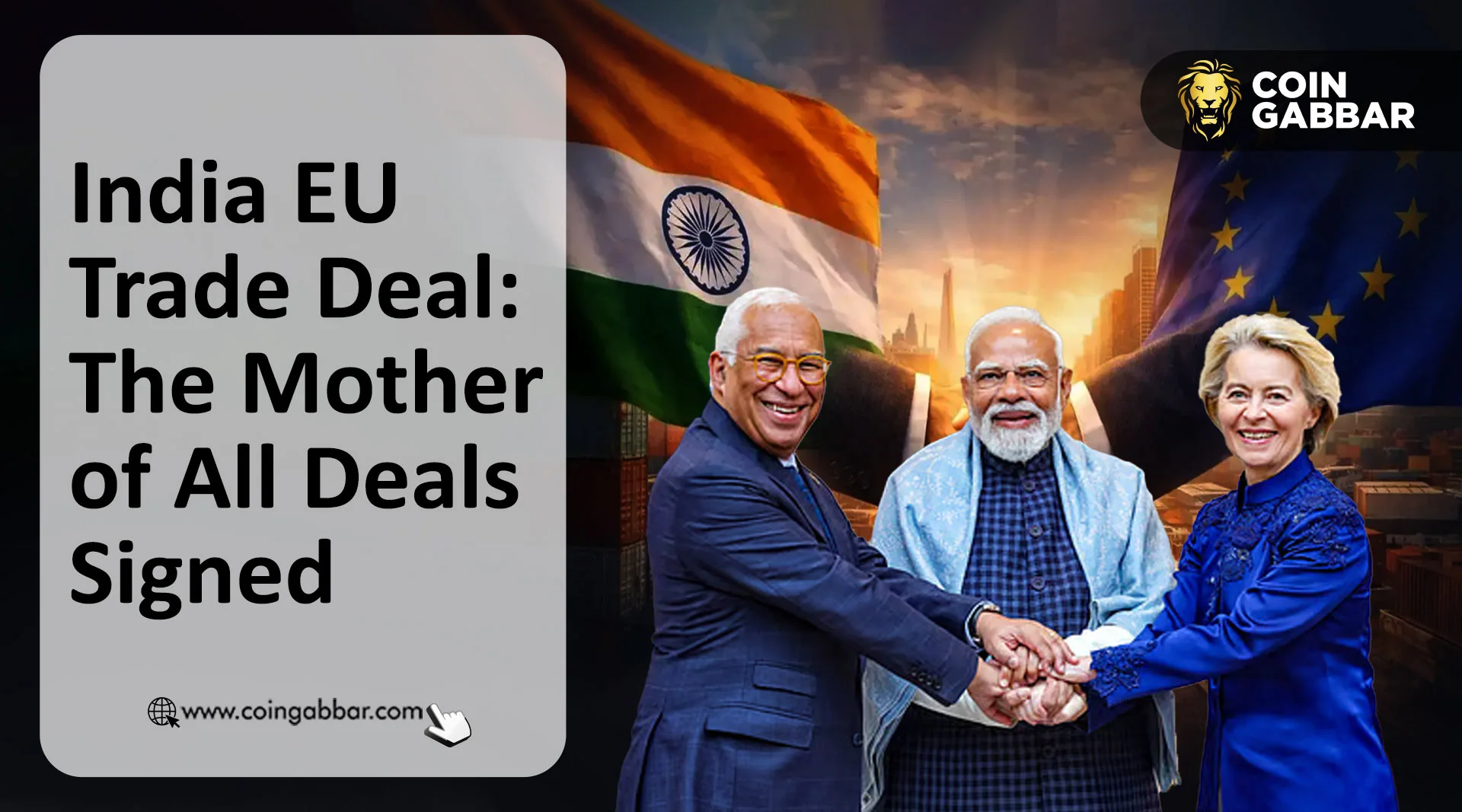
The global economic map was essentially redrawn on Tuesday, January 27, 2026. After nearly twenty years of awkward "will-they-won't-they" negotiations, Prime Minister Narendra Modi and EU President Ursula von der Leyen finally closed the India EU Trade Deal. It is a massive moment world leaders are already calling it the "mother of all deals" creating a free trade zone for two billion people and a quarter of the world's GDP.
 Source: X(formerly Twitter)
But this isn't just about car parts and textiles. This deal represents a sophisticated strategic pivot, offering a resolute alternative to the mounting chaos of rising tariffs and protectionist walls seen elsewhere. For India, it is a way to stop being bullied by single-market deal wars. For the rest of us, especially those in the digital and crypto spaces, it is a signal that the future of money is moving toward a multipolar, East-meets-West reality.
How the India EU Trade Deal Impacts the Crypto Economy
If you look past the headlines about cars and chemicals, the real juice of the India EU Trade Deal is in the "Digital Trade" chapter. For the first time, we are seeing a framework that actually tries to harmonize how two massive digital economies talk to each other. When you open up a corridor for $200 billion in yearly trade, the old-school banking system starts to look like a rusty bicycle in a Formula 1 race.
The friction of moving money between New Delhi and Brussels has been a nightmare for years. This agreement encourages "interoperable digital infrastructure." In plain English? It’s a massive green light for stablecoins and Central Bank Digital Currencies (CBDCs) to start handling the heavy lifting of B2B settlements.
As businesses try to dodge the headache of a fluctuating U.S. dollar, the demand for EUR and INR-pegged digital assets within this duty-free zone is set to explode.
Geopolitical Resilience: Hedging with Code
The timing here is everything. We are living through a "tariff war" era where economic nationalism is the new normal. By locking in the India EU Trade Deal, both sides are basically "de-risking" their futures. It’s a hedge. And when traditional trade routes get messy, the crypto market usually steps in as the "Plan B."
There’s also a huge "Green Tech" angle. The EU has some of the world’s strictest carbon rules. Indian exporters who want to sell into Europe for zero duty now have to prove their "green" credentials. This is a massive "Information Gain" for the blockchain world. We’re going to see a surge in on-chain tracking for carbon footprints and supply chain transparency. If you can’t prove it’s green on the ledger, you don’t get the tax break. It’s that simple.
Expert Analysis: The Future Outlook
We are witnessing a "Great Decoupling." This deal proves that the world is no longer waiting for a single superpower to set the rules. For the crypto sector, this means the center of gravity is moving toward regions that have clear, bilateral agreements.
I expect to see a wave of new institutional "Trade-Finance" tokens. Imagine an Indian pharmaceutical company selling to Germany and getting paid instantly in a tokenized Euro, settled on a ledger that both governments trust. That isn't sci-fi anymore this deal just built the foundation for it. The real winners won't be the ones watching the charts; they’ll be the ones building the bridges between these two massive economies.










