Japan’s First Bitcoin ETF Could Launch Amid 2026 Crypto Reforms


Finance Minister Backs Japan’s First Bitcoin ETF With The Recent Claim
Japan is now taking bold steps to embrace digitalization in 2026, signaling a pivotal year for blockchain and cryptocurrency adoption.
Finance Minister Satsuki Katayama called the year “Digital Year One” and pledged full support for exchanges to ensure public access to crypto directly. This has also renewed talk around Japan’s first Bitcoin ETF, despite approval timelines and final regulatory interpretations remaining uncertain

Source: Money Ape
Finance Minister Katayama emphasized public access to digital assets through exchange infrastructure. Speaking at the Tokyo Stock Exchange, she underscored the importance of fintech innovation. Comparing ETFs to the U.S., Katayama stated that ETFs could provide a hedging option for the public, similar to trends in the United States.
With this emphasis on Exchange-Traded Funds, is the country finally set to approve its first-ever crypto ETFs, filed in August 2025?
Japan’s First Bitcoin ETF on the Horizon
SBI Holdings, a $214 billion financial company, filed in August 2025 to launch $BTC and $XRP ETFs, with approval still pending amid the country’s evolving regulatory framework.
Analysts highlight that Japan’s $1.5 trillion in household savings could generate significant inflows once ETFs go live, potentially boosting crypto adoption nationwide.
With the Finance Minister's “Digital Year One” declaration, the country is enhancing its crypto portfolio, which already soars on global levels.
Japan Crypto Adoption: Yen Stablecoins and Tokenized Deposits Drive Innovation
Japan is emerging as one of the most crypto-friendly major economies in 2026. It is applying major changes in crypto adoption to give it a more secure space:
Tax Reform: Crypto taxes are announced to be fixed at 20% from current 55% rates.
Regulatory Shift: Over 100 cryptocurrencies reclassified under securities-like rules, boosting transparency, and product possibilities.
Other Steps: Public firms like Metaplanet are adding bitcoin to Treasuries, retail also participating significantly.
The country launched its first legal yen stablecoin, JPYC, in October 2025. Adding on, Japanese megabanks, including MUFG, SMBC, and Mizuho, are also piloting yen-pegged stablecoins and tokenized bank deposits for faster, blockchain-based settlements.
These reforms, combined with a Bank of Japan policy shift, aim to revive domestic trading, draw institutional capital, especially as the country’s economy is struggling with Yen weakness and inflation hikes.
Bank of Japan Tightens Policy
Monetary policy is shifting alongside the nation's digital push. On January 5, 2026, 10-year Japanese government bond yields jumped to 2.12%, the highest since 1999, signaling the Bank of Japan’s (BOJ) move away from decades of ultra-loose policy.
However, the experts said this open shift is to maintain the broader economic conditions. The native currency, Yen, has weakened continuously despite frequent rate hikes (currently at 0.75% – a 30-year high). Inflation in the country also remained above the 2% target at 2.90% for consecutive years.
BOJ Governor Kazuo Ueda confirmed that rate hikes will continue if growth and inflation targets hold. This hawkish shift strengthens the yen, potentially creating yen volatility and influencing risk assets, including Bitcoin, which has already reacted with strong upward momentum.
Reaction on Bitcoin: Current Market Condition
Reacting to the news, the crypto market gained 1.12% in the last 24 hours, building on a 5.75% weekly rise, with Bitcoin surging to $92,500 (+1.37%), fueling optimism amid economic challenges.
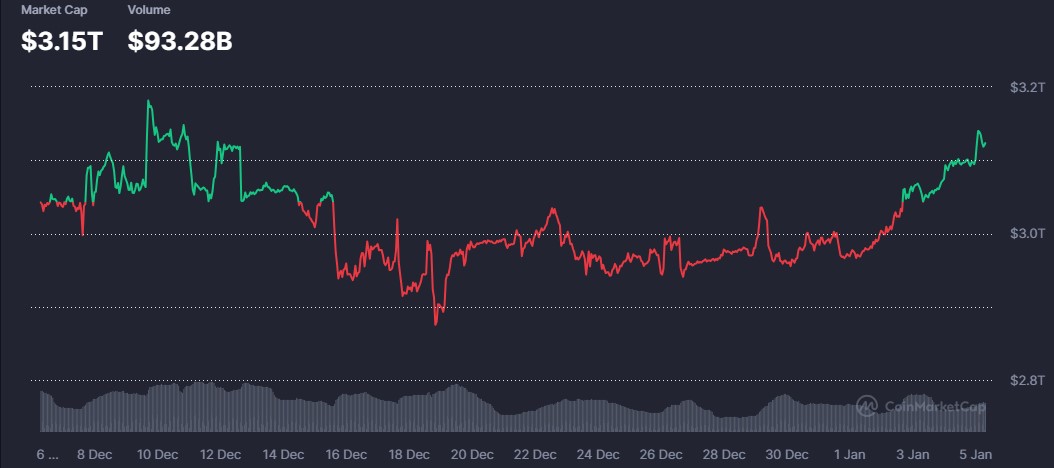
Source: Coin Market Cap
U.S. ETF inflows of $459M and $63.79M in BTC short liquidations boosted bullish momentum, while sentiment improved, with the Fear & Greed Index rising to 42 from 25 last month.
Finance Minister Katayama: A Digital Vision for Growth
Katayama’s New Year address framed 2026 as a turning point for the country. She called for responsible fiscal policy and targeted investment in growth sectors, aiming to overcome deflation and shift household savings into productive investments.
Referencing Japanese political milestones, she noted that the “glass ceiling has already been broken”, encouraging optimism for market growth. The minister expressed intent to support exchanges fully, ensuring that citizens can benefit from digital assets through secure and efficient trading platforms.
With this, Japan’s first Bitcoin ETF approval seems closer than ever, as sweeping reforms reshape the country’s financial system in 2026.









