KuCoin Dubai Cease-and-Desist Order Forces Halt of UAE Services


KuCoin Dubai Action Signals Global Crackdown on Unlicensed Exchanges
The KuCoin Dubai situation has taken a serious turn after Dubai’s Virtual Assets Regulatory Authority (VARA) ordered the crypto exchange to immediately stop providing virtual asset services to UAE residents.
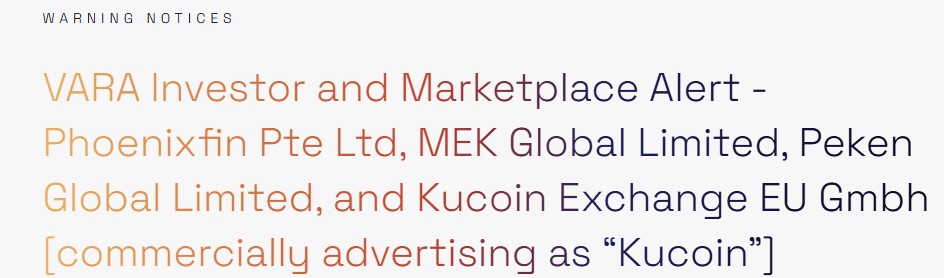
Source: VARA Official
The order, issued around March 5-6, 2026, states that the exchange does not hold the required license to offer cryptocurrency services in or from the emirate and, thus, requires KuCoin and its related entities to cease all unlicensed operations connected to Dubai.
Although the move does not shut down KuCoin globally, it blocks services for users in the UAE region only.
KuCoin Violates UAE Crypto Rules: VARA in Action
According to VARA’s official notice, KuCoin Dubai operations violated local regulations because the platform promoted and provided virtual asset services without authorization.
Under Dubai Law No. 4 of 2022, any company offering cryptocurrency services to residents must first obtain approval from VARA. Authorities said any promotion, solicitation, or trading services targeting UAE users without a license is illegal.
The cease-and-desist order applies to several linked entities, including:
Phoenixfin Pte Ltd
MEK Global Limited
Peken Global Limited
KuCoin Exchange EU GmbH
VARA also warned that investors who use unlicensed cryptocurrency platforms could face financial and legal risks.
KuCoin Facing Continuous Push Backs: EU and US Regulatory Pressure
The KuCoin Dubai crackdown comes after the exchange faced regulatory pressure in other regions over the past two years.
Key events include:
March 2024: The U.S. Department of Justice charged the exchange for operating an unlicensed money-transmitting business.
Early 2025: The exchange resolved the case by paying about $297 million in penalties and forfeitures and agreed to exit the U.S. market for two years.
February 2026: Austria’s financial regulator partially suspended KuCoin EU operations over missing AML and sanctions compliance officers under the EU’s MiCA rules.
While there is no confirmed coordination between regulators, the timing of these actions highlights increasing global scrutiny of cryptocurrency exchanges operating without licenses.
Crypto-Friendly Reputation Faces Compliance Test
Dubai has spent the last few years positioning itself as a major global hub for digital assets. Estimations show the region has 25–31% (3 to 3.78 million) of the population owns or uses digital assets. The country also recorded around $56 billion in crypto inflows in 2024–2025, up 33% year over year, with Dubai driving nearly 45% of the UAE’s blockchain activity.
Through VARA, the city also introduced one of the most structured crypto licensing, named VASP (Virtual Asset Service Provider), systems in the world.
However, the regulator now seems to be willing to enforce the rules also strictly.
In October 2025, VARA fined 19 unlicensed crypto firms for operating in the region without proper approval. Many of those companies later returned after fixing compliance issues and securing licenses.
In January 2026, the Dubai Financial Services Authority banned privacy coins like Monero and Zcash, while only fully fiat-backed stablecoins with clear reserves and audits are permitted to work.
The development highlights a broader shift in crypto regulation. Authorities are increasingly applying the rule: if an exchange serves residents in a country, it must obtain a local license.
Regulatory Pressure Is Reshaping the Crypto Exchange Model
The KuCoin Dubai case reflects a larger change happening across the crypto industry. For years, many exchanges operated from offshore locations and served global users without clear local licenses.
That time it was acceptable as crypto is not so popular. But now the sector gained a lot of attention that too in a very short time, forced regulators to take it seriously. Increasing scams, frauds and crimes related to digital assets are also playing a major role in the demand of a proper compliance structure to protect users.
For users, this trend raises awareness about counterparty risk on offshore exchanges. Experts often recommend monitoring regulatory updates and considering self-custody or licensed platforms in their jurisdiction.









