Is Kucoin Unsafe? Japan FSA Warns For Unregistered OTC Crypto Trading?

Japan FSA Warns KuCoin Again for Unregistered Crypto Trading Services
KuCoin warned for unregistered OTC derivatives services by the Japan FSA. The nation strengthens cryptocurrency rules amid 12M domestic crypto accounts. The regulatory authority urges app removal; legal shift to a stricter framework.
Why Did Japan FSA Target KuCoin Again?
The Japan Financial Services Agency (FSA) has issued a fresh warning to crypto exchange KuCoin for allegedly soliciting over-the-counter (OTC) derivatives trading to Japanese residents via the internet. This action, released in March 2026, places the exchange alongside other platforms like NeonFX, theoption, and GTCFX under regulatory scrutiny for operating without proper registration under Japanese law.
The FSA specifically highlighted KuCoin, headquartered in the Seychelles, as providing services to Japanese users, while the other flagged platforms mainly cater to international clients.
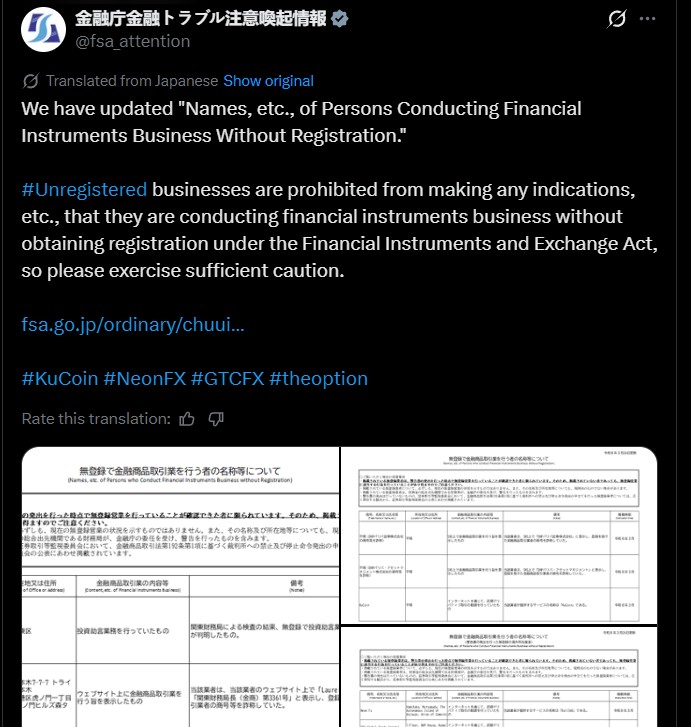
Source: Official X
Is KuCoin Repeating Past Mistakes?
Ku Coin is not the first to appear on the Japanese regulatory radar. In November 2024, the FSA had already cautioned exchanges, including Bybit, to provide products to Japanese residents without registering. In February 2025, Japan took the issue a step further and asked Apple and Google to delete the exchanges app from their stores, indicating that the government is not tolerant of any unregistered crypto activities.
How Big is Japan’s Crypto Market?
The nation is still a significant cryptocurrency center. By February 2025, the FSA had more than 12 million crypto accounts on a population of approximately 123 million. Chainalysis (2025 Global Crypto Adoption Index) indicates that Japan is ranked 19th in the global list of countries with a high digital asset adoption.
What’s Changing in Japan's Regulatory Landscape?
The threat is that the country is set to move its legislation to the Financial Instruments and Exchange Act as opposed to the Payment Services Act. Such a shift will broaden reporting on initial exchange offerings and token issuers and offer regulators greater enforcement mechanisms over unregistered platforms, which will effectively increase regulation of the industry.
Are App Stores Facing Pressure Too?
After the November 2024 warnings, the FSA asked Apple and Google to block the downloads of the mobile apps. These measures indicate that regulators are relying more and more on tech platforms to impose compliance and guard domestic users against potentially risky or unregistered financial services.
Could KuCoin Face Global Regulatory Repercussions?
The exchange did not have regulatory issues alone. As an example, the financial regulator of Austria recently banned the business of the EU exchange KuCoin. This trend of warnings underscores the increased international questioning of exchanges that conduct business in more than one jurisdiction without following local compliance regulations.
What About Other Crypto Controversies in Japan?
In a similar turn of events, the Prime Minister of Japan, Sanae Takaichi, denied that he was involved in the so-called Sanae token, which briefly increased to a market value of about $28 million. The authority supposedly had to think of investigating the issue, which highlights its intention to analyze crypto-related actions connected to high-profile individuals.
Conclusion: Is Compliance the Key to Survival?
The frequent warnings issued are indicative of the need to follow regulations in the fast-changing crypto-environment. Having millions of active users and even stricter rules in sight, unregistered platforms are now under increased threat, both legally and operationally.
Disclaimer: This is not financial advice. Please DYOR before investing. CoinGabbar is not responsible for any financial losses. Crypto assets are highly volatile, a nd you can lose your entire investment.







