Kyrgyzstan Stablecoin KGST Debuts on Binance Global Platform


How Kyrgyzstan Stablecoin KGST Fits Into Global Stablecoin Growth
The Kyrgyz Republic entered the global digital currency market with the introduction of its national stablecoin, KGST. The Kyrgyzstan stablecoin is pegged to the Kyrgyz Som and is now live on Binance, which is the world’s biggest cryptocurrency exchange platform.
Although this move promises faster payments and deeper crypto integration, there are many questions that need to be addressed in relation to the future of money and control that this could potentially have in the future.
How the Kyrgyzstan Stablecoin KGST Could Change Payments
President Sadyr Japarov confirmed on December 24 that KGST, a coin pegged 1:1 to the Kyrgyzstani native currency Som, has been listed on Binance. The project was developed on BNB Chain, allowing fast and low-cost transactions.
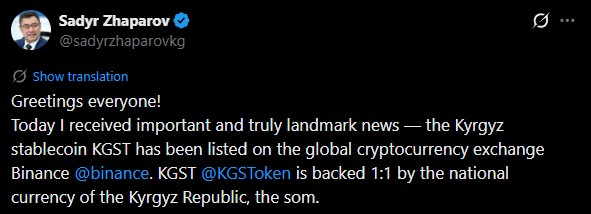
According to Japarov, the Kyrgyzstan stablecoin will help improve cross-border payments and deepen the country’s engagement with the crypto industry. For a nation of roughly seven million people, this marks a major step toward digital finance adoption.
KGST has also made history as the first stablecoin from the Commonwealth of Independent States (CIS) to be listed on a major global exchange.
Binance and CZ Signal More Government Stablecoins Ahead
Following the announcement, Binance founder Changpeng Zhao (CZ), responded by saying that “many more” government-backed stablecoins are expected to be listed on the exchange.

Source: X Official
CZ has served as an advisor to Kyrgyzstan since April, offering technical support, consulting, and blockchain expertise. His involvement reflects growing cooperation between governments and major crypto platforms.
KGST and USDKG: Two Stablecoins, Two Goals
Alongside KGST ($0.01142), Kyrgyzstan has also launched USDKG, a US dollar-pegged stablecoin backed by physical gold. USDKG was initially issued on the Tron network with 50 million tokens, with plans to expand to Ethereum.
While KGST supports local currency usage, USDKG offers dollar stability, showing that the nation is exploring multiple digital currency paths at once. Officials have also confirmed plans to pilot a central bank digital currency (CBDC) and establish a national crypto reserve.
The country has over 200 licensed crypto firms, revealed by the Economics and Commerce Minister – Bakyt Sydykov. He also highlighted that the total industry turnover reached 1 trillion soms (over $11.4 billion) in the first 7 months of 2025.
A Wave That isn’t Limited to Any Specifics
Although dollar-based stablecoins like USDT and USDC still dominate the market, more countries are launching their own currency-backed tokens. Japan, Europe, and the UAE have announced similar projects.
The case of Kyrgyzstan stablecoin indicates that governments are adopting blockchain technology in their endeavor to modernize payment systems while maintaining control. But this case also indicates a rise in rivalry between banks, CBDCs, and digital money.
In this regard, with more countries opting for this alternative, one possible answer from the experiment in Kyrgyzstan is a solution to a burning question in the global arena: can stablecoins coexist with or work with a government rather than against one?









