Lighter EVM Launch: Will This Upgrade Drive LIT Price Higher?

What Is the Lighter EVM Launch and Why Does It Matter for LIT Price?
The Lighter EVM Launch is more than just a technical upgrade. It clearly shows that Lighter wants to move beyond being known only as a fast trading platform. Until now, they are focused mainly on speed, low fees, and high-performance crypto trading. With this launch, it is taking its first real step toward becoming a full DeFi and blockchain ecosystem.
By adding Ethereum Virtual Machine support, the project now allows developers to build and deploy smart contracts directly on its platform. This means apps for lending, swaps, staking, and liquidity management can now live alongside Lighter trading engine.
Why Is This Upgrade Important?
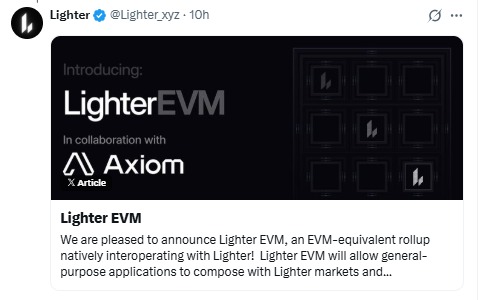
Earlier, the strength was its custom technology that enabled fast trading. But this same technology restricted the kind of development that could be done. The Lighter EVM Launch removes this constraint by retaining the speed and introducing flexibility.
Source: X (formerly Twitter)
Developers can now create EVM-based DeFi apps that directly interact with Lighter markets and liquidity. This results in a more seamless experience where trading, lending, and shared liquidity are integrated rather than being fragmented across multiple platforms.
Designed for Speed Without Sacrificing Trust
One key reason the Lighter EVM Launch stands out is how it balances speed and security. It continues to use its specialized zero-knowledge circuits for trading, while general smart contracts run on OpenVM, a ZK virtual machine developed with Axiom.
Both systems settle together on Ethereum. This allows users to move assets, place trades, or manage positions across the EVM and it’s core platform within seconds. Users do not have to wait long for confirmations, which is a major improvement for active DeFi users.
The team is also researching ways to make execution even faster, including possible synchronous execution for more complex DeFi use cases in the future.
What Does This Means for DeFi Users?
The EVM Launch opens many new possibilities. Developers can build lending protocols that share collateral with perpetual trading, create faster bridges, and even issue stablecoins directly on Ethereum Virtual Machine.
Another important goal is to reduce unhealthy reward farming. By tightly connecting real trading activity with DeFi rewards, it hopes to create a more efficient and sustainable system instead of one driven only by short-term incentives.
LIT Price Action Post Announcement
Following the EVM Launch,
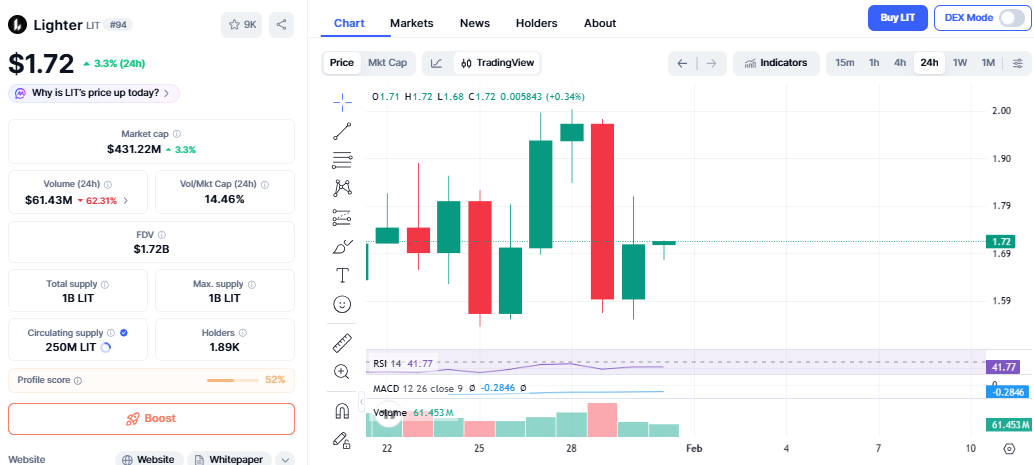
Lighter token is trading near $1.72, showing a modest 2.3% daily gain. This comes after a steep fall over the past month, which suggests the recent move is more of a technical bounce than a strong bullish trend.
The technical indicators show,
LIT token recovering from the $1.55–$1.60 support area and now holding above $1.70. Resistance remains around $1.75–$1.80.
The RSI is near 41, indicating weak but stabilizing momentum. Lower trading volume also explains why price movements remain uneven.
Source: CoinMarketCap
Price Prediction
If LIT stays above $1.70, it may slowly move toward $1.85–$1.90.
A strong break above this range could push the price closer to $2.10.
On the downside, failure to hold support may send LIT back toward $1.60 or $1.53.
For now, the market looks cautious rather than confident.
Final Thoughts
The Lighter EVM Launch shows that the project is aiming for long-term relevance, not just fast trades. By combining high-speed execution with EVM-based DeFi tools, it is trying to build a more complete ecosystem. Whether this move succeeds will depend on real user adoption, developer interest, and steady growth after the launch.
YMYL Disclaimer: This content is for informational purposes only and does not constitute financial advice. Crypto investments are risky do your own research before investing.