Michael Saylor Defends Bitcoin: Is Boris Johnson’s Ponzi Claim Right?


Michael Saylor Defends Bitcoin Amid JPMorgan’s $328 Million Lawsuit
Is your money safer in a digital network or a traditional bank? This question is at the heart of a heated debate between a former world leader and a tech visionary. However, MicroStrategy founder Michael Saylor defends Bitcoin by arguing that it lacks the central operator required for a true Ponzi scheme. While Johnson points to "tales of woe" from local victims, Saylor insists a decentralized network run by code is the ultimate protection against fraud.
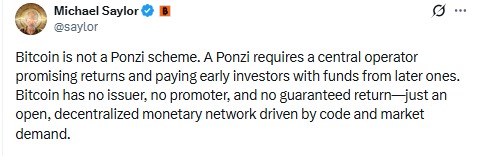
Source: X (formerly Twitter)
While Bitcoin prices hover around $71,054, critics and supporters are clashing over whether this digital asset is the future of finance or a giant trap for the "greater fool."
Why Boris Johnson Fears a Crypto Collapse?
Former UK Prime Minister Boris Johnson recently shared his doubts about the world's largest cryptocurrency. After hearing "tales of woe" from a neighbor in Oxfordshire, Johnson labeled Bitcoin a potential Ponzi scheme. His friend reportedly lost £20,000 after a "chap in the pub" promised to double his money.

Source: Boris Johnson X Account
Johnson argues that unlike gold or even Pokemon cards, Bitcoin lacks "intrinsic value." He pointed out that Roman coins had value because they carried Caesar’s image, representing a power that could collect taxes. To Johnson, a currency with no central leader to hold accountable is a recipe for disaster.
Michael Saylor Rebuts the Ponzi Label
MicroStrategy founder Michael Saylor defends Bitcoin by pointing out the technical definition of fraud. He explains that a Ponzi scheme requires a central operator who pays old investors with money from new ones. According to Saylor, BTC has no issuer, no promoter, and no guaranteed returns.
Instead, he describes it as an open, decentralized monetary network. It runs on math and code rather than the whims of politicians. While critics worry that firms like MicroStrategy are "hoarding" supply to create an elite playground, Saylor insists the fixed limit of 21 million BTC protects users from the inflation found in government-issued money.
Banking Giants and the Reality of Crypto Scams
The debate comes at a sensitive time. JPMorgan Chase is currently facing a lawsuit from over 2,000 investors. They claim the bank enabled a $328 million Ponzi scheme run by Goliath Ventures. Between 2023 and 2026, the firm allegedly promised high returns but used new deposits to pay off old investors.
The lawsuit alleges that $253 million moved through Chase accounts, with $123 million sent to Coinbase wallets and $50 million paid out as fake "profits." This case highlights that while Bitcoin itself is a protocol, third-party bad actors can still use the financial "plumbing" of big banks to trick everyday people.
Conclusion
The clash between centralized authority and decentralized code continues. While skeptics see a bubble waiting to burst, advocates see a system free from government overspending. As Bitcoin remains a volatile asset, the responsibility falls on the individual to distinguish between the underlying technology and the scammers who exploit the hype.
Bitcoin represents a shift from "trust in people" to "trust in math." While the lack of a central authority creates a learning curve for traditional investors, the transparency of the ledger provides a level of auditability that traditional banking systems often lack. Success in this space requires high digital literacy to avoid third-party scams.
YMYL Disclaimer: This article is for informational purposes only and does not constitute financial advice. Cryptocurrency investments carry high risk. Always consult with a certified financial professional before investing.









