OpenAI India Office to Open in Delhi Amid Rising ChatGPT Growth

Why OpenAI India Office in Delhi Sparks Growth Hopes and Concerns
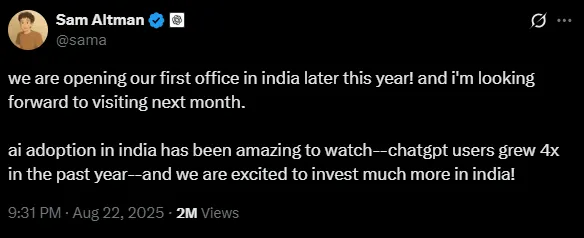
OpenAI has officially set up a local unit in India and confirmed plans to open its first office in the capital city, Delhi, later this year. The firm's co-founder and CEO Sam Altman announced the development in a post on X, saying he looks forward to visiting the country next month.
Source: X
The OpenAI India Office decision signals how the state has emerged as a major market, with ChatGPT users in the country increasing four times in the previous year.
But is this enough to make such a big move? Or is there anything more that influences the company’s traction?
The Golden Bird Become A Key Market for ChatGPT
The OpenAI India office move is not based on some rational calculations, but the company’s own data shows that the nation is becoming more and more important for the company. Here are highlights:
The country is now ChatGPT’s second-largest market by users.
In the last year, weekly active users in the nation have grown four times.
The nation is now among the top five countries for the developers on the platform.
It also has the largest number of students using the platform in the world.
To take this influencing opportunity and grow in the state, the firm introduced special services like ChatGPT Go, OpenAI-Academy, GPT-5 with Indian languages support, and study mode.
Government Welcomes, Social Media on Debate
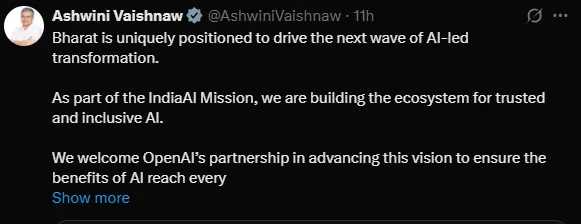
The OpenAI India office announcement got mixed reactions. Union Minister Ashwini Vaishnaw welcomed the plan, saying it supports the government’s IndiaAI Mission for safe and fair AI growth. And fans said OpenAI India Office could help working with local developers and universities.
On the other hand, many on social media questioned the choice of Delhi over Bengaluru, India’s largest tech hub. They claimed that Delhi was picked mainly to be close to the government, not for tech talent.
Others worried that big global companies could overshadow local AI startups and the native jobs that could contribute to the nation's economy. So, are the concerns right or just an arguing topic? And is the country not able to see this while others are warning?
The Foreign Country Dilemma
The concerns are not completely senseless. Foreign companies surely offer higher salary, more jobs, and skill development, but the negative impact on the local market of the nation, especially a developing one, can’t be ignored.
Regional companies may find it hard to hire skilled workers.
Top talent leave local startups to work for alien firms.
Some profit may go out of the country instead of staying local.
Differences in local currency may indirectly reduce the working cost of natives.
Let’s Summarize
The company in progress of OpenAI India office, will host its first Education Summit in the state later this month followed by a Developer Day later this year. The company has already begun hiring people in the country. With support from Microsoft and rising competition from Goggle’s Gemini and Perplexity, this step shows Open AI is making a long-term bet on the nation’s fast growing AI market.









