Kevin Warsh Becomes New Fed Chair After Powell’s 8-Year Run


Powell Stepped Down: Is Crypto Bull Start Under New Fed Chair Warsh
Jerome Powell officially stepped down as Fed Chair on May 15, 2026, eight years after he took the job. Now, a new era begins. And the crypto world could not be more excited about who took his seat.
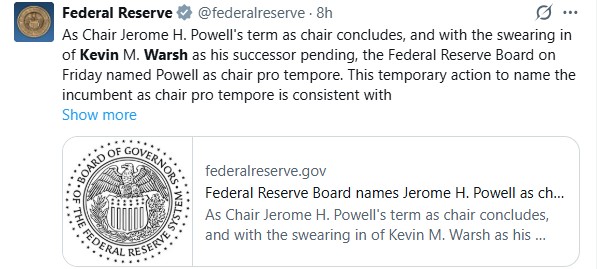
Source: Federal Reserve Official
Kevin Warsh won Senate confirmation by a 54-45 vote just days before Powell's exit. That margin was not exactly comfortable, but it was enough. Warsh is now the new Fed Chair, and markets have taken notice.
Importantly, Powell himself is not fully gone yet. He said he will stay on as a governor for some time after his term as chair ended, leaving when he personally decides it is time. So technically, his vote still sits at the table, a parting gift Trump did not ask for.
What Made Powell's Run So Complicated: Why Warsh vs Powell Matters
Powell's eight years covered some of the wildest economic swings in living memory. He steered policy through a global pandemic, a historic inflation spike, and a string of banking sector scares. Whether you agreed with his decisions or not, the range of crises he faced was genuinely unprecedented.
His biggest criticism came from the 2021–2022 period. Critics argued the Fed moved too slowly on inflation, letting prices run hot for too long before raising rates aggressively. Warsh himself called those moves "fatal policy errors." That criticism is now coming from inside the building.
"Bitcoin is the new gold for people under 40," Kevin Warsh, on why he sees Bitcoin as a sustainable store of value and not a threat to the dollar.
Kevin Warsh's Crypto Stance Is Bullish, and the New Fed Chair Means It
Warsh is not just crypto-tolerant. He disclosed personal investments in more than 30 crypto and DeFi projects before his confirmation, including Solana, Polymarket, Blast, and Bitwise. He is required to divest them now. But the disclosure alone makes him the first Fed-Chair with real, hands-on exposure to the industry.
He has praised Bitcoin specifically, calling it a useful signal for whether the Federeal Reserve is getting policy right. He views it as a new gold, particularly relevant to younger generations, and has said it does not make him nervous. That is a sharp turn from how most central bankers typically talk about crypto.
He also strongly opposes a U.S. central bank digital currency, calling a CBDC a bad policy choice. That position removes one of the biggest regulatory risks the crypto sector has worried about for years. Crypto communities largely called him the most crypto-friendly Fed Chair in U.S. history after his nomination came through.
Kevin Warsh Monetary Policy: What Changes for Markets and Bitcoin
Warsh is historically hawkish on inflation. He wants a strict 2% inflation target, not the average targeting approach the Fed adopted in 2020. He also wants the Fed's balance sheet to shrink significantly, aiming toward around $3 trillion from its current much higher levels. He has called quantitative easing "reverse Robin Hood" because it disproportionately benefits people who own assets.
But here is where it gets interesting for crypto. Warsh believes AI-driven productivity growth acts as a disinflationary force. That means stronger economic output without price pressure. And in that environment, he is open to rate cuts. Lower rates historically push money toward riskier assets, including Bitcoin.
His idea of running quantitative tightening alongside rate cuts is unusual. But if he pulls it off, it could create a liquidity environment that benefits risk assets without reigniting inflation. That is the scenario crypto bulls are betting on. The short-term risk is that his inflation-first instincts could delay those cuts if price data stays hot.
New Fed Chair 2026: What Comes Next for Crypto Investors
Warsh served as a Federal Reserve Governor from 2006 to 2011, so he sat through the 2008 financial crisis firsthand. He rarely dissented during those years but has been vocal ever since about what he thinks the Fed got wrong afterward. His views draw on monetarist thinking, particularly Milton Friedman's emphasis on money supply as the root of inflation.
As chair, analysts expect him to start shrinking the balance sheet steadily, push for clearer Fed communications, and work toward structural reforms in how inflation gets measured. He is interested in trimmed mean PCE, a metric that strips out outlier price swings, as a more accurate benchmark than standard measures.
The crypto-friendly Fed Chair era is officially open. Whether Warsh can thread the needle, cutting rates when growth demands it while keeping inflation anchored, will define his tenure. Bitcoin's direction over the next two years might just depend on how well he does.
Note: This article is for information purposes only. All the information and facts are based on market present data. The article itself does not claim anything.






