SEC Crypto Broker Registration rules clarify wallet path


New SEC Crypto Broker Registration Path for User Interfaces
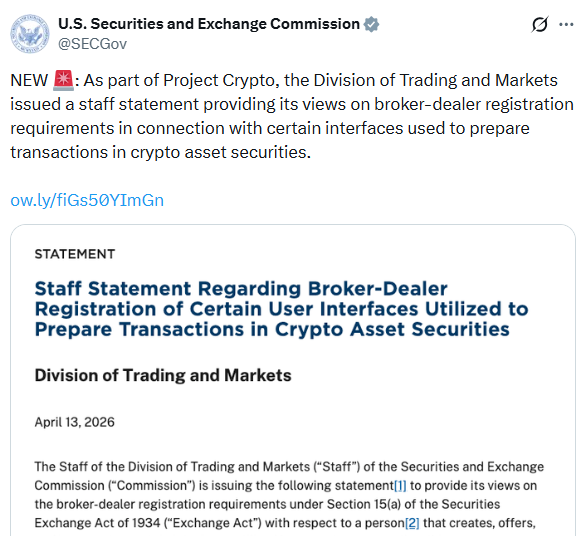
What changes for digital asset builders when Washington says some software is not acting like a market intermediary? That is the key issue behind SEC Crypto Broker Registration after the agency’s Division of Trading and Markets issued a staff statement on April 13, 2026, under Project Crypto. The regulator posted the statement on its website and later shared it on X. The message was clear. Some interfaces used with self-custodial wallets may work without that status if they stay neutral and follow clear limits.
 Source: X(formerly Twitter)
This matters because many wallet tools help users set up trades but do not hold funds or make choices for them. The new SEC Crypto Broker Registration guidance does not remove all rules. It does, however, give builders a clearer path. For developers, wallet teams, and DeFi front ends, that path may shape how products are built and how they stay within U.S. securities law.
SEC Crypto Broker Registration and wallet limits
The heart of SEC Crypto Broker Registration is the agency’s definition of a “Covered User Interface.” The regulator says this can be a website, a browser extension, or a software app. It can also be built into a wallet. Its job is to help users prepare crypto asset securities transactions through a self-custodial wallet. In simple terms, these tools can take user choices like buy, sell, size, and price and turn them into blockchain-ready code. They may also show market data, possible trade routes, and estimated gas fees.
 Source: SEC Official Page
The new SEC Crypto Broker Registration line is narrow. It is not broad relief for the whole market. Staff said it would not object to these tools operating without that approval only in limited cases. Users must control their own trade settings. Providers must not push users toward specific trades. Route displays must use neutral and objective sorting. They cannot use labels such as “best price” or “most reliable.”
The agency also said fees must be fixed and clearly disclosed. Software rules must be disclosed in advance and be easy to verify. Providers must also explain conflicts, integrations, cyber controls, and default settings in a clear way. That means the relief is tied to user control, neutral design, and full disclosure.
Why SEC Crypto Broker Registration matters now
This part of SEC Crypto Broker Registration matters because it draws a line between neutral software and traditional securities intermediation. The statement does not protect interfaces that give investment advice. It also does not protect tools that arrange financing, process trade papers, hold user funds or stablecoins, execute or settle trades, or route orders. Put simply, the relief is meant for tools that help users act on their own. It is not meant for firms that take on the role of a market middleman.
The agency also said that this policy is only an interim staff view. The Commission is still looking at wider digital asset regulatory issues. Unless the Commission takes more action, the statement will be withdrawn five years from April 13, 2026. The agency is also asking the public to send comments under File Number 4-894.
Commissioner Hester Peirce welcomed the move. Still, she said she prefers a more permanent approach to the dealer definition in today’s market. That shows this step is helpful, but it is not the final framework.
Expert Analysis on SEC Crypto Broker Registration
For the market, this policy is more about legal clarity than price action. The materials did not mention token prices or trading data. So the early response is mostly about how people read the guidance. Developers of wallet interfaces and DeFi-style front ends now have a clearer checklist for staying on the software side of the line.
Even so, this is not a blanket exemption. It is also not a final rule. Compliance, disclosure, and user control still remain the main tests. The regulator is moving toward activity-based guardrails for digital asset interfaces. That may reduce some uncertainty for self-custody tools and related apps.
But the bigger long-term signal will still depend on formal rulemaking, Commission action, and any future market structure law. For now, builders have more guidance than before, but they still do not have a permanent safe harbor.
YMYL Disclaimer: This article is for informational purposes only and does not provide legal, financial, or investment advice. Readers should review the original agency statement and consult qualified professionals before making decisions involving digital assets or securities.
Also read:









