SEC Crypto Enforcement Faces Scrutiny Under Chair Paul Atkins


Impact of SEC Crypto Enforcement Shift on Market Stability
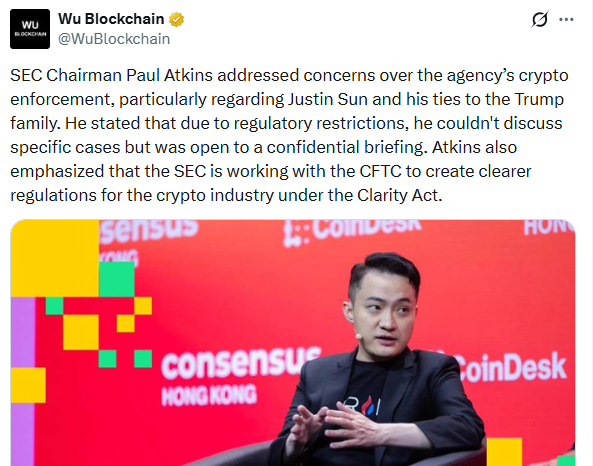
On February 11, 2026, the halls of Congress echoed with a heated debate over the future of digital money. During a high-stakes House hearing, Chairman Paul Atkins addressed the growing scrutiny surrounding the current SEC crypto enforcement strategy. Since taking office, Atkins has presided over a 60% decline in new lawsuits. This move has drawn both praise from the industry and fierce criticism from Democratic lawmakers. The Chairman argued that the agency is no longer interested in "surprising" companies with lawsuits. Instead, he wants to build a foundation of clear, predictable rules for everyone to follow.
Source: X(formerly Twitter)
The focus of the hearing quickly shifted to the agency’s recent decision to pause several big investigations. Most notably, the pause on the Justin Sun and Tron Foundation case has sparked a political firestorm. While some see this as a sign of being too soft, the current SEC crypto enforcement philosophy is different. It focuses on "real fraud" that directly hurts people rather than small paperwork errors. Atkins stated that while he cannot discuss private cases, he is happy to give a confidential briefing to lawmakers to explain the details.
How the SEC Crypto Enforcement Shift Affects You
This shift in SEC crypto enforcement is not just about dropping old cases. It is about creating a new set of rules for the United States. Under the leadership of Paul Atkins, The Commission is now working closely with the Commodity Futures Trading Commission (CFTC).
They have a joint program called Project crypto. This effort aims to align federal oversight with the Clarity Act. This is a major law passed to define which tokens are securities and which are commodities.
Clear Rules for All: Moving away from courtroom battles and toward making clear rules so companies know how to follow the law.
Stopping Real Scams: Prioritizing cases involving actual theft, Ponzi schemes, or people losing their life savings.
No More Turf Wars: Clearly dividing duties between The Commission and CFTC to end years of fighting over who controls Digital assets.
Boosting Confidence: Recent dismissals of cases against major exchanges like Binance have encouraged more big banks to enter the U.S. market.
Expert Analysis: The Future of the SEC Crypto Enforcement Model
The current SEC crypto enforcement model under Paul Atkins represents a fresh start for the industry. By moving away from aggressive lawsuits, The Commission is trying to create a "safe harbor" for developers and builders. However, this lighter touch puts more pressure on the agency. They must prove they can still protect the public from bad actors without using the old "regulation-by-enforcement" style.
As we move through 2026, the success of this plan will depend on new laws like the GENIUS Act and the work of Project Digital assets. If the SEC can successfully change from being a "prosecutor" to a "partner" in innovation, the U.S. may finally fix the legal confusion that has driven many companies away. The goal is simple: to keep the market safe while allowing the digital asset economy to grow under fair and clear laws.