Silver Market Manipulation Shocks Investors with $600B Drop


How Paper vs Physical Markets Fuel Silver Market Manipulation Risks
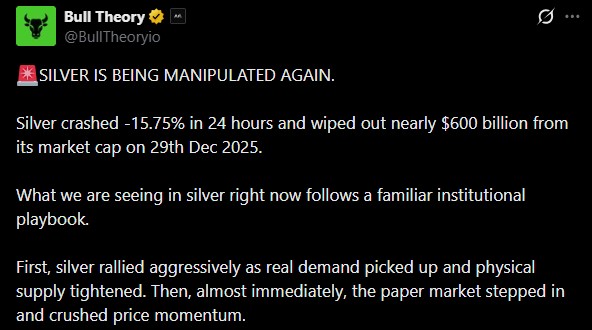
Have you ever wondered why silver prices can suddenly crash even when demand is rising? On December 29, 2025, the asset fell 15.75% in just 24 hours, wiping out nearly $600 billion in market value. For many marketplace watchers, this sudden fall does not look natural. Experts say this is a result of silver market manipulation, a pattern seen repeatedly over the years.
Source: Bull Theory
What Happened Before the Crash?
Before the price drop, silver’s value was rising quickly. Demand for physical-silver was increasing, and supply was getting tighter. Normally, this should support higher values.
But soon after the rally, rates were pushed down sharply. This did not happen because demand disappeared. It happened because of how the metal traded.
Paper vs Physical Silver: A Growing Price Gap
The white metal trades in two very different markets. The first is the paper-silver market, mainly on futures exchanges like COMEX, where contracts are traded without moving real-silver.
The second is the physical-silver markets, where real metal is bought and sold.
On COMEX, it's priced around $70–$73 per ounce, but physical prices are much higher:
Japan: ~$130
UAE: ~$115
India: ~$110
Shanghai: $80–85
These premiums of $10 to $60 per ounce suggest strong physical demand and limited supply, a gap that normally should not exist in a balanced marketplace.
This gap exists because the paper market is highly leveraged. For every one ounce of real metal, there are 400 or more ounces of paper contracts. When prices rise too fast, selling in the paper-market can push values down quickly. Recently, margin rules were tightened, forcing many traders to sell, which caused the crash.
History Repeating in the Market?
This pattern is not new. Between 2008 and 2016, JP Morgan traders were found guilty in court of manipulating gold and silver futures using spoofing, a practice involving fake orders to move price.
In 2020, the bank paid $920 million in fines for precious metals marketplace manipulation. While there is no confirmed proof that the same institutions are doing this again today, key risks remain.
What For Now
Paper leverage is now even higher, physical asset inventories are lower, and large banks still hold massive paper positions.
History shows that nearly every major rally follows the same sequence: real demand pushes prices up, paper pressure forces liquidation, and prices are suppressed. The current marketplace behavior closely matches that pattern.









