Trump Latest Tariffs on India, Japan, Pharma and Semiconductors


Trump Imposes New Tariffs on Indian Goods, Japanese import, and Pharma
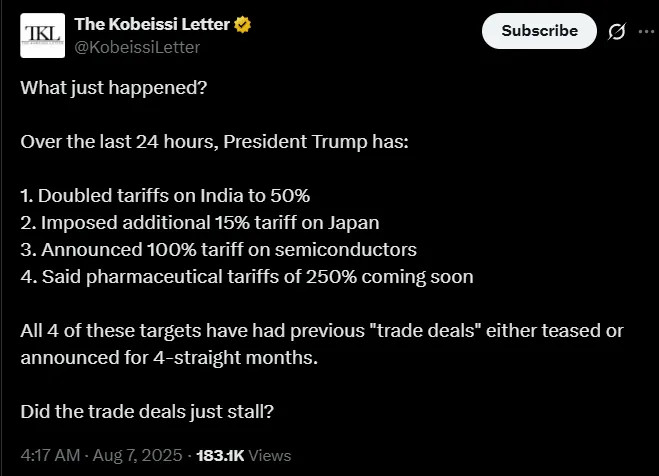
In a surprising and dramatic shift in the past 24 hours, President Donald Trump has announced a fresh wave of tariffs targeting major global economies and key industries. Trump announced the following tariff:
Doubled tariff on Indian imports to 50%
Imposed a new 15% on goods from Japan
Introduced a 100% on all imported semiconductors
Announced pharmaceutical tariffs could rise to 250%
These moves follow four months of repeated hints and headlines about potential trade deals with the same countries. Now, those expectations appear to have been replaced by a hardline tariff-first approach, leaving businesses and governments scrambling for answers.
Source: X
Trump Puts 50% Tariffs on India
Doubling the tariffs on Indian imports, the United States has mentioned the fact that India is still trading in oil with Russia as one of the primary causes. This new policy shift will impact Indian exporters in various sectors, such as textiles, pharmaceuticals, and electronics.
The Ministry of External Affairs (MEA) of India reacted with a sternly worded statement, terming the action
“This is unfair, unjustified, and unreasonable.”
The MEA also reiterated that India has a sovereign right to meet its energy requirements of more than 1.4 billion people, and its oil imports are influenced by market forces. India, too, has taken a swipe at the selective targeting, noting that other nations also import Russian oil without being hit in a similar manner. The government threatened to do anything to safeguard national interests.
Trump’s Pharmaceutical Tariffs: Up to 250% Possible
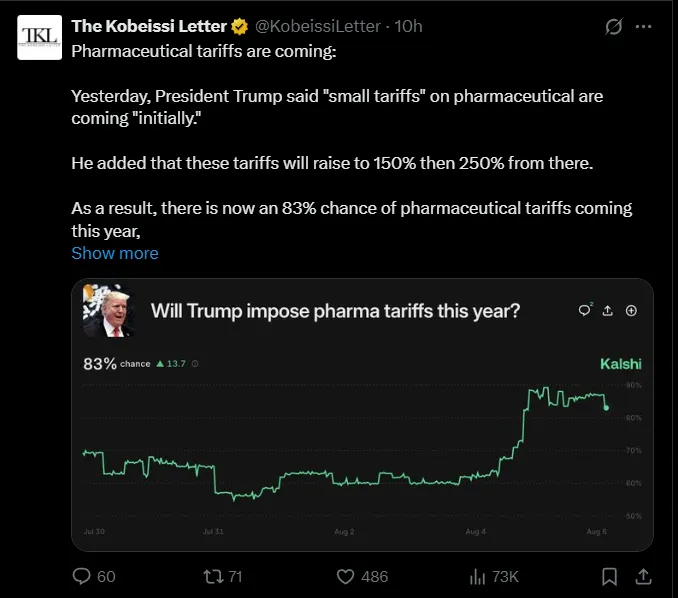
President Trump also announced that “small” tariffs on pharmaceutical imports will begin shortly. However, he added that these could increase to 150%, and eventually 250%.
These proposed Trump pharmaceutical tariffs could deeply affect global drug manufacturers, especially Indian and European companies that export generic medicines to the U.S.
Market prediction platform Kalshi now gives an 83% probability that the pharmaceutical tariffs will be implemented this year.
Source:X
Japan Hit With 15% Tariff Hike After Months of Deal Talks
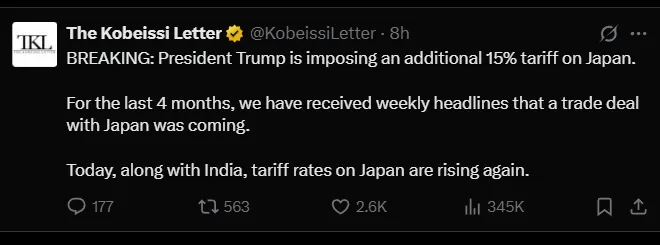
Regardless of the negotiations and constant news reports of a possible U.S.-Japan trade agreement, President Trump has now declared another 15% tariff on Japanese products.
This is a major turnaround in the trade relations between the U.S. and Japan and is likely to have a far-reaching impact on a wide spectrum of imports such as cars, machinery, and electronics
Source: X
100% Semiconductor Tariff Introduced—But Apple and Nvidia Get a Pass
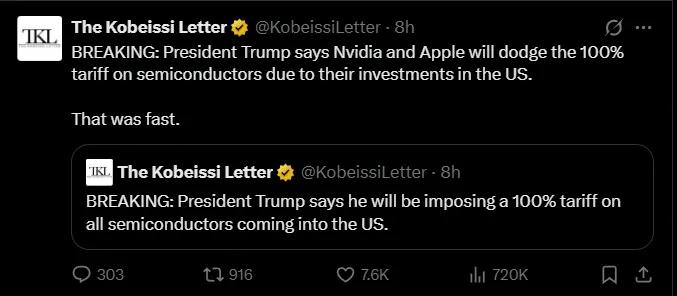
One of the most impactful moves came with the announcement of a 100% tax on all imported semiconductors. This has major implications for global chipmakers and could raise costs across the technology sector.
However, Apple and Nvidia have reportedly been exempted due to their major U.S. investments, including Apple’s newly announced $600 billion expansion in American manufacturing.
Interestingly, the market’s reaction was muted. The Semiconductor ETF ($SMH) fell only 0.04%, showing that investors may be less reactive to Trump’s tariff policies than in the past.
Source: X
Apple’s Dilemma: Lose-Lose in the Trade War
Apple finds itself in a difficult position. After relocating iPhone production from China to India to avoid past taxes, the new 50% puts those operations at risk. This shift appears to have backfired despite the company’s substantial U.S. investments. As a result, Apple remains caught in a trade war that keeps changing direction without warning.
What’s Next in Trump Tariffs?
Trump recently pulled a critical comment on India and Russia trade. He aggressively says, Avoid trade with India and Russia, as they are dead economies. This decision affected many countries and companies' trade sentiments. Companies, particularly those in the tech and manufacturing industries, are preparing to experience even more volatility as Tax Policy 2025 is still being implemented.






