Trump News Today: S&P 500 Hits 7365 as Iran Deal Nears

Trump News Today: What Is Driving the Rally Right Now
When was the last time the Trump News Today stock market record hit an all-time high because of a peace deal that has not happened yet? That is exactly what just happened on May 6, 2026. President Donald Trump's stock market just logged one of its strongest single sessions of the year—and the catalyst was not earnings, not the Fed, and not a tax cut. It was hope.
The S&P 500 advanced 1.46 percent to close at 7,365.12 on May 6, 2026. The Nasdaq Composite gained 2.02 percent to end at 25,838.94. Both indexes touched new highs and closed at records. The Dow Jones Industrial Average added 612.34 points — or 1.24 percent — to close at 49,910.59.
That is not a small move. The Dow gained over 600 points in a single session. The Nasdaq crossed levels it has never seen before. And the reason behind it all traces back to one word: Iran.
Trump News Today: What Is Driving the Rally Right Now
Axios reported, citing sources, that the U.S. and Iran were getting close to a deal that would bring a resolution to the conflict. According to the report, the agreement would include a moratorium on nuclear enrichment. An Iranian foreign ministry spokesperson also told CNBC that Iran was evaluating a U.S. proposal toward a resolution.
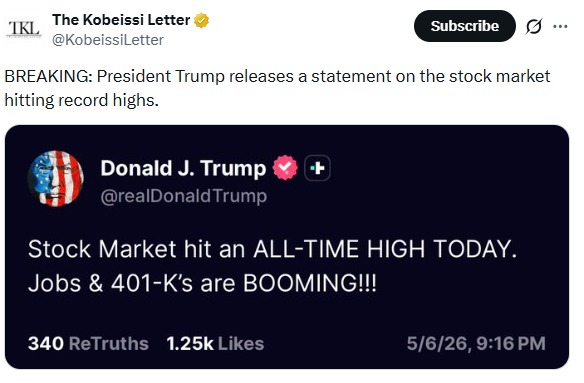
Source: X Account
Markets did not wait for confirmation. They moved on hope alone.
Investors' hopefulness over the situation in the Middle East and a strong first-quarter earnings season have driven stocks higher to new records in recent days. The Iran war started in February 2026 and immediately crashed markets. Oil prices surged 42 to 44 percent. Gasoline hit an average of $4.30 across the U.S. The Strait of Hormuz—through which one-fifth of the world's oil flows—closed. Every relief signal since then has pushed stocks sharply higher.
This is the pattern that has defined 2026. War headlines crash the market. Peace signals send it to records.
Terry Sandven, chief equity strategist for U.S. Bank Asset Management Group, said the equity market is still generally trending higher — going back to healthy fundamentals. He added that sustained earnings growth is crucial for supporting these valuations.
The fundamentals back it up too. U.S. consumer spending rose 5.3 percent year over year through February. Incomes rose 3.7 percent. Economists still expect about 2.2 percent real economic growth in 2026. Tax refunds were running approximately $40 billion higher than in 2025 through April 17.
Smaller-company stocks have risen more than 60 percent from last April's lows—suggesting confidence has broadened rather than resting on a narrow group of large stocks. When small caps rise alongside large caps, analysts typically read it as a healthier rally with a stronger foundation.
But Trump himself introduced caution. President Donald Trump signaled later Wednesday that a deal was not certain, saying it was a "perhaps, a big assumption" that Iran would agree to the U.S. terms.
That one statement is the most important risk in this rally. The entire record-high move is built on an assumption. If Iran talks collapse—or if the Strait of Hormuz closes again—the same speed that pushed markets to records will work in reverse.
Jay Hatfield, founder and CEO at Infrastructure Capital Advisors, said he does not anticipate the war being resolved quickly. He does not think Iran is going to get rid of its nuclear capabilities easily. Even so, Hatfield sees the S&P 500 hitting 8,000 by the end of the year.
The bull case and the bear case both start with the same question: does the Iran deal happen?
Trump News Today: What Comes Next?
Goldman Sachs estimates global AI infrastructure spending could exceed $2 trillion over the next decade—a structural tailwind that runs beneath daily Iran headlines. The 2026 outlook remains constructive but risky: strong consumer spending, earnings, tax relief, and expected easier monetary policy support stocks, while high valuations, tariffs, inflation, and geopolitics push back.
Over the next 30 days, watch:
Any official Iranian response to the U.S. peace proposal.
Oil prices as the quickest gauge of Middle East risk.
The Fed’s stance is that rates stay steady, but rate cuts could come if inflation eases.
The Trump‑era record high on May 6 is real—but it depends entirely on whether the peace the market priced in actually arrives. Data reflects trends and official sources; no outcomes are guaranteed.
Disclaimer: This article is for informational purposes only and does not constitute financial or investment advice. Stock market data reflects conditions on May 6, 2026, and changes rapidly. Always conduct independent research before making any investment decisions.









