Is UPI Going On-Chain? NPCI Sparks Big Questions at IBW 2025

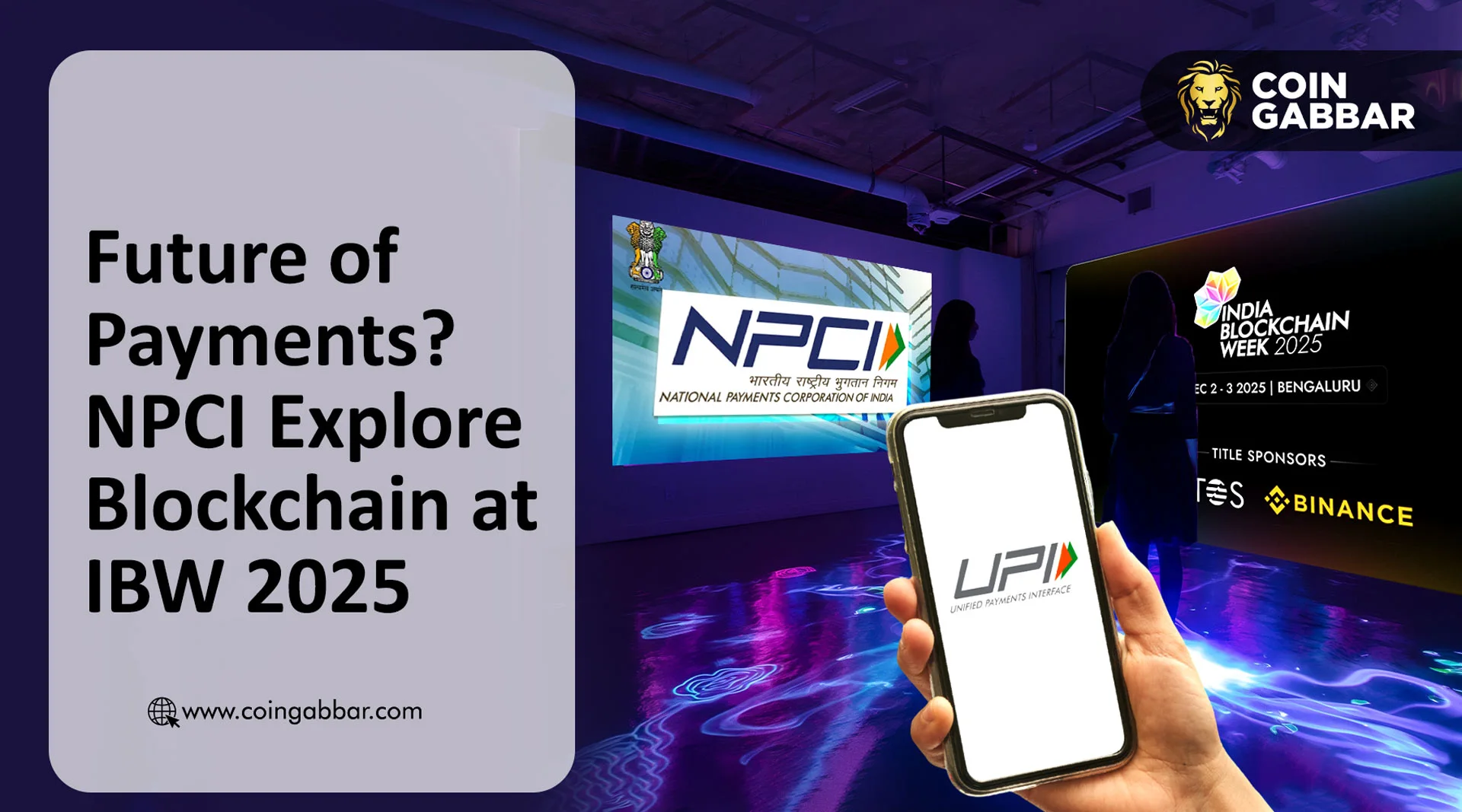
UPI to Web3: NPCI Shows India Digital Growth at Blockchain Week 2025
India is also moving in the direction of next-generation digital payments with NPCI investigating blockchain at India Blockchain Week (IBW) 2025, which will open up faster, safer, and more inclusive financial systems.
The Big Move by NPCI to Blockchain Innovation.
The National Payments Corporation of India (NPCI), which is the brainchild of the groundbreaking UPI payment system, has affirmed it will be taking part in and sponsoring IBW 2025, which will be hosted in Bangalore, on the 1st-7th of December.
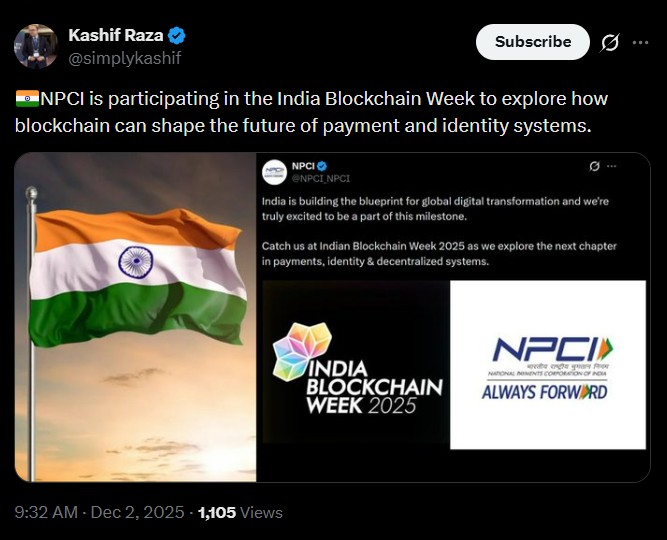
Source: Kashif X
This is a big step in the increasing interest of nations in blockchains, seeking to know how decentralized technologies can enhance payment infrastructure, identity systems, and cross-border remittances.
This will involve the National Payments Corporation of the country being at Stall S02 at the Sheraton Grand, Whitefield, on December 2-3, where it will interact with developers, industry leaders, and other global ecosystems.
Why is NPCI looking into blockchain today?
Empowering the Digital Transformation of India.
UPI now handles billions of transactions monthly, establishing world standards in real-time, safe, and inexpensive payment.
Blockchains are the next stage that NPCI will use to improve:
Real-time settlement
Identity authentication mechanisms.
Security at scale
Efficiency of cross-border payments.
A connection between blockchains and UPI has the potential to transform the way nations transfer money and make remittances less expensive and time-consuming, particularly among Indians in foreign countries.

Source: X
Increasing Regulatory Interest.
As the Indians gradually liberalize to blockchain pilots, payment cooperatives are making the right move in line with the ambition of the government to create a less-cash, digitally empowered economy.
This involvement is also useful in promoting safer and controlled blockchains adoption throughout the Indian fintech ecosystem.
Potential of an INR-Backed Stablecoin (ARC).
The discussion on social media regarding the announcement led to new speculation regarding a possible INR-backed stablecoin, commonly known as ARC.
As discussed in the community, this stablecoin can be released as early as Q1 2026, but NPCI has not officially done so.
Introduced, such a stablecoin could:
Offer real-time blockchains-based transfers of INR.
Enhance financial inclusion.
Permit business and government programmable payments.
Enhance the international digital payment impact of India.
This conjecture indicates the high demand for regulated crypto-powered financial instruments in India.
Current Blockchain Activities at NPCI.
This is not new. Its previous projects comprise:
Falcon is an open-source application based on Hyperledger Fabric.
Hackathons attract developers.
These initiatives indicate that payment cooperatives are interested in the long term in combining traditional finance with decentralized technologies.
India Blockchain Week 2025: One of the largest innovation centers
IBW 2025 unites the leading Web3 communities in the world: ETHIndia, Aptos, Polygon, Polkadot, and Filecoin.
The inclusion in the list makes the event a transition between the conventional financial infrastructure and the decentralized future.
Conclusion
The appearance at the event is an indicator of increased investment in payment systems of the future. The next stage of digital development can be the use to revolutionize identity, payments, and cross-border transfers.
Disclosure: This paper is informational in nature and is not financial advice.