US Iran Deadline: Trump’s Shifting Threats Stir Market Chaos

How the US Iran Deadline Extensions Cause Global Market Volatility?
The world is watching as the US-Iran war update takes a strange turn. Over the last 17 days, President Donald Trump has changed the deadline five different times. These constant shifts are doing more than just delaying a fight; they are causing massive waves in the global markets.
On April 6, 2026, the latest US Iran deadline extension was announced. Traders and experts are now questioning if these repeated delays are a strategy to move prices for oil and Bitcoin. Every time a threat is made, prices spike. Every time a time limit is moved, markets breathe a sigh of relief.
How the US Iran Deadline Delays are Forming Uncertainties?
The center of this conflict is the Strait of Hormuz. This narrow water path is a chokepoint where about 20% to 30% of the world's oil flows. Because Iran has blocked this path, oil prices have exploded. Brent crude oil recently surged past $110 per barrel, a record high not seen in years.
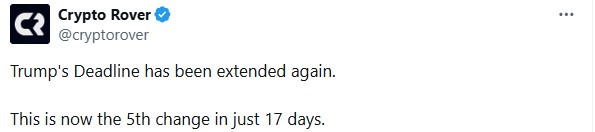
Source: Crypto Rover
The US Iran deadline 2026 timeline shows a clear pattern of back and forth moves:
March 21: Trump gave an initial 48-hour ultimatum to open the strait.
March 26: The final date moved to April 6 at 8:00 P.M. ET.
April 5: Trump pushed the date again to Tuesday, April 7, at 8:00 P.M. ET.
Latest News: Reports of a potential 45-day Strait of Hormuz ceasefire caused oil to drop 4% instantly.
This frequent US Iran deadline extensions create a fear cycle.
How Trump’s Deadline Extensions Move Your Money
Every time a new time limit is set or extended, it sends a shockwave through areas like energy and risk assets i.e., Bitcoin. This predictable volatility is why some critics are raising concerns about market manipulation.
Understanding this market behavior is key to seeing what happens next:
The Fear Spike (Oil): When a decision point approaches without an extension, oil prices surge. For example, WTI crude recently jumped over $111 per barrel on April 6 as the market feared a strike on Iranian power plants.
The Relief Rally (Crypto): Conversely, whenever a US Iran deadline extension is announced, investors feel safer. Bitcoin often bounces from lows of $65,000 back toward $69,000 when a 48-hour reset gives diplomacy more time.
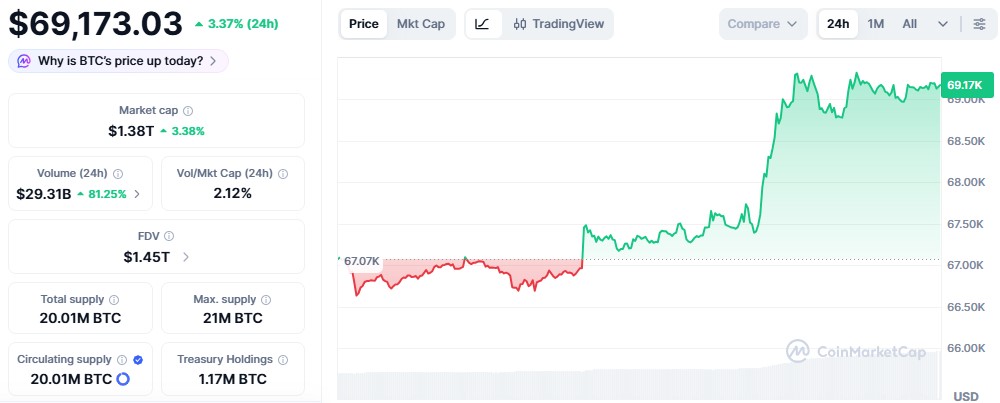
Source: CoinMarketCap Official
Inflation Connection: Higher fuel prices due to the Strait of Hormuz closure mean higher shipping and energy costs. This fuels inflation, which usually makes the Federal Reserve stay hawkish, creating a tough environment for stocks too.
US-Iran Conflict Latest: Is a Strait of Hormuz Ceasefire Near?
While the US Iran war threats remain high, there is a glimmer of hope. New reports suggest that the U.S. and regional leaders are discussing a 45-day pause. If this happens, the Strait of Hormuz ceasefire could lead to a permanent end to the fighting.
For the average person, this news is vital. High oil prices lead to expensive gas and higher inflation. For the crypto community, a peaceful update on the conflict is very bullish. Lower energy costs and less war fear usually help Bitcoin climb back toward the $70,000+ range.
The US Iran deadline is currently set for tomorrow night. Whether it results in a strike or another extension, the world will be glued to the charts.
Note: This article is for informational purposes only; It does not constitute any claims or advice.
Also read:









