US Senate CLARITY Act Vote Explained: Will The Act Pass On May 14?


Why Banks Oppose CLARITY Act Stablecoin Yield Rule Before May 14 Vote?
The U.S. Senate Banking Committee will review the CLARITY Act on May 14. The decision could shape the future of crypto regulation in America. Lawmakers, banks, crypto firms, and prediction markets now focus on one key question: Can the bill finally move to a Senate floor vote?
Why Is the CLARITY Act Suddenly Moving Again?
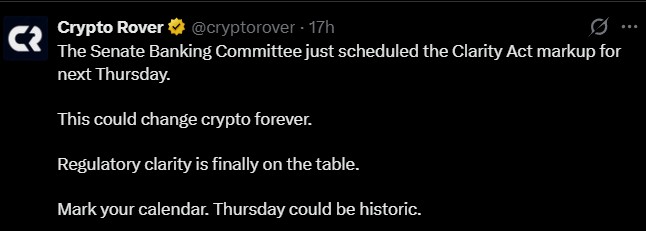
The Senate Banking Committee officially scheduled the long-awaited markup session for the Digital Asset Market Clarity Act, known as the CLARITY Act. The hearing will begin Thursday, May 14, at 10:30 a.m. ET.
The move ends months of delays in Washington. A compromise between Senators Thom Tillis and Angela Alsobrooks reportedly unlocked progress on stablecoin yield rules.
Source: CryptoRover X
The CLARITY Act passed the House in 2025. The bill aims to split cryptocurrency oversight between the SEC and the CFTC. Under the proposal, securities-like tokens would fall under SEC control. Commodity-style digital assets would move under CFTC oversight. The legislation also includes:
DeFi safe harbor protections
Anti-CBDC provisions
New cryptocurrency market structure guidelines
The supporters say the bill could finally replace years of enforcement-led regulation. Many firms argue that the current system lacks clear legal standards.
Senator Kirsten Gillibrand added pressure this week during Consensus. She warned there would be “no deal” without insider trading restrictions and Trump-family ethics provisions tied to activity. Meanwhile, CFTC Chair Mike Selig publicly called for “immediate passage” of the legislation.

Source: X
Why Are Banks Fighting the Stablecoin Rules?
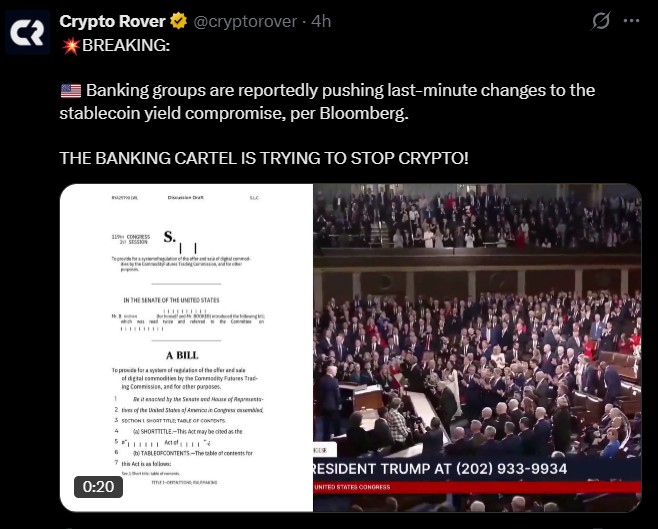
Banking groups continue pushing for last-minute changes before the markup vote. Several industry organizations want tighter limits on stablecoin yields.
The American Bankers Association reportedly fears yield-bearing stablecoins could pull deposits from traditional banks. Fewer deposits may reduce lending capacity across the banking sector. Many view the lobbying effort as an attempt to block competition from blockchain-based finance.
Source: X
The influencers described the fight as “the banking cartel trying to stop cryptocurrency.” His X post included congressional footage and bill text connected to the ongoing Senate process.
There's a claim that President Donald Trump would not allow major banks to sabotage the legislation. The post referenced Trump’s earlier push to make the United States the “crypto capital of the world.” White House crypto adviser Patrick Witt also fueled optimism this week.

Source: X
Prediction Markets Signal Growing Confidence
Prediction markets now show rising confidence around the bill’s chances. Polymarket traders currently assign a 75% probability that the CLARITY Act becomes law in 2026. The odds increased by roughly 10% in recent sessions.
Coinvo separately reported an 89% probability for passage this year. The platform linked the jump to growing momentum in the Senate. Traders believe regulatory clarity could reduce legal uncertainty for crypto exchanges, token issuers, and decentralized finance platforms.
The Senate markup remains the biggest hurdle. If lawmakers approve the bill on May 14, the legislation could move toward a Senate floor vote in June.
Some analysts warn that failure could delay major crypto legislation until after the August recess. That timeline may push broader reform discussions closer to 2030.

Source: Coinvo X
What If the Vote Favors the CLARITY Act?
It may bring much-needed clarity to the market if it is approved by the Senate. The exchanges, stablecoin companies, and DeFi projects might be subject to more distinct U.S. regulations. Digital assets could be a greater share of institutional investors' portfolios. The sentiment of Bitcoin and major Altcoins could be stronger. The bill may also help ease the uncertainty that has been haunting crypto companies over the years, driven by the SEC.
What If Senators Vote Against the CLARITY Act?
The US Senate vote could create a regulatory vacuum that may persist across the U.S. The regulators may enforce more against exchanges and token projects. Rules may be ambiguous, leading to a slower rate of institutional adoption. In the short term, traders might get a negative reaction. Further delays could extend the crypto legislation timeline past the 2026 elections.
What Changes Could Traders and Investors Face?
It has the potential to significantly impact traders and investors. Crypto exchanges could be provided with more definite compliance guidelines. There may be new yield limitations for stablecoin products. Institutional firms can be more aggressive in entering markets. Retail traders may be better protected in court. The downside of the new rules, however, is that they will likely raise compliance costs throughout the industry as well as impose more stringent reporting requirements and regulatory oversight.
Why the May 14 Vote Matters
The vote is not just a political one. It may influence the future of crypto in the U.S. for years to come. If the vote is successful, it could bring government regulation of cryptocurrencies to America. If the vote is positive, it could lead to regulated crypto in America. If the vote fails, it may lead to uncertainty in exchanges, DeFi, stablecoins, and institutions.
Disclaimer: This article is for informational purposes only. It does not provide financial, legal, or investment advice. Crypto markets remain volatile, and readers should conduct independent research before making decisions.







