Volo Protocol Losses: $3.5M Exploit Hits Sui DeFi

What Is Volo Protocol Losses and Why Sui Users Are Watching
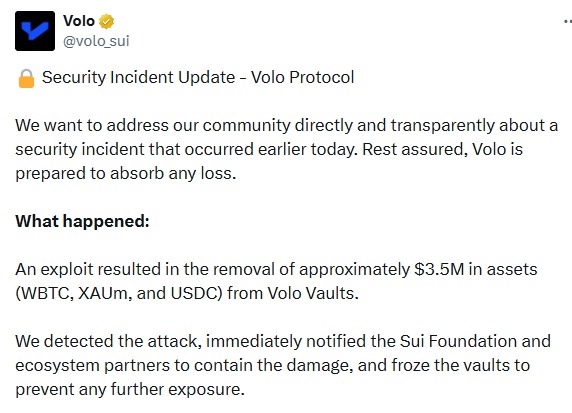
Two DeFi exploits in one week. How much more can user trust take? That is the big question behind volo protocol losses today. Volo said an exploit removed about $3.5 million in WBTC, XAUm, and USDC from its vaults, then froze all vaults while it works on recovery and a full post-mortem.
Quick Facts
— $3.5M stolen: WBTC, XAUm, and USDC
— 3 vaults exploited, 28M in TVL confirmed safe
— All vaults frozen pending post-mortem
— team absorbing loss — users won't pay
— KelpDAO exploit same week: $293M
$500k already frozen: The Sui Foundation and security partners successfully immobilized nearly half a million dollars of the stolen funds within hours.
What Is Volo and Why Sui Users Are Watching
Volo Protocol is a DeFi vault platform built on Sui — a fast Layer 1 blockchain. It lets users deposit assets to earn yield. That yield promise is now under scrutiny.
Source: X Account
Why Volo Protocol Losses Matter After the KelpDAO Shock
The timing stands out. Just days earlier, KelpDAO suffered a much larger exploit reported in the hundreds of millions, which several reports said may be linked to North Korea’s Lazarus Group. Security analysis tied that breach to a weak one-verifier setup and compromised infrastructure, making it one of 2026’s biggest losses so far.
That wider backdrop makes it losses more than a one-project story. It adds to fresh fears around vault safety, bridge design, and how fast teams can react when money starts moving out.
A "Bad April" for DeFi: This follows the $293M KelpDAO and $285M Drift Protocol hacks earlier this month, both linked to the Lazarus Group. It highlights a massive industry-wide security crisis.
What Volo Protocol Losses Mean for Sui DeFi Users
Volo said the exploit hit three specific vaults only. The team added that the remaining vaults do not share the same weakness. It also said about $28 million in TVL across other its vaults remains safe. Most important for users, it said it is prepared to absorb the loss rather than pass it on to customers.
Here are the main points. Volo shared:
All vaults are frozen during review
The attack was isolated to three vaults
Recovery work is ongoing with on-chain investigators
A full post-mortem will follow
The team says users should not bear the loss
Can Protocol Losses Change DeFi Security in 2026?
The near-term outlook is simple. Users will now watch for two things: proof of recovery and proof of stronger controls. After the KelpDAO breach showed how damaging weak verification can be, volo protocol losses may push more DeFi teams to recheck vault isolation, response speed, and external dependencies. That is an inference based on the recent pattern, not a guaranteed outcome.
For now, all data remains based on public market sources, project statements, and security reporting. No exact outcome on recovery, attribution, or fund return is guaranteed. Still, it losses now sit at the center of a bigger 2026 story: DeFi users want yield, but they also want proof that safety comes first.
Not a Code Bug: Initial reports suggest the exploit was a compromised admin key, not a smart contract flaw. This proves that even audited code cannot save a project from poor "key management.
Disclaimer: This content is for informational purposes only — not financial advice. Always do your own research before investing in any DeFi protocol.








