Tether Steps In Drift Protocol Recovery Plan: Can Drift Win User Back?

Tether Backs Drift Protocol Recovery Plan: Can Platform Recover $295M?
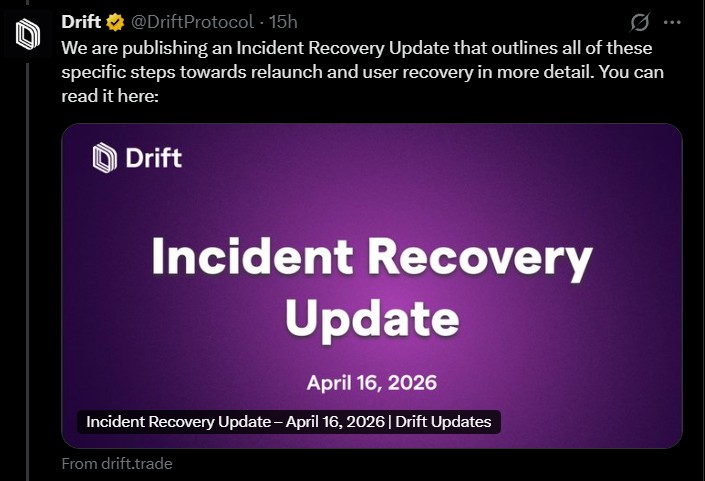
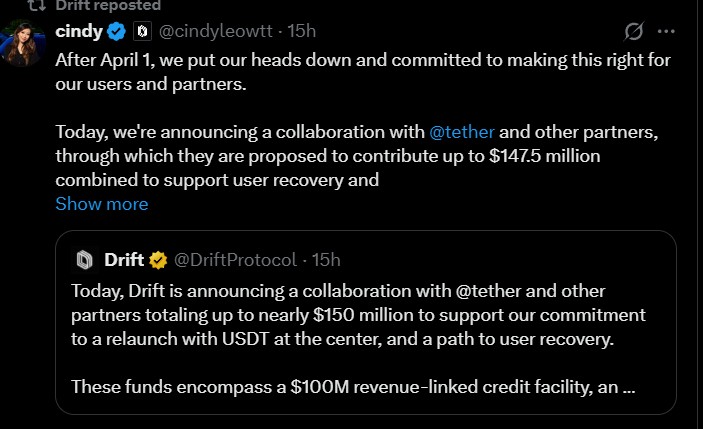
Drift Protocol has outlined a recovery plan after its April 1 exploit. In posts on X, its website, and Business Wire, the Solana exchange said Tether and partners may provide $147.5 million as user losses now stand at $295.7 million.
The Drift Protocol hack began on April 1, when attackers exploited the platform and drained roughly $295 million in user funds. The stolen assets included USDC, SOL, cbBTC, and other tokens. The incident became one of Solana DeFi’s biggest security breaches, leaving users locked in uncertainty while investigators tracked the stolen funds.
Can $147.5 million start to close a $295.7 million hole?
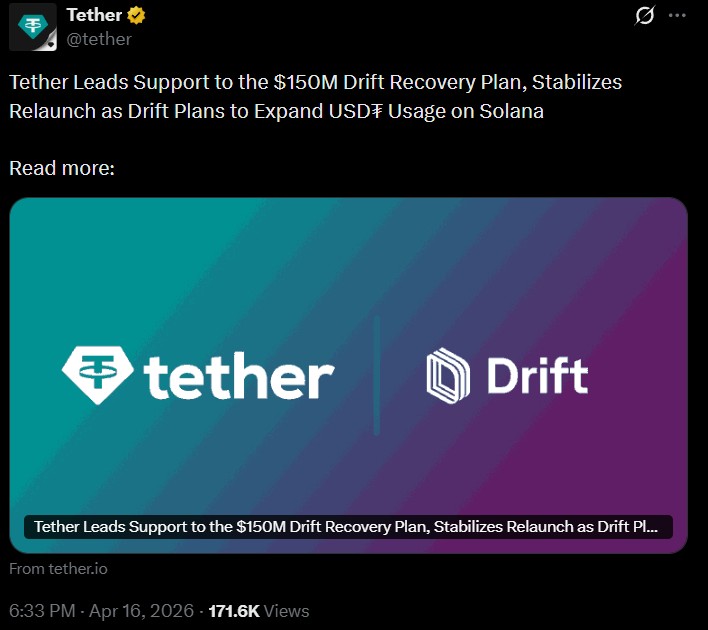
The plan starts with a dedicated recovery pool. Tether proposes up to $127.5M. Other partners propose another $20M. Drift protocol hack recovery package has three parts. These are a $100 million revenue-linked credit facility, an ecosystem grant, and loans to market makers. A revenue-linked facility means support tied to future platform income.
That structure matters for users. A large share of exchange revenue will help fund the pool in its first phase. It also said any assets recovered by law enforcement or forensics partners would go into that same pool.
Affected users will also get new recovery tokens. Drift protocol said these tokens are separate from the DRIFT governance token. In simple terms, they act like transferable claims on future repayments from the pool.
Source: Tether Official X
Why switch from USDC to USDT now?
It will relaunch with USDT, not USDC, as its settlement asset. Tether also plans a USDT support facility for designated market makers. The stated goal is deeper liquidity from day one. The Drift protocol also says it will not reopen quickly or casually. OtterSec is auditing the rebuilt codebase. Asymmetric is reviewing operational security after the exploit.
It plans tighter controls as well. It said a new community-governed multisig will manage core assets. Signers must use dedicated devices, while timelocks and outside transaction checks will protect key actions.
Source: Official X
Relief for Drift, fresh pressure for Circle
Its own update puts outstanding user losses at $295,706,374.93. The same update lists stolen assets across JLP, USDC, cbBTC, SOL, USDT, and several other tokens. That shows how broad the damage was.
It is the largest decentralized perpetual futures exchange on the Solana ecosystem. The platform has served more than 175,000 traders and handled about $150 billion in cumulative volume.
The wider fallout is still growing. Circle now faces a class-action case in Massachusetts. Plaintiff Joshua McCollum alleges Circle failed to freeze about $230 million in USDC moved from Solana to Ethereum through CCTP.
That lawsuit may shape sentiment around stablecoin controls after major hacks. For users, the next checkpoints look clear: audit results, recovery token terms, and enough liquidity at relaunch to rebuild trust.
Source: X
Conclusion
The Drift protocol now has a plan, not a promise. The funding package, audit process, and switch to USDT may help rebuild confidence. Still, recovery depends on execution, future revenue, and asset tracing. Traders will watch the relaunch closely from here on.
Disclaimer: This article is for informational purposes only. It is not financial or legal advice. Crypto assets remain risky, and recovery terms can change. Read official updates, court filings, and independent research before you make any crypto investment decision.






